Hello! Welcome to your first lesson in the Paid Ads course.
Based on your goal to master Google Ads, we're starting with the most fundamental concept: the engine that drives the entire system. Understanding this will be the bedrock for everything we cover later, especially when we get to bidding strategies.
This lesson addresses the first learning outcome of the course: Explain how the Google Ads auction works, including the roles of Ad Rank, Quality Score, and bid amount. By the end of our 60 minutes, you'll be able to describe precisely how Google decides which ads to show and how much advertisers pay for each click.
Let's get started.
1. The Google Ads Auction: What Happens When You Search?
Every time a user enters a query into Google, an incredibly fast and complex auction takes place in the background to decide which ads, if any, will appear on the search results page. This isn't a traditional auction where the highest bidder simply wins; it's a sophisticated process designed to benefit the user, the advertiser, and Google.
To get a dynamic overview of this process, let's start with a short video.
How The Google Ads Auction Works
This video from Surfside PPC provides an excellent introduction to the Google Ads auction. It explains when the auction occurs and introduces the core concept of Ad Rank.
Please watch the first three minutes of the video (00:00 - 03:29). Focus on how Google identifies eligible ads for a search and uses a value called 'Ad Rank' to determine their order on the results page.
As the video explained, when a search happens, Google:
- Finds all the ads whose keywords match the search query.
- Filters out any ineligible ads (e.g., targeting a different location or disapproved).
- For the remaining ads, it calculates a score called Ad Rank.
- It then displays the ads in order, from the highest Ad Rank to the lowest.
Now, let's break down what "Ad Rank" really is.
2. The Core Components: Ad Rank, Bid, and Quality Score
Ad Rank is the score that determines your ad's position on the page. A higher Ad Rank means a better position. The basic formula for Ad Rank is surprisingly simple:

As you can see, two main levers influence your Ad Rank: your bid and your Quality Score.
Your Bid (Max. CPC)
This is the most straightforward component. Your Maximum Cost-Per-Click (Max. CPC) bid is the highest amount you are willing to pay for a single click on your ad. While you set a maximum, you often end up paying less, which we will cover in a moment.
Quality Score
This is where Google's focus on user experience becomes clear. Quality Score is a diagnostic metric, rated on a scale of 1 to 10, that estimates the quality of your ads, keywords, and landing pages. It's Google's way of measuring how relevant and useful your ad is to the user. A higher Quality Score not only helps you achieve a better Ad Rank but can also lead to lower costs.
Quality Score is determined by three main components:
- Expected Click-Through Rate (CTR): Google's prediction of how likely a user is to click your ad when it's shown for a particular keyword. This is based on historical performance.
- Ad Relevance: How closely your ad's message matches the intent behind a user's search. If a user searches for "blue running shoes," an ad for "running shoes" is relevant, but an ad specifically mentioning "a wide selection of blue running shoes" is even more so.
- Landing Page Experience: How relevant, transparent, and easy-to-navigate your landing page is for users who click your ad. The page should load quickly and deliver on the promise made in the ad copy.
To dive deeper into these concepts and see how a high Quality Score can outperform a high bid, please read the following sections from a helpful guide.
Understanding Google Ads Ranking: A Simple Guide
This article, 'Understanding Google Ads Ranking: A Simple Guide,' does an excellent job of breaking down the components of Quality Score and illustrating its power.
Please read two sections of the article: start with 'Understanding Quality Score: The Key to Better Positions at Lower Cost' and continue through to the end of the table in 'Real-World Example: The Power of Quality Score on Costs.' Pay close attention to the table that compares four advertisers—it clearly shows how Quality Score impacts Ad Rank.
The key takeaway is that a high bid can be undermined by a low Quality Score. Conversely, an excellent Quality Score can help you win a higher ad position even with a lower bid. This ensures that users see relevant, high-quality ads, not just ads from the advertisers with the biggest budgets.
3. The Second-Price Auction: What You Actually Pay
You've now seen that your Max. CPC bid is not what you are charged. Google Ads operates on a second-price auction model. This means you don't pay your maximum bid; instead, you pay just enough to beat the Ad Rank of the advertiser directly below you.
The formula for your Actual CPC is:
Let's look at a visual representation of this calculation.
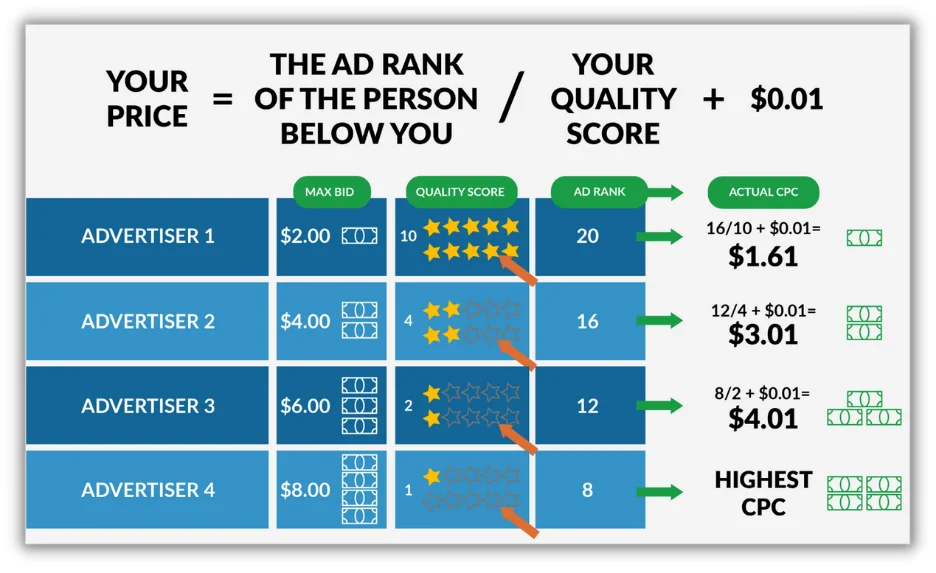
As the formula and the image demonstrate, a higher Quality Score directly reduces your Actual CPC. In the example shown in the image, Advertiser 1's stellar Quality Score (10/10) means they divide their competitor's Ad Rank by a larger number, resulting in a much lower cost to maintain the #1 position.
This system incentivizes advertisers to create high-quality, relevant experiences for users, which is a win for everyone:
- Users get more relevant search results.
- Advertisers with relevant ads are rewarded with better positions at lower costs.
- Google maintains the quality of its search results, encouraging users to keep coming back (and clicking ads).
To reinforce these ideas, this final video provides excellent, concrete examples of what creates high vs. low Ad Rank and summarizes the relationship between your bid and Quality Score.
What Is Ad Rank? Google Ads Ad Rank Explained For Beginners
This video from Surfside PPC, 'What Is Ad Rank?,' clearly explains the factors that make up Quality Score and provides practical examples.
Please watch from 00:43 to 03:59. This segment covers the main factors of Quality Score, gives a tangible example of a 'high ad rank' campaign versus a 'low ad rank' campaign, and clarifies the distinct roles of your bid and your Quality Score.
Conclusion
You've now covered the core theory behind the Google Ads auction, which is the essential first step toward building and managing effective campaigns.
Here are the key takeaways from this lesson:
- The Auction: Every relevant Google search triggers an auction to determine ad placement.
- Ad Rank: Your ad's position is determined by its Ad Rank, not just its bid. The basic formula is
Ad Rank = Max. CPC Bid × Quality Score. - Quality Score: This 1-10 metric is Google's rating of your ad's quality and relevance. It's composed of Expected CTR, Ad Relevance, and Landing Page Experience.
- Actual CPC: You pay just $0.01 more than what's needed to outrank the advertiser below you. A high Quality Score is your most powerful tool for lowering your actual cost per click.
- Quality over Budget: The system is designed to reward advertisers who provide the best user experience, allowing a high-quality ad to beat a high-bidding, low-quality ad.
In our next lesson, we will build directly on this foundation. We'll discuss the function of conversion tracking in enabling automated bidding strategies, exploring how you can let Google's machine learning use this auction system to bid on your behalf to achieve specific business goals.