Welcome to the third lesson in our "Domain Deep Dive & Problem Scoping" module. In our first two lessons, we established a strong foundation by defining the ideal structure of the PM POSHAN scheme and then creating a systematic framework for the types of violations that occur in reality. You now have a clear picture of what a "good" meal looks like and a categorized list of what can go wrong.
Today, we will address a crucial question: If these violations are happening, why aren't they being caught? Your goal is to describe how meal quality monitoring currently works in practice and identify its key limitations. We will investigate the official, on-paper mechanisms designed to ensure quality and then, using performance audits and reports, we will see where and why these mechanisms break down. Understanding these gaps is the final step in this module and will form the core justification for the automated monitoring system you plan to build.
The Official Monitoring Framework: A Multi-Layered Approach
On paper, the PM POSHAN scheme is not operating in a vacuum. It has a comprehensive, multi-layered monitoring framework designed to ensure accountability from the school kitchen all the way up to the state government. Let's examine these layers.
1. School-Level Monitoring: The First Line of Defense
The most immediate checks are designed to happen at the school itself, creating a daily feedback loop.
- Mandatory Tasting: Before the meal is served to children, it must be tasted by at least one teacher and one member of the School Management Committee (SMC), which often includes parents. This is the most direct and crucial quality control step.
- Community Oversight: The scheme involves parents and the community through the SMC. Their presence is meant to ensure transparency in the daily serving of meals.
- Record Keeping: The school Headmaster is responsible for maintaining several registers, including daily consumption of food grains, student attendance, and stock levels. This documentation serves as the primary data source for all higher-level monitoring.
2. Official Inspections and Oversight
A hierarchy of officials is tasked with physically inspecting schools to verify that the scheme is running correctly.
- Field Inspections: Government orders mandate a certain number of monthly inspections by officials at different levels. For example, a Block Education Officer (BEO) might be required to inspect 10 schools per month, while a District Education Officer (DEO) inspects 5.
- Steering-cum-Monitoring Committees (SMCs): Committees at the Block, District, and State levels are supposed to meet quarterly. Their job is to review inspection reports, analyze data, and take corrective action where problems are found.
3. Technology and Data-Driven Monitoring
To manage the scheme's enormous scale, several technology systems have been put in place. Given your background in data management and web applications, you'll recognize the intent behind these systems.
- Automated Monitoring System (AMS): This system, often based on SMS, requires schools to send daily real-time data on the number of students who ate the meal.
- Web-based Management Information System (MIS): All the data from schools (attendance, food grain usage, etc.) is meant to be entered into a central web portal. This consolidated data is then used by district and state officials for planning, fund allocation, and monitoring.
4. External Audits
Two other powerful mechanisms exist outside the direct chain of command.
- Social Audits: This is a key feature of the scheme's accountability framework. A social audit is a public process where community members, officials, and parents come together to review records and give direct feedback on the scheme's performance. It's designed to bring ground-truth to light and hold the system accountable.
- Scientific Food Testing: Some states have implemented a system where officials randomly collect cooked food samples from schools and send them to a certified laboratory. These labs test the food for nutritional value (calories, protein) and for microbiological contaminants to ensure safety.
To get a better sense of how these pieces are meant to fit together, please watch this video by an administrator involved in running the scheme.
PM POSHAN - Provisions & Potentials
This video provides an administrator's perspective on the monitoring mechanisms in place.
Please watch the following three segments: The section on testing of meals, which explains the process of lab testing. The overview of monitoring and reporting, which discusses the use of apps and field validation. The explanation of social audits, which highlights their role in bridging the gap between policy and implementation.
From Paper to Practice: Where the System Fails
The framework you just reviewed seems robust. So why do we still see headlines about "rice-and-salt" meals? The reality is that there is a significant gap between policy and implementation. A performance audit of the scheme conducted by the Comptroller and Auditor General (CAG) of India provides a detailed, evidence-backed look at these failures.
[PDF] CHAPTER III PM POSHAN – Mid-Day Meal Scheme (MDM)
This audit report is a critical resource for understanding the practical limitations of the current monitoring system. We will focus on the key findings related to monitoring failures.
Please read the following sections from this report: Start with the section titled "Poor Monitoring and Inspection mechanism" under paragraph 3.6.1. Read this paragraph to understand the gap between inspection targets and actuals. Also in the monitoring section, read paragraph 3.6.2 on "Short Message Service based monitoring" to see the issues with the technology implementation. Now, look at paragraph 3.3.2.3, "Food tasting". This short paragraph reveals a failure in the most basic, daily quality check. Next, read paragraph 3.2.5, "MDM consumption shown in excess of actual attendance". This section exposes how manual data can be manipulated, showing how consumption was inflated. Finally, to see an extreme case of monitoring failure, read paragraph 3.4, "Service of MDM to children in non-existing schools". Focus on the finding that funds were likely misappropriated for schools that did not even have physical infrastructure.
The CAG report paints a clear picture: the monitoring system is failing at every level. Let's summarize these limitations systematically.
1. Human Oversight is Weak and Inconsistent
The foundation of the system—human inspection and verification—is broken.
- "Ghost" Inspections: As the CAG report shows, the vast majority of mandated inspections simply do not happen. Committees that are supposed to review performance rarely meet.
- Basic Checks are Skipped: The most fundamental check, tasting the food before serving, is regularly ignored. This bypasses the simplest and most effective safety measure.
- Social Audits are Neglected: Social audits, a powerful tool for community accountability, are conducted infrequently or not at all in many states, as highlighted by both the CAG report and news reports.
Mid-Day Meal: Rice-Salt Meal At School In UP's Ayodhya, Why Mid-Day Meals Are Failing Across India
This news clip from India Today reinforces the findings about failed audits.
Watch the segment from 01:30 to 02:14, which discusses how inadequate inspections and the failure to conduct social audits contribute to the scheme's problems.
2. Data is Unreliable, Incomplete, or Fraudulent
The technology-based monitoring systems are only as good as the data fed into them. Your experience with data pipelines will tell you that the "garbage in, garbage out" principle applies here with severe consequences.
- Defunct Technology: The SMS-based system, intended for real-time monitoring, has been defunct or poorly adopted, creating a black hole in the data stream.
- Inflated Reporting: Even when data is reported, it is often fraudulent. The CAG finding of schools inflating the number of children fed is a classic example of data manipulation to misappropriate resources.
- Systemic Supply Chain Issues: Another report provides findings from a social audit that directly point to limitations that higher-level data might miss.
[PDF] 1. INTRODUCTION: Mid Day Meal Programme was introduced in ...
This section from a social audit reveals problems that happen before the food even reaches the school.
Find the section "Details of Evaluation studies conducted by State/UTs" and read the bulleted list under "Observations in Social Audit." Pay close attention to the findings about rice quality, weight, and delivery.
These findings show that monitoring must also account for the supply chain. Problems like underweight rice bags or non-delivery to the school point directly impact meal quantity and are clear limitations of a system that only tracks consumption at the school level.
3. Systemic and Financial Constraints
Finally, some limitations are built into the economics of the scheme itself. Even with perfect monitoring, if the resources are insufficient, quality will suffer.
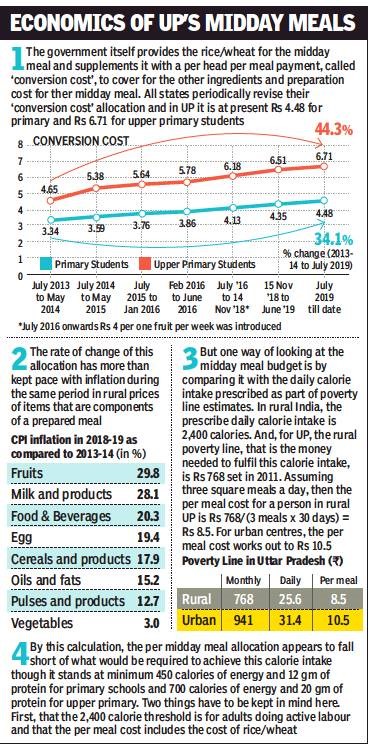
When the allocated budget per meal is less than the actual cost of providing a nutritious meal, schools and cooking agencies are forced to cut corners, leading to the very nutritional violations we discussed in the last lesson. This is a systemic limitation that a school-level monitoring system cannot solve on its own but is crucial context for your project.
Conclusion
In this lesson, we have dissected the official monitoring framework for the PM POSHAN scheme and contrasted it with the stark reality of its failures.
Key Takeaways:
- A Multi-Layered but Flawed Framework: The scheme has a comprehensive monitoring design involving daily tasting, official inspections, technology platforms (MIS/AMS), and social audits.
- Pervasive Implementation Gaps: In practice, each layer is compromised. Inspections are infrequent, basic checks are skipped, technology adoption is low, and accountability mechanisms like social audits are neglected.
- Unreliable Data: The data that underpins the monitoring system is often incomplete, inconsistent, or deliberately falsified to cover up poor performance or misappropriate funds.
- Systemic Constraints: Overarching issues, like funding gaps that don't keep pace with inflation, create an environment where maintaining quality is nearly impossible, regardless of monitoring.
These limitations are not just a critique of the current system; they are the justification for your project. A failing human inspection system creates a clear need for an independent, scalable, and data-driven alternative. Your ML models, trained on images and text from the ground, can provide evidence that is harder to falsify than a number in a logbook. By aggregating this evidence, you can identify patterns and hotspots that a sporadic inspection regime would inevitably miss.
This concludes our first module. You now have a deep understanding of the PM POSHAN scheme, a framework for its violations, and a clear view of the monitoring gaps. In our next lesson, we will begin Module 2: Translating Problems into ML Tasks, where we will take this domain knowledge and start designing the concrete machine learning components of your project.