Introduction
Welcome to your new lesson. In our previous session, we analyzed how the fundamental design elements of a bra—its color, fabric, and silhouette—are used as a sophisticated vocabulary in drama films to build character and convey emotional arcs. We saw how these choices can represent everything from a character's inner journey in Priscilla to their "armor" in Molly's Game.
Today, we shift genres from drama to horror, where undergarments play an equally crucial, albeit different, role. Our focus is on one of the most enduring archetypes in cinema: the 'final girl'. This lesson will guide you to identify the 'final girl' trope and its associated bra and undershirt styling in modern horror films. We'll explore how a seemingly simple garment like a white tank top became the definitive costume for survival and resilience.
Part 1: Defining the Final Girl Trope
Before we analyze the clothing, we need to understand the character type. The 'final girl' is the last character, typically female, left alive to confront the killer at the end of a horror film, particularly in the slasher subgenre. From a statistical perspective, she is the predictable sole survivor in a high-mortality scenario.
Historically, her survival was linked to her moral purity. Costume design was used to visually separate her from her more promiscuous, and therefore doomed, friends.
The H Word: Fashion and the Final Girl
To understand the 'final girl's' signature style, we first need to define the trope itself. This article from Nightmare Magazine, 'The H Word: Fashion and the Final Girl,' explains how her wardrobe is intentionally crafted to set her apart from other characters.
Please read the section that begins with 'While fashion and style is an important part of film overall...' and ends just before the 'Cool girl' monologue from Gone Girl. Focus on how the final girl's clothing (e.g., Nancy in A Nightmare on Elm Street, Laurie in Halloween) contrasts with that of her friends.
As the article highlights, the classic final girl's wardrobe is defined by what it isn't.
- Laurie Strode in Halloween (1978) wears a shapeless cardigan, long skirt, and thick tights.
- Nancy Thompson in A Nightmare on Elm Street (1984) is styled in practical sweaters and slacks.
In both cases, their outfits are modest, practical, and almost pointedly "boring" compared to their friends' more fashionable or revealing clothes. This visual coding establishes them as sensible and less sexually available, which, in the logic of early slasher films, is the key to their survival.
Part 2: The Modern Final Girl and the Tank Top Uniform
Starting in the late 1990s and solidifying in the 2000s, the final girl trope evolved. Her survival became less about moral virtue and more about her innate toughness, intelligence, and will to fight back. Her costume changed to reflect this shift, and the simple undershirt or tank top became her new uniform.
As the final girl evolved from a passive survivor into an active fighter, her costume evolved too. The TV Tropes page for 'Tank-Top Tomboy' perfectly explains why this simple garment became the go-to choice for the modern horror heroine.
Read the main introduction to the trope, from the start down to the end of the paragraph that begins 'This trope has also become common in Western horror movies...'. Pay attention to the rationale provided: it's practical, signals toughness, and balances sex appeal with credibility.
This reading explains the functional and narrative power of the tank top in horror:
- Practicality: It allows for freedom of movement, essential for running, hiding, and fighting.
- Characterization: It visually codes the wearer as "tougher," "more masculine," and resourceful—a tomboy or an "Action Girl" in the making.
- Visual Storytelling: As a typically white or light-colored garment, the tank top acts as a canvas. It visibly accumulates dirt, blood, and tears, charting the character's physical and psychological ordeal throughout the film.
- Vulnerability: While practical, it also exposes the arms, shoulders, and neckline, creating a sense of vulnerability that generates suspense.
This styling reached its zenith in the 2000s horror remakes. The look of Erin from The Texas Chainsaw Massacre (2003) is perhaps the most definitive example.
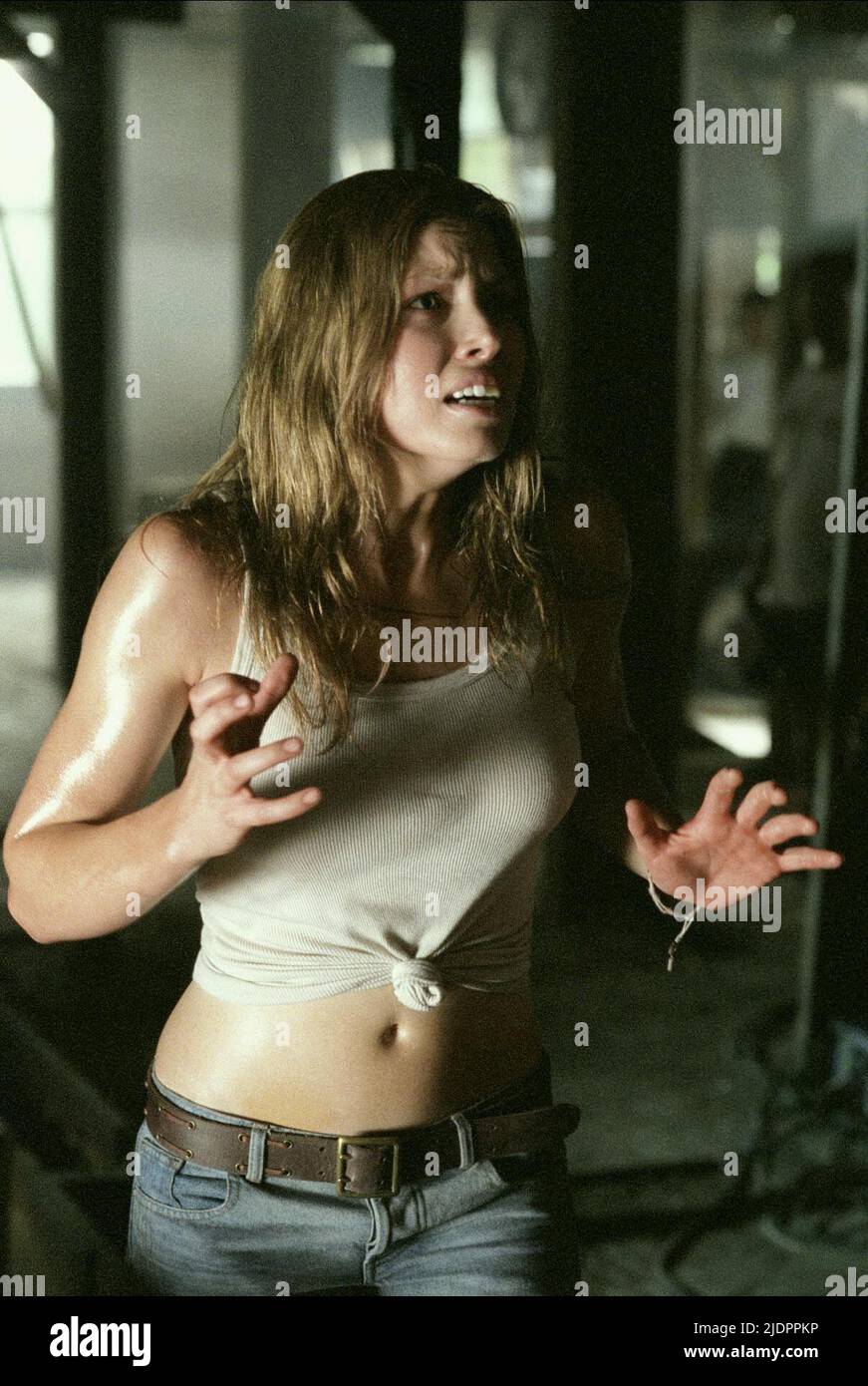
Let's analyze this iconic look from a design perspective:
- Silhouette: A simple, body-hugging ribbed tank. It offers no padding or artificial shaping, emphasizing a natural and athletic physique. The fit is close enough to be practical, not baggy or restrictive.
- Fabric: The material is key. It's a basic cotton rib-knit, the kind used for functional undershirts. This choice grounds the character in realism and suggests she isn't preoccupied with fashion. Crucially, this fabric is not durable; it gets wet, dirty, and torn easily, making it perfect for showing the progression of her struggle.
- Color & Styling: The white color provides maximum visual contrast for blood and grime. It's also tied at the waist, a common 2000s trend that here serves a dual purpose: it keeps the garment from snagging and exposes the midriff, subtly increasing the sense of physical vulnerability and sex appeal discussed in the TV Tropes article.
This "tank top and jeans" combination appears on countless modern final girls, including Sam in Wrong Turn (2003), Sarah in The Descent (2005), and was later adopted by the new-era final girl Sam Carpenter in Scream (2022).
Part 3: Variations on the Theme
While the white tank top is the classic choice, the underlying principle is about revealing a functional, tough base layer as the character is stripped of her pretenses—and her outer clothing—by trauma. A great recent example is Grace's costume in Ready or Not (2019).

Here, the costume's journey is the story. Grace begins in the ultimate symbol of tradition and femininity—a wedding dress. As she is hunted, the dress is systematically ripped and torn away, revealing the underpinnings:
- Silhouette & Structure: The costume is built on a strapless bustier and a lace bodysuit. From a design standpoint, this is a fascinating choice. The bustier provides more rigid support and structure than a simple bra or tank top, almost like a piece of soft armor. It’s a functional undergarment that becomes her primary top.
- Fabric: The lace of the bodysuit connects back to the bridal theme, but as the outer layers are destroyed, it loses its delicate connotation and simply becomes a practical base layer.
- Evolution: The costume undergoes what's known as an "Adrenaline Makeover." The frilly, impractical dress is shed, and the outfit is augmented with practical items: comfortable sneakers replace heels, and a shotgun bandolier is slung over the top. The final look—a tattered bustier, torn skirt, and combat accessories—perfectly encapsulates the modern final girl: a woman forced by circumstance to become a warrior.
Conclusion
Today we traced the evolution of the final girl and her signature style. We saw how her costume shifted from a signifier of moral purity to a symbol of resilience and grit, with the simple undershirt or tank top becoming a key part of her modern identity.
Key Takeaways:
- The 'final girl' is a recurring horror archetype whose costume is a critical tool for non-verbal storytelling.
- The classic final girl's styling was deliberately modest and practical (e.g., sweaters, high necklines) to visually signal her moral character, which was tied to her survival.
- The modern final girl's uniform is most often a simple tank top or undershirt, which functions to highlight her toughness, practicality, and resourcefulness.
- This undershirt look is effective because it combines freedom of movement with a sense of vulnerability, and its material acts as a canvas that visually documents the character's struggle.
- The core principle of this styling is the revealing of a tough, functional base layer (be it a tank top or a bustier) as the character endures trauma and fights back.
Next Lesson
We have now seen how undergarments are used to style the heroine in horror. In our next lesson, we'll delve into a different aesthetic within the same genre. We will identify Gothic and dark lingerie aesthetics in horror films, exploring how lace, leather, and corsetry are used to create atmospheres of the supernatural, the forbidden, and the macabre.