Introduction
In our last lesson, we explored the visual language of fantasy costumes, comparing ceremonial and battle attire to understand how costume designers communicate a character's role and power. We focused on how foundational garments, whether ornate corsets or practical armor, create the intended silhouette.
Today, we transition from purely imagined worlds to the realm of historical recreation. We will analyze how recent, popular historical dramas portray undergarments to build an authentic sense of a specific time period. This directly addresses our learning outcome: to identify bra and undergarment styles presented as period-appropriate in recent historical dramas.
You'll find that just as armor is the base layer for a warrior, period-specific undergarments are the essential, unseen architecture that gives historical costumes their distinctive shape. We will examine several case studies, moving chronologically from the early 19th century to the mid-20th century, to build your visual vocabulary of these foundational styles.
1. The Regency Era (c. 1800-1820): The Empire Silhouette of Bridgerton
The Regency period is defined by the "Empire" silhouette: a high waistline just below the bust, with a long, flowing skirt. This Neoclassical style was a dramatic shift away from the restrictive, waist-cinching corsetry of the 18th century. The goal was not to create an hourglass shape, but to support and lift the bust.
To understand how this was achieved, let's look at the undergarments featured in the popular series Bridgerton.
Fashion Historian Fact Checks Bridgerton's Wardrobe
The following resource is a transcript of a fashion historian's analysis of the costumes in 'Bridgerton'. It details the specific undergarments worn during the Regency era and points out where the show is accurate and where it takes creative liberties.
Please read the sections discussing Daphne Bridgerton's undergarments. These can be found under the headings 'First up, the undergarments and stockings' and 'And then the corset'. Focus on the description of the 'short stays' and their function.
As the analysis points out, the key bust-supporting garment of this era was not a modern bra, but a form of corset called stays.
- Short Stays (or Half Stays): Unlike the later Victorian corsets that covered the entire torso, these were shorter, ending just below the bust. Their primary function was to lift and separate the breasts to create the high, rounded bustline required for the Empire waist dress. They were typically lightly boned and not meant to be tightly laced to reduce the waist.
- Chemise: This was a simple, machine-washable slip-like garment worn as the innermost layer to protect the outer clothes and corset from the skin. As the historian notes, historical dramas often omit this layer to make the undergarments appear more alluring to a modern audience.
- Petticoat: During this period, the petticoat often had an attached bodice, making it more like a full slip or underdress. It provided a modesty layer, especially under the lightweight and sometimes sheer fabrics popular at the time.
The key takeaway for this era is that bust support was integrated into a corset-like garment designed to work with the high-waisted fashion, not a separate bra.
2. The Gilded Age (c. 1870s-1880s): The Structured Silhouette of The Gilded Age
Moving forward to the late 19th century, the fashionable silhouette changed completely. The Gilded Age favored an exaggerated hourglass figure with a severely cinched waist, a rounded abdomen, and a prominent posterior. This shape was impossible to achieve without complex and highly structured undergarments.
Let's examine the layers required to build this silhouette as depicted in HBO's The Gilded Age.
Fashion Historian Fact Checks HBO's The Gilded Age
This transcript of a 'Would They Wear That?' episode analyzes the costumes of 'The Gilded Age' (set in 1882). It provides a fantastic layer-by-layer breakdown of the undergarments that both 'old money' and 'new money' characters would have worn.
Please read the sections detailing the undergarments for both Agnes Van Rhijn and Bertha Russell. You'll find these under the subheadings 'First up, the undergarments' for Agnes, and 'Let's draw this gown layer by layer' for Bertha. Pay attention to the descriptions of the corset and the bustle.
The underpinnings of this era were a multi-part system:
- Chemise and Drawers: The base layer now consisted of two separate pieces: the chemise for the upper body and drawers (or pantalets) for the lower body.
- Corset: The Gilded Age corset was a formidable piece of engineering. Heavily boned with steel or whalebone, it was designed to dramatically reshape the entire torso, creating a tiny waist and smooth, rounded hips. It provided all the bust support, lifting and pushing the breasts together.
- Bustle: This was the signature item of the era. A cage-like structure, typically made of steel, it was worn at the back under the skirts to create extreme posterior fullness.
- Petticoat: Worn over the bustle and corset, the petticoat added another layer of volume and helped to smooth the lines of the underlying structures.
In this period, there is still no separate bra. The corset is the all-in-one shaping device for the entire torso.
3. Edwardian to the Roaring Twenties (c. 1910-1925): From Curve to Column in Downton Abbey
The early 20th century saw another radical shift in fashion. The S-curve silhouette of the Edwardian era gave way to the straight, slender, and boyish "garçonne" look of the 1920s. This required a fundamental change in undergarments, marking the true emergence of the brassiere.
Fashion Historian Fact Checks Downton Abbey's Costumes | Glamour
This video provides a fashion historian's analysis of the costumes in 'Downton Abbey', which spans this exact transitional period. You'll see the evolution from the longline corset to the modern bra and girdle.
Please watch the following three clips: 1913 Undergarments (02:05 - 03:04): Note the description of the long corset designed to elongate the torso. The historian mentions the patenting of the brassiere in 1914 but its slow adoption. 1920 Undergarments (05:48 - 06:37): Observe how the ideal body is changing. The goal is now to de-emphasize curves, and the corset evolves into a lighter girdle. 1925 Undergarments (10:00 - 10:51): This is key. The historian discusses the simple bandeau-style brassiere used to achieve a fashionably flat chest.
This period covers a crucial evolution:
- 1910s: Women still wore a longline corset that extended from under the bust to mid-thigh, creating a smooth, columnar line. However, the first true brassieres were being developed and patented, designed to be worn with this corset.
- 1920s: The fashionable ideal became a flat chest and slim hips. The heavy corset was abandoned in favor of a lighter girdle to smooth the hips. To achieve the flat-chested look, women wore a bandeau-style brassiere—a simple band of fabric that flattened and compressed the bust. This is the direct ancestor of the modern bra, but its function was the opposite of today's lift-and-separate designs.
4. The Mid-20th Century (c. 1950s): The Hourglass Returns in The Marvelous Mrs. Maisel
After the austerity of the war years, the 1950s saw a return to a hyper-feminine, structured hourglass silhouette. This look, however, was achieved not with a Victorian-style corset, but with a new generation of bras and girdles.

Fashion Historian Fact Checks The Marvelous Mrs. Maisel's Wardrobe | Glamour
To see these undergarments in action, let's turn to 'The Marvelous Mrs. Maisel'. This video fact-checks the show's costumes, providing an excellent overview of the foundational garments that created the iconic 1950s look.
Please watch the following clips: Daywear Undergarments (03:32 - 05:04): Focus on the description of the pointed-cup brassieres, longline bras, and girdles. Evening Undergarments (09:49 - 10:24): Note the explanation of the strapless all-in-one garment known as a 'merry widow'.
The 1950s silhouette was built with a combination of highly engineered pieces:
- The Bullet Bra (or Cone Bra): This iconic bra used concentric circles of stitching to create a stiff, pointed cup shape. The goal was a prominent, high, and sharply defined bust.
- The Longline Bra: This style extended down to the waist or hips, combining the function of a bra with the smoothing effect of a light girdle.
- The Girdle: Made with elasticated fabrics and sometimes boning, this was essential for nipping in the waist and creating a smooth line over the hips.
- The Merry Widow: For strapless evening gowns, this all-in-one garment combined a strapless bra, a waist-cincher, and garters for stockings into a single, structured piece.
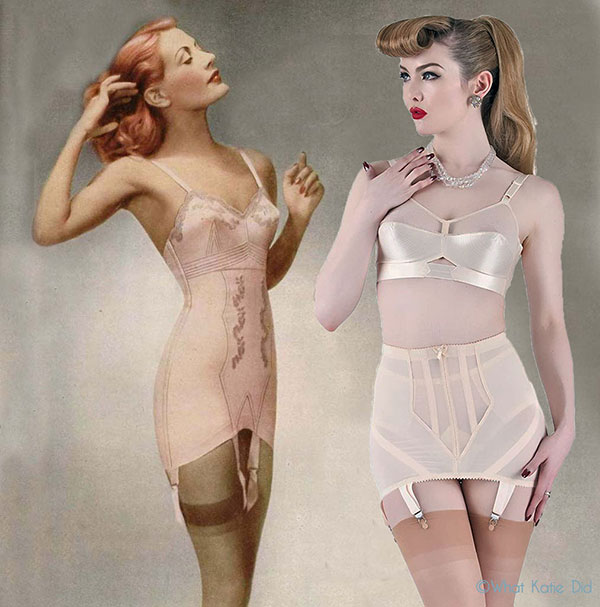
Given your background in lingerie design, you can see how the construction techniques of this era—like the circular stitching of the bullet bra and the strategic paneling of girdles—were entirely dedicated to creating a very specific and dramatic external shape.
Conclusion
Today we've traced the evolution of bra and undergarment styles as they are presented in popular historical dramas. We've seen how these foundational garments are not mere accessories, but the essential engineering that defines the silhouette of an era.
Key Takeaways:
- Period-appropriate undergarments are the crucial first layer for costume designers in historical dramas.
- The form of bust support has changed dramatically over time: from bust-lifting stays in the Regency era, to torso-shaping corsets in the Victorian period, to bust-flattening bandeaus in the 1920s, and finally to bust-projecting bullet bras in the 1950s.
- Understanding these foundational garments is key to identifying and analyzing the accuracy and aesthetic choices in historical costuming.
Next Lesson
Having explored how the past is recreated on screen, our next lesson will bring us firmly into the present. We will begin to analyze bras in contemporary romance films, where the function of lingerie shifts from creating a historical silhouette to communicating character, mood, and intimacy. Our next goal will be to identify the range of bra styles featured in contemporary romance films, from everyday to luxury lingerie.