Welcome to the final lesson of our module on Financial Accounting. In our previous session, you learned to analyze a firm's financial health using a variety of ratios and the powerful DuPont framework. We concluded by noting that these ratios, while useful, are not infallible truths; their meaning is context-dependent and they are based on data that itself has limitations.
Today, we will delve into that crucial caveat. This lesson is dedicated to critiquing the very foundation of our analysis: the financial statements themselves. We will explore how accounting rules, managerial choices, and deliberate manipulation can create a picture of a company that is distorted, incomplete, or misleading. Your goal is to move from being a user of financial statements to a critical and skeptical analyst, capable of identifying these distortions. This is less about calculation and more about understanding the structural assumptions and potential weaknesses of the financial reporting system—a perspective that should resonate with a mathematical appreciation for the axioms and boundaries of a system.
The Illusion of Precision
Financial statements present numbers in a clean, audited format, which can create an illusion of objective precision. However, it's vital to understand that accrual accounting is not a rigid measurement system like one found in the physical sciences. It is a system of rules and principles that requires significant judgment, estimation, and choice. Management has considerable discretion over how it applies these rules, and this discretion can be used to either reflect economic reality more faithfully or to obscure it.
These limitations fall into several broad categories, as illustrated in the diagram below.
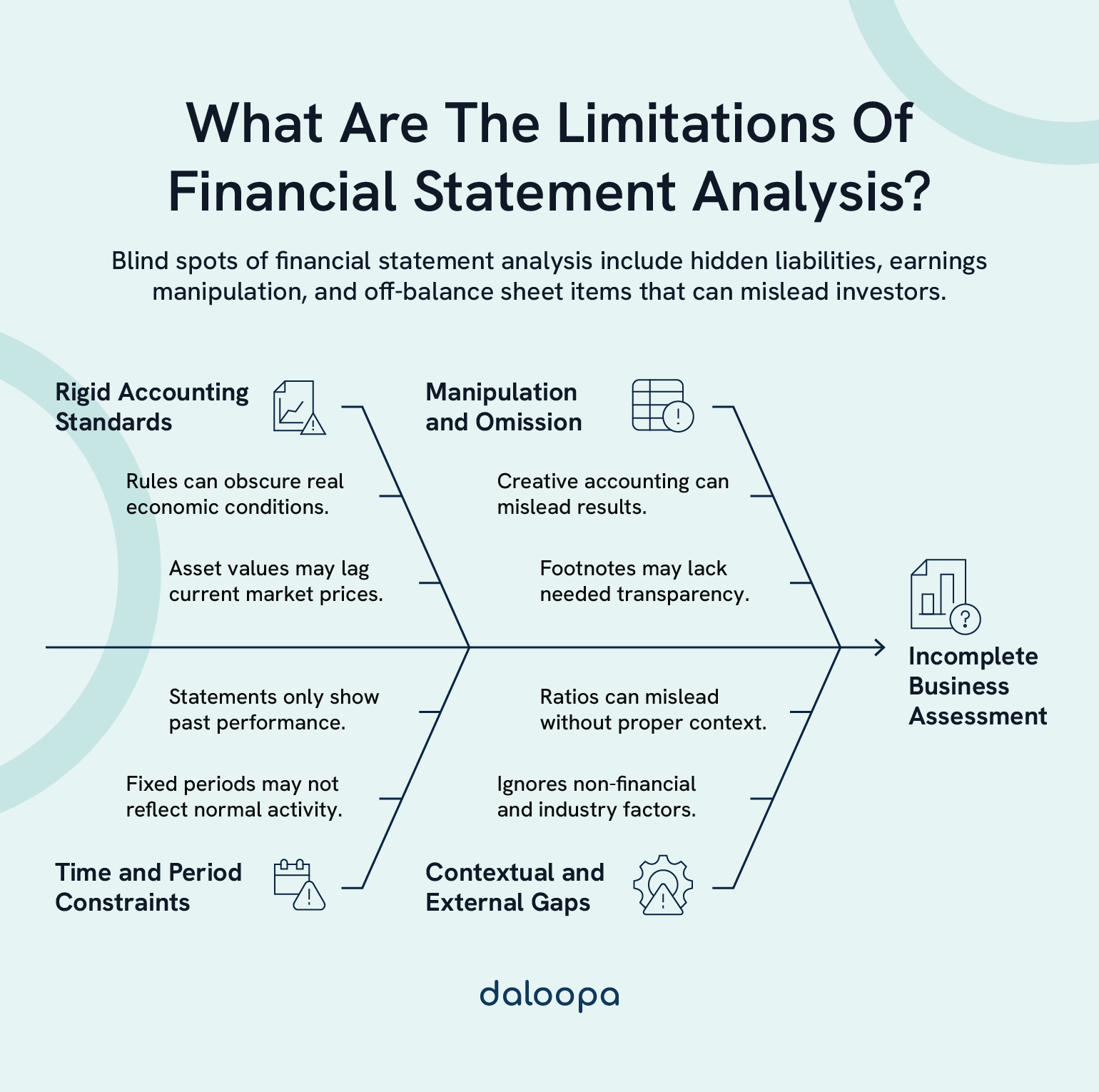
We will focus on two of the most critical areas where an analyst's skepticism is required: the choices managers make within the accounting rules (earnings management) and the transactions they structure to fall outside the rules (off-balance-sheet financing).
Earnings Management: Discretion Within the Rules
Earnings management occurs when managers use the flexibility in accounting rules to either mislead stakeholders about the underlying performance of the company or to smooth earnings to present a less volatile picture. This is not necessarily illegal fraud, but it certainly obscures the true economic performance.
Earnings Management Techniques
This video provides a concise and clear overview of the most common earnings management techniques, illustrated with real-world examples.
Please watch the segments covering the main techniques: Improper Revenue Recognition: This section discusses aggressive revenue recognition and channel stuffing, using Under Armour as an example. Improper Capitalization: Watch this segment to understand how WorldCom fraudulently boosted income by capitalizing expenses. Manipulating Estimates: This part explains how Waste Management manipulated estimates for depreciation. Altering Business Decisions: Finally, watch this section to see how companies can make poor long-term decisions, like cutting R&D, to meet short-term profit targets.
As the video demonstrates, managers have several levers to pull:
- Revenue Recognition: The timing of when revenue is booked is one of the most common areas of manipulation. Pushing product to distributors with generous return policies ("channel stuffing") can inflate quarterly sales, but it's not a sustainable practice and often leads to a sales slump in the following quarter.
- Capitalization Policies: Deciding whether to expense a cost immediately or capitalize it as an asset to be depreciated over time has a huge impact on current-period income. As the WorldCom fraud showed, improperly capitalizing operating expenses is a powerful way to inflate profits.
- Estimates and Assumptions: Management must estimate things like the useful life of an asset, the salvage value, the amount of uncollectible accounts receivable (bad debt expense), and warranty costs. Each of these estimates directly impacts net income. A manager looking to boost profits can simply extend the estimated useful life of an asset, thereby reducing annual depreciation expense.
- Choice of Accounting Method: Where permitted, changing methods can have a significant effect. Under US GAAP, for example, the choice between LIFO and FIFO inventory accounting can lead to very different gross profit figures, especially during periods of inflation.
The key issue for an analyst is not just that choices exist, but that a lack of consistency in those choices over time, or choices that deviate from industry norms, can destroy comparability.
[PDF] The effect of consistency in accounting choices on financial ...
This academic paper empirically investigates the relationship between consistency in accounting choices and financial statement comparability. It provides a strong theoretical basis for why analysts should be wary of accounting changes.
Please read the Introduction and Hypothesis Development sections. In the introduction, focus on the conceptual distinction made by the IASB: "Comparability is the goal; consistency helps to achieve the goal." In the Hypothesis Development section, pay attention to the reasons why accounting changes can reduce comparability, such as managerial opportunism and the difficulty for analysts to accurately forecast earnings after a change.
The key takeaway is that an accounting change is often a red flag. While sometimes justified by a change in business, it can also signal an attempt to manage earnings. It fundamentally disrupts time-series analysis, making it difficult to assess whether the company's performance has truly changed or if the numbers have just been re-shuffled.
Off-Balance Sheet Financing: Gaps in the Rules
Beyond bending the rules, companies have historically been adept at structuring transactions to keep large liabilities off the balance sheet entirely. This makes a company appear less leveraged and more solvent than it actually is. The response from standard-setters has been a multi-decade game of cat and mouse, with new rules constantly being written to close loopholes exploited by companies.
The classic examples of this are operating leases, pension liabilities, and the use of Special Purpose Entities (SPEs).
The Enron Case: Variable Interest Entities (VIEs)
Perhaps the most famous accounting scandal, the collapse of Enron in 2001 was largely due to its use of thousands of off-balance-sheet entities, then called Special Purpose Entities (SPEs). Enron used these entities to hide massive amounts of debt and to create fictitious profits. The accounting rules at the time allowed Enron to avoid consolidating these entities if an independent third party held a mere 3% equity stake. The scandal led to new rules around what are now called Variable Interest Entities (VIEs), focusing on control rather than equity ownership.
Variable Interest Entity Explained: The Enron Case
This video provides an excellent explanation of VIEs through the lens of the Enron scandal. It explains the "substance over form" principle that now governs the consolidation of these entities.
Please watch the following segments: Introduction to Consolidation: Watch the beginning to understand the traditional "voting model" of consolidation (voting model). The Enron Example: Pay close attention to how Enron used SPEs to avoid consolidating losses and keep debt off its books (Enron case). VIE Characteristics: Finally, review the criteria that define a VIE and determine who must consolidate it (VIE criteria).
The Enron case is the ultimate cautionary tale. It proves that even with audited financial statements, a company's reported health can be a complete fabrication. It forced the accounting profession to adopt a more economic-substance-based approach, asking "Who is really in control and exposed to the risks and rewards?" rather than just looking at voting shares.
The Analyst's Response: Reconstructing the Financials
Sophisticated users of financial statements, like credit rating agencies and investment analysts, do not take the numbers at face value. They perform their own adjustments to "correct" for accounting distortions and get closer to economic reality. A prime example is the work done by Moody's, which systematically adjusts company financials for things like leases, pensions, and securitizations.
Financial Statement Adjustments in the Analysis of Non- ...
This document from Moody's is a masterclass in financial statement critique. It details how and why a credit rating agency adjusts reported financials. It's a professional analyst's playbook.
Your goal here is to understand the logic behind the adjustments, not to memorize the exact mechanics. Start by reading the Summary section (Summary) and the section on Purpose and Application (Purpose and Application). This explains why they make adjustments—to improve comparability and better reflect underlying economics. Next, review Exhibit 1 and Exhibit 2 (Exhibits 1 & 2). These tables provide a fantastic overview of the most common analytical adjustments. Notice how many of them relate to topics we've discussed: operating leases, pensions, securitizations, and LIFO inventory. Finally, read in-depth about two specific and important adjustments: Defined Benefit Pension Plans: Read the section starting with The Reporting Problem – Part 1. Focus on how "smoothing mechanisms" distort the income statement and how underfunded obligations are a form of debt. Operating Leases: Read the section starting with The Reporting Problem under the Operating Leases heading. This explains why an operating lease is economically similar to debt and how analysts capitalize it to reflect this. (Note: New accounting standards, ASC 842 and IFRS 16, have since brought most leases onto the balance sheet, but this document shows how analysts dealt with this issue for decades and provides a model for how to think about other off-balance-sheet items).
The Moody's document demonstrates a crucial point: financial statement analysis at the professional level is not a passive activity. It is an active, forensic process of investigation and reconstruction. Analysts must read the footnotes carefully—where companies disclose information about leases, pensions, and other items—and use that data to build a more accurate picture of the company's debt, assets, and earnings.
Conclusion
In this lesson, we have peeled back the veneer of precision on financial statements to reveal the judgments, estimates, and structural limitations that lie beneath. You have learned that the numbers are not always what they seem and that a healthy dose of skepticism is a financial analyst's most valuable tool.
Key Takeaways:
- Financial statements are not objective facts but are the product of a rule-based system that allows for significant managerial discretion and has inherent limitations.
- Earnings management involves using discretion over accounting choices (e.g., revenue recognition, capitalization, estimates) to manipulate reported results. A lack of consistency in these choices over time is a major red flag.
- Off-balance-sheet financing involves structuring transactions (e.g., via operating leases or special purpose entities) to keep debt-like obligations hidden from the balance sheet, making a company appear less risky.
- Sophisticated analysis is a forensic process. Professional analysts systematically "adjust" reported financials to reverse the effects of these distortions and arrive at a figure that more closely reflects economic reality. The footnotes to the financial statements are the primary source of information for these adjustments.
This concludes our first module on the Foundations of Financial Accounting. You have progressed from understanding the basic language and structure of financial statements to using them for analysis and, finally, to critiquing their limitations.
In our next module, "Principles of Corporate Finance," we will shift our perspective. Having learned how to measure a company's performance and assess its financial health, we will begin to explore how companies create value. We will start by tackling a fundamental question in finance: how do you determine the appropriate rate of return for a risky investment? This will lead us to our first topic, the Capital Asset Pricing Model (CAPM).