Introduction
Welcome to the first lesson in your journey toward mastering advanced financial modeling. Our goal today is to establish the single most important principle of professional model building: creating a modular design that clearly separates inputs, calculations, and outputs. This architectural foundation is not just a best practice; it is the bedrock upon which reliable, flexible, and auditable financial models are built.
Mastering this concept is crucial for your goal of achieving the Advanced Financial Modeler (AFM) designation, as it aligns directly with the standards promoted by organizations like the Financial Modeling Institute (FMI). By the end of this lesson, you will understand the philosophy behind this structure and know how to organize your Excel workbooks to reflect it, setting a strong foundation for all the subsequent topics in this course, from three-statement modeling to startup valuation.
The Philosophy of Modular Design
A financial model's ultimate purpose is to support decision-making with clarity and confidence. A disorganized model, where assumptions, calculations, and results are jumbled together, undermines this purpose. It becomes difficult to understand, painful to update, and nearly impossible to audit for errors. The professional standard, therefore, is a disciplined, structured approach.
A leading expert from the Financial Modeling Institute (FMI) puts it best. A great model must satisfy two criteria: it must work flawlessly electronically (with clear, simple formulas) and it must work beautifully on paper (reading like a clean, logical presentation).
Financial Modeling Best Practices - Webinar Presentation by Financial Modeling Institute
To begin, watch this brief segment from a webinar by the Financial Modeling Institute. The speaker introduces the two core criteria that define a high-quality financial model.
Please watch the clip from the two criteria. Pay close attention to the distinction between a model that works "electronically" and one that works "on paper."
This dual requirement for electronic integrity and presentation-level clarity is the 'why' behind modular design. A well-structured model inspires confidence in its conclusions.
A popular framework that codifies this philosophy is the FAST Standard, which stands for:
- Flexible: The model can be easily adapted for new scenarios and assumptions without rebuilding formulas.
- Appropriate: The model is not over-engineered. It reflects the key business drivers without unnecessary complexity.
- Structured: The layout and organization of the model are consistent and logical.
- Transparent: The model's logic is easy to follow, using simple formulas that can be understood by others.
Your background in business intelligence and data modeling will provide a strong intuition here. Just as you separate data sources, ETL processes, and dashboard visualizations, a financial modeler separates assumptions, calculation logic, and presentational outputs.
Intro to FAST Financial Model | Part 1 | Financial Modeling with Querinfer
This video provides an excellent, quick overview of the FAST principles in a practical context.
Watch the section from the four basic principles. The presenter walks through what Flexibility, Appropriateness, Structure, and Transparency mean in practice. Note how he links structure to separating sheets for different purposes and transparency to using simple, broken-down formulas.
The Three (+1) Core Components of a Model
At its heart, a modular financial model can be broken down into three distinct components. The FAST Standard adds a fourth, which is essential for robust, professional models.
- Inputs / Foundation: This is the dedicated section for all the model's assumptions and hard-coded numbers. Think of revenue growth rates, inflation forecasts, tax rates, or project start dates. Centralizing these in one place makes the model easy to update and allows users to see all the key drivers at a glance.
- Calculations / Workings: This is the "engine" of the model. This section takes the inputs and applies the business logic to them. It contains all the formulas that build up revenues, costs, depreciation schedules, debt schedules, and ultimately the financial statements.
- Outputs / Presentation: This is the model's "dashboard." It presents the key results in a clear and digestible format. This includes the main financial statements (Income Statement, Balance Sheet, Cash Flow Statement), summary tables, key ratios, and charts.
- Controls: This component, emphasized by the FAST standard, includes mechanisms for managing the model itself. This encompasses error checks (e.g., ensuring the balance sheet balances), scenario switches, a table of contents, and version control information.
The images below illustrate this separation. The first shows a dedicated "Assumptions" sheet, where inputs are neatly organized. The second shows a model with "Main Assumptions" on the left (Inputs) and "Key Metrics" on the right (Outputs).

This is a classic example of an "Inputs" sheet. Notice how assumptions are grouped logically (General, Capital Cost, Operating Cost) and all input cells are clearly laid out for easy modification.
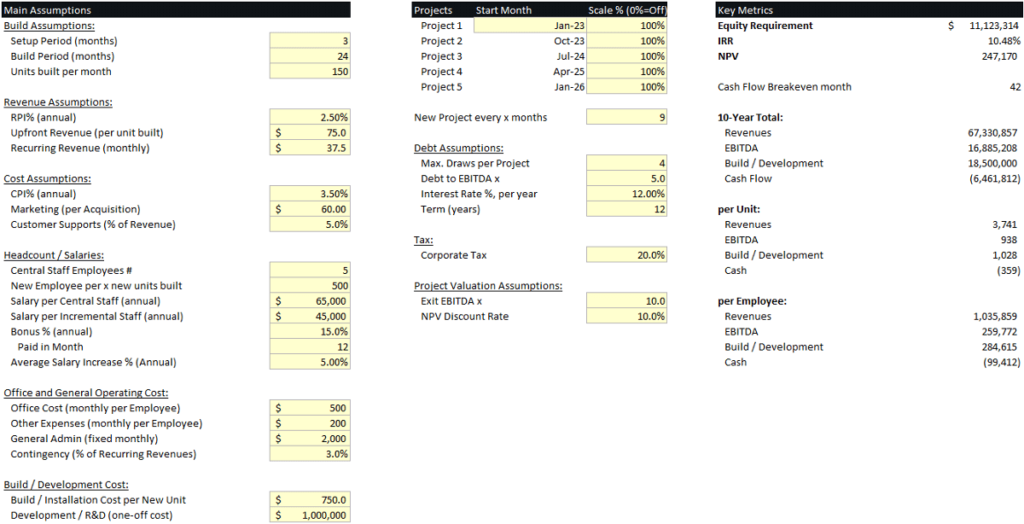
This model demonstrates the physical separation of inputs and outputs on a single sheet. Assumptions are grouped on the left, while key output metrics like IRR and cash flow are summarized on the right.
To formalize this structure, the most rigorous frameworks, like the FAST Standard, advocate for organizing the entire workbook around these components.
Practical, structured design rules for financial modelling.
The FAST Standard is the definitive guide for structured modeling and is highly respected in the industry. We will read the sections that lay out the high-level design principles for organizing your workbook and worksheets.
In this document, please read the following sections: Start with Section 1.0 / Workbook Design. Focus on rule FAST 1.01-01, which introduces the four functional classes of worksheets: Foundation, Workings, Presentation, and Control. Continue to Section 1.02 / Sheet Organisation. Pay attention to the rule to arrange sheets logically and to subdivide Workings sheets. Finally, review Section 2.0 / Worksheet Design. The most important principles here are that logic should flow top-to-bottom and left-to-right, and the introductions to the different sheet types, especially Input Sheets and Presentation Sheets.
Implementing the Modular Structure in Excel
Now, let's translate this theory into practice. The core takeaway is to use separate worksheet tabs for each component. A common and effective structure might look like this:
[Cover] [TOC] [Scenarios] [Inputs] [Workings_Ops] [Workings_FS] [FS_Output] [Summary]
1. Keep All Assumptions Up Front
As the FMI webinar emphasizes, it is critical to centralize your assumptions. Scattering them throughout your calculation sheets makes the model opaque and extremely difficult to update. A client or manager should be able to go to one or two sheets (Inputs, Scenarios) and understand every single decision that drives the model.
Financial Modeling Best Practices - Webinar Presentation by Financial Modeling Institute
Let's return to the FMI webinar. The speaker makes a powerful case for why assumptions must be kept upfront and how this facilitates scenario analysis and client communication.
Watch the segment from keep the assumptions up front. Note the logic of the recommended model order: Cover Page, Executive Summary, and then Assumptions. Then, watch the segment on seeing outputs while changing assumptions from two great ways to see the impact of your changes immediately.
2. Isolate Calculations in "Schedules" or "Workings"
This is perhaps the most violated rule in amateur modeling, but the most important for professionals. Never perform complex calculations directly on your final output sheets. The financial statements should be pristine. Every line item on your Income Statement, Balance Sheet, and Cash Flow Statement should be a simple link to a calculation performed elsewhere.
These "elsewhere" locations are your calculation schedules or workings sheets. You'll have a schedule for revenue, one for operating costs, a depreciation schedule, a debt schedule, and so on. This makes the model incredibly transparent and easy to audit. If there's an issue with the depreciation figure on the income statement, you know exactly where to look: the depreciation schedule.
Financial Modeling Best Practices - Webinar Presentation by Financial Modeling Institute
The FMI speaker explains this "schedules" concept perfectly. He also gives crucial advice on how to structure formulas to maintain transparency.
First, watch the section from Do not build any formulas. The speaker stresses that financial statement lines should only be links to schedules. Next, watch from Build simple formulas to understand how to construct those schedules. The key is to repeat data and use many simple formulas rather than one complex one.
This approach of breaking down complex logic into simple, auditable steps is the hallmark of an advanced financial modeler. It demonstrates discipline and a commitment to clarity over perceived cleverness.
Conclusion
In this lesson, we have laid the architectural cornerstone of advanced financial modeling. You learned that designing a modular model with separated inputs, calculations, and outputs is not an arbitrary convention but a foundational principle that ensures flexibility, transparency, and reliability.
Here are the key takeaways:
- Modular Design: Professional models are built in three (or four) distinct blocks: Inputs (Foundation), Calculations (Workings), Outputs (Presentation), and Controls.
- Centralized Assumptions: All hard-coded inputs and assumptions must be gathered in one place, typically on dedicated
InputandScenariosheets, for easy auditing and modification. - The Power of Schedules: Calculations should be performed in dedicated "schedules" or "workings" sheets. Output sheets, especially the financial statements, should contain only simple links to these schedules, never complex formulas.
- Simplicity is Key: Prioritize simple, transparent formulas. Break down complex calculations into multiple steps rather than creating long, un-auditable "mega-formulas."
This structure is the professional standard you will be expected to demonstrate in the AFM exam and in any high-stakes business environment.
In our next lesson, we will build directly on this foundation. We will explore how to apply consistent formatting, such as color-coding and number formats, to further enhance your model's readability and make the separation between inputs and formulas instantly visible.