In our last lesson, we saw how the strength of gravity depends on two things: the mass of objects and the distance between them. More mass means stronger gravity, while more distance means weaker gravity. This sets the stage for a fascinating question: If you throw something upwards from Earth, is there a speed at which it can overcome gravity completely and never fall back?
Today, we will answer that question by defining escape velocity. You will learn what this term means and why it's the crucial first step on our journey to understanding how a star's gravity can become so powerful that it creates a black hole.
Breaking Free from Gravity
Imagine you're standing on the surface of the Earth and you throw a ball straight up. It travels upwards for a moment, slows down, stops, and then falls back into your hand. Earth's gravity pulls it back down.
Now, what if you could throw it much faster? It would go much higher before falling back. If you could throw it even faster, it would go into orbit, continuously "falling" around the Earth but never hitting the ground. This is how satellites stay up.
But what if you threw it faster still? At a certain, specific speed, the ball would have enough momentum to overcome Earth's gravitational pull entirely. It would travel away from Earth and never return. This minimum speed required to break free from a celestial body's gravitational grip is called escape velocity.
The following illustration shows these different possibilities. A slow launch causes the object to fall back to Earth. A faster launch achieves a stable "orbital velocity." A launch at an even higher speed achieves "escape velocity," allowing the object to break free and travel away indefinitely.

What is Escape Velocity?
To get a more dynamic feel for this concept, let's watch a segment from the "Crash Course Astronomy" series. The host, Phil Plait, uses the same analogy of throwing a rock progressively harder to explain how an object can go from simply falling, to orbiting, to escaping completely.
The Gravity of the Situation: Crash Course Astronomy #7
This video provides a clear, conceptual explanation of orbital mechanics and escape velocity.
Please watch the segment from this point. The video explains that if you throw an object hard enough, gravity weakens too quickly with distance to stop it, allowing it to escape forever. This critical speed is the escape velocity.
As the video explains, escape velocity is the threshold. Any speed below it, and the object is still bound by gravity, either falling back or settling into a repeating orbit. At or above that speed, the object is on a one-way trip out into space.
The Great Escape: One Speed for All
A common point of confusion is whether a heavy object needs a higher escape velocity than a light one. Surprisingly, it does not. The escape velocity from a planet like Earth is the same for a massive rocket as it is for a tiny baseball.
An excellent article from "Let's Talk Science" clarifies this point.
This article provides a straightforward definition of escape velocity and addresses a key misconception.
Please read the first three paragraphs, from the introduction. The author uses an analogy of driving a car versus a truck to explain why the mass of the escaping object doesn't matter. Then, continue reading to find out the value for Earth.
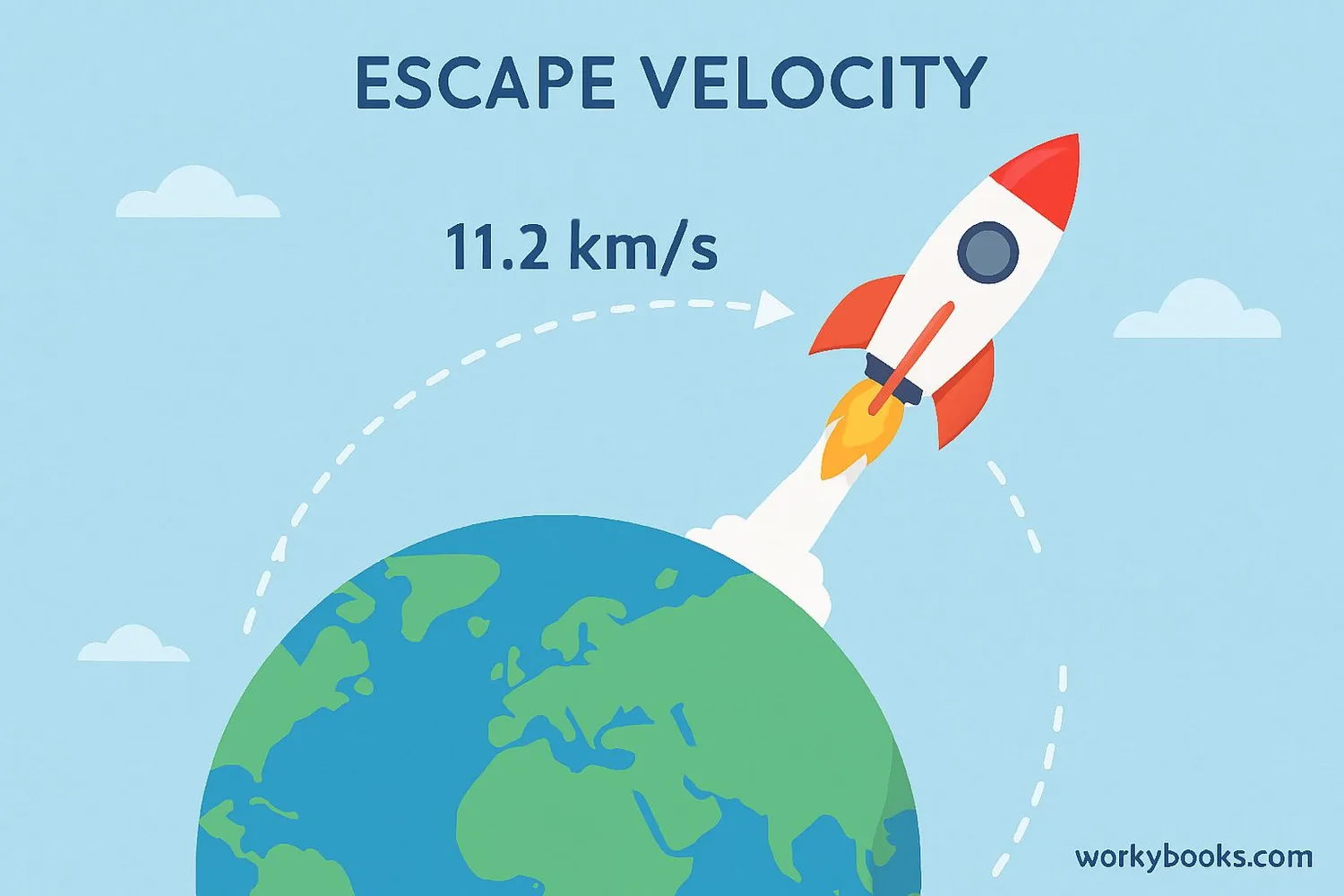
As the article states, the escape velocity from Earth's surface is a staggering 11.2 kilometers per second (which is over 40,000 km/h or 25,000 mph).
Different Worlds, Different Speeds
Since escape velocity is about overcoming gravity, and we know gravity's strength depends on the mass of the celestial body, it follows that different planets and stars will have different escape velocities. A more massive object has stronger gravity, so you'd need a higher speed to escape from it.
The following article from AstroCamp gives a very clear definition and some powerful examples.
What is a Black Hole Made Out Of? | AstroCamp
This article explains escape velocity in the context of different celestial bodies, which is a perfect lead-in to our main topic of black holes.
In the article, find the section titled "Escape Velocity of a Black Hole". Read the first two paragraphs, from the definition down to the examples for Jupiter and the Sun. Notice how much higher the escape velocities are for these more massive bodies compared to Earth.
The key idea is that the speed required to escape depends entirely on the properties of the world you are trying to leave—specifically its mass and its size, which together determine its surface gravity.
Conclusion
In this lesson, we've defined a crucial concept for our journey into the life and death of stars. Let's summarize the key takeaways:
- Escape velocity is the minimum speed an object needs to completely break free from the gravitational pull of a massive body, like a planet or star, without falling back.
- This speed is determined by the mass and size of the celestial body you are escaping from, not the mass of the escaping object itself.
- Anything launched with less than escape velocity will either fall back or enter into an orbit.
We've now established what escape velocity is. In our next lesson, we will look more closely at why a more massive or denser object has a higher escape velocity. This will be the final piece of the puzzle we need from the world of gravity before we can begin to explore the stars themselves.