In our last lesson, we introduced the concept of escape velocity—the speed needed to break free from a celestial body's gravity. We established that this speed depends on the mass and size of the body you're trying to escape from. Now, we'll explore why this is the case.
Today's lesson is the final piece of our "gravity puzzle." We will unpack why more massive and denser objects have a higher escape velocity. This is a critical concept, as it forms the very foundation for understanding how something as extreme as a black hole can even exist.
The Effect of Mass: More Gravity, More Speed
Let's start with the more intuitive factor: mass. As we've discussed, gravity is the force of attraction between objects with mass. The more massive an object is, the stronger its gravitational pull.
It follows logically that if an object has stronger gravity, you will need to be moving faster to overcome that pull. A rocket launching from the massive planet Jupiter needs far more power and speed to escape than a rocket launching from our much smaller Moon.
To see this principle in action with some clear examples, let's watch a short clip from the "Math and Science" channel. The presenter gives the escape velocities for several celestial bodies in our solar system, which vividly illustrates the relationship between mass and escape velocity.
What is Escape Velocity? How do we go to other Planets?
This video provides clear, numerical examples of escape velocity for different celestial bodies.
Please watch the segment from these concrete numbers. Pay attention to how the escape velocity dramatically increases as we move from the low-mass Moon to the high-mass Earth, the much more massive Jupiter, and finally the Sun.
As you saw, escaping the Sun requires a staggering speed of 618 km/s, while escaping our Moon requires only 2.38 km/s. This directly shows that as mass increases, so does the escape velocity.
The Effect of Density: Size Matters
The second factor—density—is a bit less obvious but is the real key to understanding black holes. Density is the measure of how much mass is packed into a given space. A kilogram of lead and a kilogram of feathers have the same mass, but the lead is far denser because its mass is packed into a much smaller volume.
How does this affect gravity and escape velocity? The strength of gravity you feel from an object depends on its mass and how far you are from its center. If you shrink an object while keeping its mass the same, you can get closer to its center. And the closer you get, the stronger the gravity becomes.
This is the secret behind the immense gravity of some objects. It's not just about how much mass they have, but how tightly that mass is compressed.
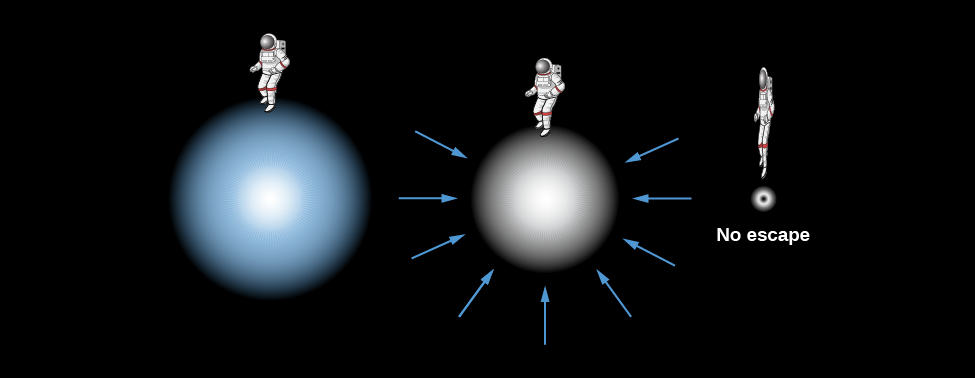
This illustration shows how compressing an object's mass into a smaller space (increasing its density) leads to a stronger gravitational pull and a higher escape velocity. Eventually, the escape velocity becomes so high that nothing can get away.
To make this concept intuitive, let's turn to a brilliant analogy from astronomer Phil Plait. He uses a crumpled piece of paper to explain why a small, dense object can have stronger surface gravity than a large, puffy one of the same mass.
Why do black holes have such strong gravity?
This video uses a simple but powerful analogy to explain why density increases gravitational pull.
Watch the segment from the crumpled paper analogy. Notice how shrinking the paper allows a particle to get closer, increasing the force of gravity it experiences. The video then connects this directly to how black holes form from collapsed stars.
Squishing the Earth
Let's reinforce this idea with a thought experiment from NASA.
This article from NASA's "Imagine the Universe!" site provides a clear, text-based explanation of how escape velocity is affected by both mass and size (density).
Please read the first few paragraphs of the article, from the beginning down to the explanation of the Schwarzschild radius. This will walk you through the thought experiment of compressing Earth into a tiny sphere and what that implies for its escape velocity.
As the article explains, if you could squish the Earth down to a radius of just 9 millimeters, its escape velocity would become equal to the speed of light. Anything smaller, and the escape velocity would be greater than the speed of light, meaning not even light could escape. You would have created a black hole.
This brings us to a crucial point: a black hole is not necessarily more massive than the star it came from. Rather, its parent star's core has collapsed into such a tiny, dense object that its escape velocity at its "surface" exceeds the cosmic speed limit—the speed of light.
This is beautifully visualized in the popular "gravity well" analogy, which shows spacetime as a rubber sheet. A more massive or denser object creates a deeper, steeper well that is harder to climb out of.

This image compares the "gravity wells" of the Sun, a neutron star, and a black hole. Although a neutron star might have a similar mass to the Sun, its extreme density creates a much deeper well. A black hole represents the ultimate case of density, creating a well so deep that nothing can escape.
To see how these concepts of mass, density, and escape velocity all come together in the context of black holes, let's read one final excerpt.
What is a Black Hole Made Out Of? | AstroCamp
This article from AstroCamp connects the ideas of density and escape velocity directly to the formation of a black hole's singularity and event horizon.
Please read the sections titled How Dense Are Black Holes? and What is the Singularity of a Black Hole? Focus on how the collapse of a star packs mass into a point of infinite density, creating an escape velocity that surpasses the speed of light.
Conclusion
We have now assembled all the fundamental concepts of gravity needed to understand the birth of a black hole. Let's summarize the key takeaways from this lesson:
- Mass and Escape Velocity: A more massive object has a stronger gravitational pull, which means a higher escape velocity is required to break free from it.
- Density and Escape Velocity: For a given mass, a denser (smaller) object will have a higher escape velocity. This is because you can get closer to its center of mass, where its gravitational pull is much stronger.
- The Black Hole Threshold: A black hole is formed when a massive object is compressed to such an extreme density that its escape velocity exceeds the speed of light.
With this foundation in place, we can now move from the "what" of gravity to the "how" of stellar processes. In the next module, we will begin our journey into the heart of stars to understand how they live, what powers them, and what happens when they finally run out of fuel—the cataclysmic event that can ultimately lead to the formation of a black hole.