Welcome to your first lesson in this comprehensive Python course. Since you're already using Python professionally but want to build a truly solid foundation from the ground up, we'll start with a fast-paced review of the absolute fundamentals. This lesson focuses on the building blocks of any Python program: its core data types. You'll learn to identify and use integers, floating-point numbers, strings, and booleans, and understand how Python handles conversions between them.
Let's begin with a quick overview of the data types we'll be discussing.
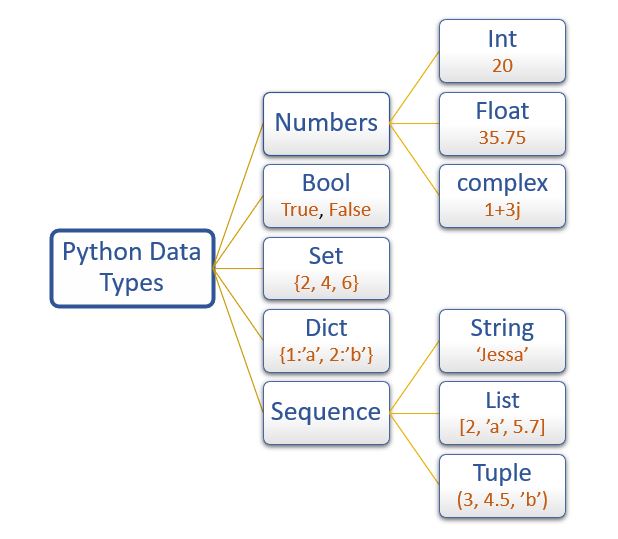
Numeric and Boolean Types
In Python, all data is represented as objects, each having a specific type. The simplest of these are the numeric types, primarily integers (int) and floating-point numbers (float). Given your background, you're certainly familiar with the distinction, but it's worth reviewing how Python handles them, their operators, and some useful built-in functions.
Corey Schafer's videos provide an excellent and concise practical walkthrough. Please watch the following segments to see these concepts in action.
Python Tutorial for Beginners 3: Integers and Floats - Working with Numeric Data
This video, "Integers and Floats - Working with Numeric Data," is a rapid tour of Python's numeric capabilities.
Watch the introduction to see the basic distinction between int and float using the type() function: int vs float. Next, review the standard arithmetic operators, including floor division (//) and the modulo operator (%): arithmetic operators. The modulo operator is particularly useful for a wide range of algorithmic tasks beyond just checking for even or odd numbers. See how Python respects the order of operations and uses a shorthand syntax for augmenting variables (e.g., +=): order of operations. Familiarize yourself with two helpful built-in functions, abs() and round(): abs and round. Finally, observe how comparison operators work. Note that they always evaluate to a Boolean (True or False) value, which we'll discuss next: comparison operators.
While the video gives a great practical overview, the following article provides additional technical depth that's worth exploring.
Basic Data Types in Python: A Quick Exploration
This article from Real Python delves into the details of numeric and boolean types.
Please read the following sections: Integer Numbers: Focus on the different ways to create integer literals, particularly the use of prefixes for different bases (0b, 0o, 0x). This is often relevant in lower-level systems programming and data manipulation. Floating-Point Numbers: Pay close attention to the section on internal representation. It mentions that Python float values are typically represented as IEEE 754 double-precision numbers, which explains the limits on their maximum value and precision. Complex Numbers: Briefly review this section. Python has native support for complex numbers, using j for the imaginary unit, which can be useful in scientific computing and signal processing. Read the short part on creating literals. Booleans: This section introduces True and False. The most critical concept here is truthiness. Read the part on the rules Python uses to determine if an object is considered "falsy" (e.g., 0, "", []) or "truthy." Understanding this is key to writing concise and "Pythonic" conditional logic.
String Type
Textual data is handled by the str type. Strings are sequences of characters and are one of the most versatile types you'll work with. They are immutable, meaning that any operation that seems to modify a string actually returns a new one.
Let's turn back to Corey Schafer for a practical guide to working with strings.
Python Tutorial for Beginners 2: Strings - Working with Textual Data
This video, "Strings - Working with Textual Data," covers the essential operations from creation to formatting.
Watch the segment on length, indexing, and slicing. As strings are sequences, you can access their parts using zero-based indices and slice notation [start:stop:step]. Next, see a demonstration of several powerful built-in string methods like .lower(), .upper(), .count(), .find(), and .replace(): string methods. Note that .replace() returns a new string. Finally, focus on the segment covering string concatenation and formatting. Pay special attention to f-strings, which are the modern, recommended way to embed expressions inside string literals: formatting and f-strings. They are more readable and efficient than older methods. The video concludes with a very useful tip on using the dir() and help() functions to explore available methods on any object. This is an invaluable technique for self-discovery: dir and help.
Type Conversion
Your programs will frequently need to convert data from one type to another—for example, reading a number from a text file (which comes in as a string) and using it in a calculation. Python handles this through both implicit and explicit conversion.
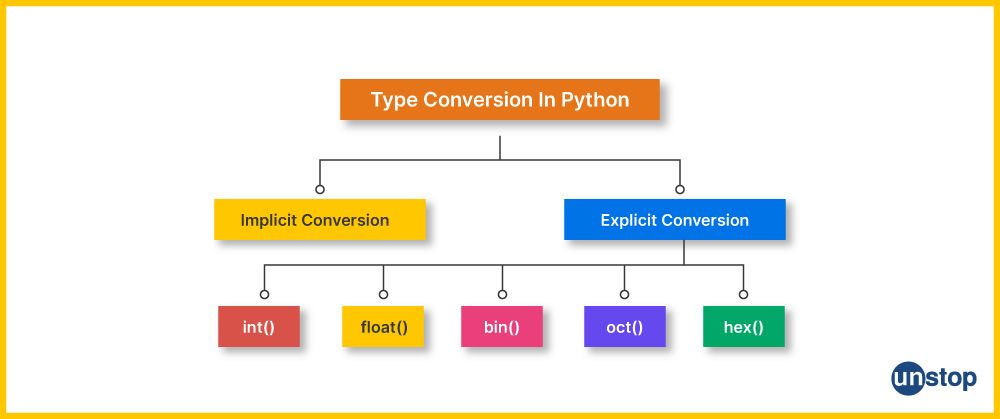
The following reading explains this distinction clearly and shows how to handle the most common conversion scenarios.
Python Data Type Conversion: A Guide With Examples
This DataCamp tutorial provides clear examples of both implicit and explicit type conversion.
Read through these sections to understand the mechanics: First, understand the difference between implicit and explicit conversion. Read the section on implicit conversion. The key concept here is type promotion: when you mix types (like int and float), Python promotes to the more "complex" type to avoid data loss. Next, review explicit conversion, also known as type casting, where you use functions like int(), float(), and str() to force a conversion. The section on string conversions is particularly important. It demonstrates the common TypeError from trying to concatenate strings with numbers and the ValueError from trying to cast an invalid string to a number.
To see this in a live coding context, let's revisit one of Corey Schafer's videos. He provides a perfect example of why you need to explicitly cast strings to numbers before performing arithmetic.
Python Tutorial for Beginners 3: Integers and Floats - Working with Numeric Data
In this final video segment, you'll see a practical demonstration of type casting.
Watch from this point, where he shows what happens when you try to add two numbers that are actually strings. He then uses int() to cast them correctly, solving the problem. This is a situation you will encounter constantly when processing user input or data from files.
Conclusion
In this lesson, we completed a rapid but thorough review of Python's fundamental data types. We've established a solid baseline for the more complex topics to come.
Here are the key takeaways:
- Python's core data types include numeric types (
int,float,complex), the text sequence type (str), and the boolean type (bool). - Each type has a specific set of associated operations and methods (e.g., arithmetic for numbers, slicing and case conversion for strings).
- Objects in Python have a "truthiness" value, allowing any object to be evaluated in a boolean context. Empty collections and numeric zeros are generally
False. - Type conversion can be implicit (automatic, to prevent data loss) or explicit (manual casting using functions like
int(),str(), etc.). Being aware of when and how to cast types is essential for preventing common errors.
In the next lesson, we will build upon these single-value data types and explore Python's built-in collection types: lists, tuples, sets, and dictionaries. These are the primary data structures you will use to organize and manage groups of objects.