The historical-crashes module begins with a distinction that matters whenever a financial firm is under pressure: lacking cash today is not the same as having assets worth less than its debts. This lesson uses small balance sheets to separate a temporary funding shortage from balance-sheet insolvency, then shows how a funding shortage can turn into a deeper loss. That distinction will help you compare the different mechanisms behind historical crashes in the next lessons.
Two questions, two time horizons
A balance sheet lists assets—things of value a firm owns or is owed—and liabilities—what it owes others. The difference is its equity:
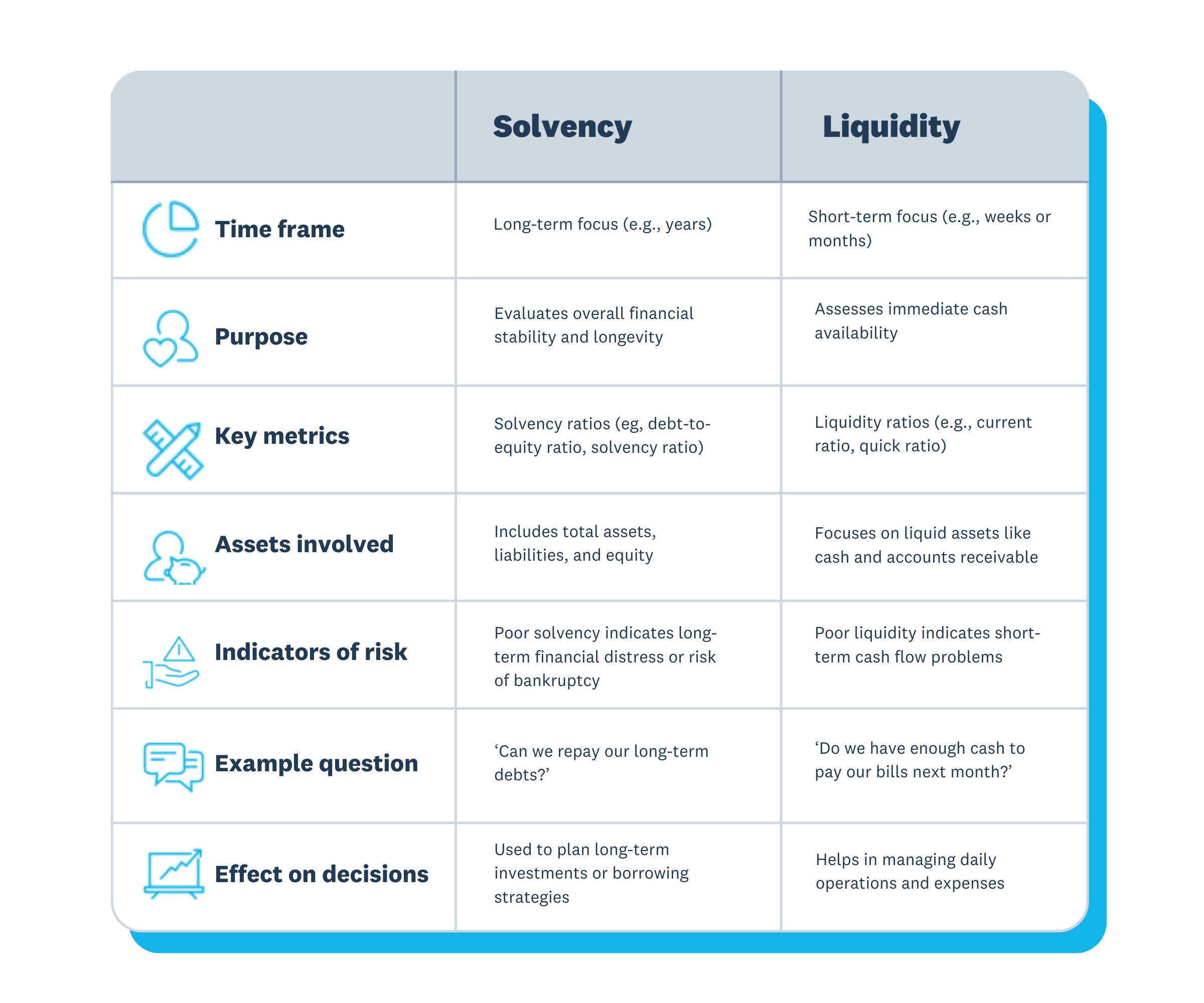
For this lesson, balance-sheet insolvency means that assets, valued realistically, are worth less than liabilities. Equity is then negative. Illiquidity means that the firm cannot obtain enough cash when a payment is due, even though its assets may still be worth more than all its debts. A valuable asset that will pay off next year cannot necessarily pay a bill tomorrow.
Watch Khan Academy’s Bailout 1: Liquidity vs. Solvency for a balance-sheet illustration. Its household example makes the timing problem visible before we apply it to a financial firm.
Bailout 1: Liquidity vs. Solvency
Khan Academy’s Bailout 1: Liquidity vs. Solvency introduces assets, liabilities, equity, and a payment that comes due before assets can be sold.
Watch the balance sheet for the asset-minus-liability calculation, then negative equity for the contrasting case. In the cash shortage, focus on why positive equity does not put cash in hand by tomorrow. Treat the video's discussion of bankruptcy as an illustration, not a rule that negative equity automatically causes a bankruptcy filing.
One qualification matters: insolvency can have different meanings in legal settings, including tests based on whether debts can be paid as they come due. We will use balance-sheet insolvency for the precise condition of negative equity, and describe an inability to make an imminent payment as a cash or funding shortage. The two problems can coexist.
A solvent firm with a payment problem
Consider a hypothetical firm with the following balance sheet, in millions of dollars. Its loans are expected to be worth their stated amount if held and collected over time; they cannot all be turned into cash by tomorrow.
| Assets | Value | Liabilities | Amount owed |
|---|---|---|---|
| Cash | 8 | Debt due tomorrow | 20 |
| Loans to customers | 92 | Debt due later | 60 |
| Total assets | 100 | Total liabilities | 80 |
The firm has positive equity of . On the stated asset values, it is not balance-sheet insolvent. Yet tomorrow’s payment is , and available cash is only . Its immediate cash shortfall is .
That is a timing gap, not evidence that the firm is poorer overall. A lender willing to advance against the loans could give the firm time to collect them. Borrowing would add of cash and of debt; it would not create equity. Such a bridge works only if funding is available and the future collections really can support repayment. A lender may refuse, or demand terms the firm cannot meet.
Accounting measures can flag this issue, but they are not substitutes for checking payment dates. In this example, the of longer-term loans are not current assets available for tomorrow’s bill. Comparing the of cash with the due tomorrow exposes the shortfall more clearly than looking at total assets alone.
Read the selected parts of OpenStax’s Using Classified Balance Sheets to Evaluate Liquidity for the distinction between assets on a balance sheet and cash available for short-term needs.
Read this OpenStax explanation to connect the example's payment dates with the accounting categories of current assets and current liabilities.
In “Using Classified Balance Sheets to Evaluate Liquidity,” read the liquidity discussion, ending with the paragraph about converting current assets into cash. Then, below the “Liquidity Is as Important as Net Worth” sidebar, read the opening of the working-capital discussion, through the shortfall. Focus on what a negative working-capital figure signals, while remembering that even an asset classified as “current” may not be cash on the exact day a bill falls due.
When the problem is a loss, not just a wait
Keep the firm’s debts at , but suppose credible new information shows that some customers will not repay their loans. The loan portfolio’s realistic value falls from to . Cash remains , so assets are now worth :
The firm still lacks cash for tomorrow’s payment, but it now has a second, distinct problem: even if every asset could be converted into cash at its revised value, the proceeds would fall short of total debts. A short-term loan might postpone a missed payment, but borrowing would add a matching liability. It would not erase the deficit.
The distinction also works in the other direction. Imagine assets of cash and in other assets, against total debts of , of which is due today. The firm can pay today’s from cash, yet its equity is still . Making the next payment does not, by itself, prove solvency.
Asset values are therefore central to the diagnosis. The original portfolio figure of was an assumption about what could ultimately be collected or realized, not a promise of what a hurried sale would fetch. A funding shortage can become a solvency problem if assets must be sold at a large loss or if their expected value proves too high. It does not follow that every temporary shortage causes insolvency: the outcome depends on the size of any loss relative to the firm’s equity cushion.
Read OpenStax’s short discussion of how the two problems can interact. Its historical example illustrates the danger of treating recorded asset values as cash immediately available at the same price.
Return to the OpenStax page for its discussion of a liquidity crisis becoming a solvency crisis. Use it as an illustration of the mechanism, rather than assuming that every troubled firm's failure has one simple cause.
Under “Ethical Considerations,” find “Liquidity Is as Important as Net Worth.” Start with its opening question comparing the firm's recorded assets and liabilities, and read the full discussion to the subsection's final sentence. Pay particular attention to the difference between an asset's recorded value and the cash obtainable when payment is urgent.
Why the distinction matters during a crash
A market can make a firm's funding problem more acute without immediately changing every borrower's ability to repay. If many creditors demand payment at once, cash needs arrive sooner than expected. The following brief bank example shows that timing mismatch.
Bank Failure - Liquidity Crisis (Bank Run) & Insolvency
EconplusDal’s Bank Failure - Liquidity Crisis (Bank Run) & Insolvency applies the cash-versus-obligations distinction to a bank facing withdrawals.
Watch the distinction, then the withdrawal example. Focus on the comparison between funds demanded immediately and assets available immediately—not on whether all the bank's longer-term assets have lost their value.
This is related to, but different from, the market liquidity of an order book. Market liquidity concerns how readily an asset can be sold without moving its price substantially. A firm’s funding liquidity concerns its ability to obtain cash to meet obligations. The two can interact: if funding disappears, a firm may have to sell assets; if many firms sell into a thin market, the prices they obtain may fall. Later historical cases will examine when such pressures amplified an initial shock.
Key takeaways
Use two checks, not one, when reading a balance sheet under stress. First, compare cash obtainable by each due date with payments due then: this identifies a potential liquidity or funding shortage. Second, compare the realistic value of all assets with all liabilities: negative equity identifies balance-sheet insolvency. A firm can face either problem, or both; refinancing can buy time for a sound asset base, but it cannot by itself repair assets worth less than debts.
The next lesson compares the 1929 and 1987 crashes. This distinction will help separate the pressures that made participants sell immediately from the losses and mechanisms that made selling self-reinforcing.