Welcome to your first lesson. Your goal of consistently achieving marks in the 90%+ range is ambitious but entirely achievable. The difference between a distinction-level answer and a top-tier answer often lies not in knowing more law, but in demonstrating a more precise and sophisticated engagement with the question itself.
This lesson is the foundational step in that process. We will focus on how to read an assessment question with the precision of a top-tier candidate. By the end of our session, you will be able to dissect any LLB question to extract its exact legal task and classify the 'command word' that dictates the nature of your answer. Mastering this skill ensures you are answering the actual question posed, which is the first and most critical gate to scoring exceptionally high marks.
1. Identifying the "Call of the Question"
In any law assessment, whether it's a 1,400-word problem question or a 100-word short answer, your first task is to isolate the specific instruction you are being asked to follow. This is often referred to as the "call of the question." It's the legally operative part of the prompt that directs your entire analysis. Any facts in a scenario or propositions in an essay title are merely the raw material you must work with to fulfil this core instruction. Failing to identify or adhere to it is the fastest way to lose marks, no matter how brilliant the rest of your answer is.
Let's begin with a resource from Georgetown Law that explains this concept.
Tips for Writing a Law School Exam
This document offers practical advice for law exams. We will focus on its guidance for identifying the core task within a question.
Please read the first full paragraph on page 2. Focus on the discussion of the call of the question and the consequences of going outside its scope. Pay close attention to the example provided from a Criminal Justice exam, as it shows how a well-formed question explicitly limits the required analysis.
The key takeaway is that your professor has set a specific task, and any analysis outside that task is irrelevant and will not earn you points. For a problem question, the "call of the question" is often found at the very end. This leads to a crucial strategic tip for tackling fact patterns.
The following video from the Legal Briefs channel provides a practical demonstration of this strategy. While the example used is from Tort Law, the principle is universal and directly applicable to your upcoming Criminal Law assignments.
Ace Your Law School ESSAY EXAMS! Strategies on Racking Up POINTS! Must know SECRETS! ACTUAL EXAM!
This video offers exam strategies for law students. We will focus on its advice for how to approach reading a new exam question.
First, watch the section on initial strategy, from the first thing you do. The presenter explains why you should always read the prompt at the end of the question first. Next, watch the walkthrough of an exam question from this part was worth 60 points and from so what is the issue here. Notice how the instruction, "prepare an assessment of Bell's legal prospects," frames the entire analysis of the facts. The reader isn't just randomly spotting issues; they are actively looking for issues relevant to Bell's legal prospects. This is how you should approach your criminal law scenarios—use the prompt (e.g., "advise the parties on their liability") to guide your reading.
2. Classifying the Command Word
Once you've identified the operative task, the next step is to analyse the verb at its heart—the "command word." This word tells you what kind of intellectual work you need to do. Are you being asked to simply recall information, apply a rule, or critically judge a legal doctrine?
Answering a question that asks you to "evaluate" with a simple "explanation" is a common reason that good students fail to get top marks. You may have demonstrated knowledge, but you haven't demonstrated the specific higher-order skill the examiner is testing.
The following article from Oxbridge Notes provides an excellent overview of this concept.
How to Spot What Examiners Are Really Asking in Law Questions
This article breaks down how to interpret law exam questions effectively. We will focus on its discussion of keywords and different task types.
Read the first two main sections of the article. Start with the section on identifying keywords and command words. Then, continue to the next section, Differentiating Between Descriptive and Analytical Tasks. This distinction is crucial and forms the basis for understanding what an examiner wants.
To structure this thinking, we can use a well-established educational framework: Bloom's Taxonomy. It organizes cognitive skills into a hierarchy, from the most basic to the most complex. By mapping law assessment command words onto this hierarchy, you can instantly gauge the level of depth and criticality required for your answer.
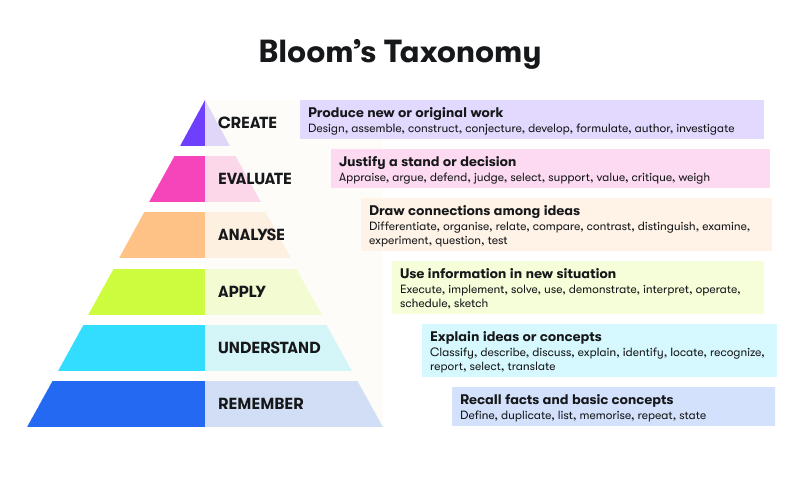
Here is how typical LLB command words fit into this framework:
-
Remember / Understand (Lower-Order): These tasks test your knowledge and comprehension of legal rules and concepts.
- State / Define: Recall and present a precise legal definition or rule. (e.g., "State the test for dishonesty from Ivey v Genting Casinos.")
- Describe / Explain: Provide details and reasons, showing how a legal concept or process works. (e.g., "Explain the requirements for a valid contract.")
-
Apply (Mid-Order): This is the core task of problem questions. You must use the legal rules you know in a new factual situation.
- Apply / Advise / Discuss liability: Use IRAC (Issue, Rule, Application, Conclusion) to determine the legal consequences for parties in a scenario. (e.g., "Advise Dave on his potential liability for theft.")
-
Analyse / Evaluate (Higher-Order): These tasks require you to go beyond simply stating the law. You must deconstruct it, form judgments about it, and support your position with reasoned argument.
- Analyse: Break a topic down into its constituent parts and examine the relationships between them. (e.g., "Analyse the components of a 'qualifying trigger' for the loss of control defence.")
- Compare / Contrast: Examine the similarities and differences between two or more legal concepts.
- Evaluate / Critically discuss / Assess: Make a judgment about the value, merit, or effectiveness of a law, a case, or a legal reform. This is the highest level of analysis and requires you to weigh arguments, consider counter-arguments, and come to a substantiated conclusion. (e.g., "Critically evaluate the decision in R v G [2003] UKHL 50.")
Your goal of achieving 90%+ requires you to excel at every level, but particularly to demonstrate mastery of the higher-order Analyse and Evaluate skills whenever they are requested.
3. A Masterclass in Deconstruction
Understanding the theory is one thing; seeing it in practice is another. The following video provides a masterclass in the kind of deep analysis of a question that separates First Class answers from the rest. The presenter deconstructs essay questions to uncover their hidden assumptions and demands.
How I got a First Class in EVERY Essay at Law School
This video by a First Class law graduate explains his method for tackling essays. Pay close attention not just to what he says, but how he thinks about the questions.
Watch from the key to successful that essays. Observe how he breaks down two different questions: "What is a constitution?" Notice how he identifies the common mistake of simply describing the British constitution and instead focuses on the fundamental concepts the question is actually asking for. "The British constitution is Unwritten, informal and flexible... discuss." Observe how he dissects this complex statement. He identifies the type of question (institutional), defines its key terms ("Unwritten," "informal," "flexible"), and identifies the core conceptual issue the question wants him to engage with ("constitutionalism"). This is the level of forensic deconstruction required for a top-tier answer.
4. Practice Deconstruction
Let's apply these principles to some sample questions relevant to your Criminal Law module. For each question below, take a moment to:
- Identify the legally operative task (the core instruction).
- Classify the main command word(s) using the Bloom's Taxonomy framework (e.g., Understand, Apply, Evaluate).
Question 1:
Alan takes a bottle of wine from a supermarket shelf. He drinks it in the store and leaves the empty bottle on a shelf before walking out without paying.
Advise Alan on his potential liability for theft.
Question 2:
Explain the meaning of 'appropriation' under s.3(1) of the Theft Act 1968, with reference to relevant case law.
Question 3:
"The 'loss of control' defence, introduced by the Coroners and Justice Act 2009, has successfully addressed the gender bias inherent in the old law of provocation."
Critically discuss this statement.
Self-Assessment Check:
- Question 1: The task is to "Advise Alan on his potential liability for theft." The command word is Advise, which requires you to Apply the law of theft to the given facts using the IRAC structure.
- Question 2: The task is to "Explain the meaning of 'appropriation'." The command word is Explain, which requires you to demonstrate Understanding of this key legal concept, supported by definitions and examples from case law.
- Question 3: The task is to "Critically discuss this statement." The command word is Critically discuss, which requires you to Evaluate the statement's claim. This is a high-level task. You cannot just describe the loss of control defence; you must assess whether it has truly fixed the alleged gender bias of the old law, using arguments, counter-arguments, and evidence to support your judgment.
Conclusion
In this lesson, we have established the critical first step toward writing a 90%+ law answer: deconstructing the question. You now have a systematic method to pinpoint the exact task you've been set and to understand the intellectual level at which you are expected to respond.
Key Takeaways:
- Every assessment question contains a "call of the question"—a specific, legally operative task you must perform.
- The strategy of reading the prompt at the end of a problem scenario first helps to focus your reading and issue-spotting.
- Command words (
State,Explain,Apply,Analyse,Evaluate) are explicit instructions about the type of thinking required. - Frameworks like Bloom's Taxonomy help classify these commands and understand the expected depth of your answer. Ignoring a higher-order command like "Evaluate" and providing a simple "Description" is a guaranteed way to lose marks.
In our next lesson, we will examine the other side of this equation: the marking criteria. You'll learn how to read a university's marking rubric and translate vague descriptors like "excellent analysis" into a concrete checklist of features that your answer must include. By combining a precise understanding of the question with a precise understanding of the marking scheme, you build a complete blueprint for a top-tier answer before you even begin to write.