In our last lesson, we focused on deconstructing the assessment question itself—isolating the precise task and classifying the command word. This ensures you're aiming at the right target. Now, we turn to the other crucial piece of the puzzle: understanding exactly how that attempt will be judged. Your goal of reaching the 90%+ mark requires not just answering the right question, but doing so in a way that explicitly demonstrates the qualities markers are trained to reward at the highest level.
This lesson will teach you how to "read the mind" of your examiner by translating your university's marking rubric into a concrete, actionable checklist. We'll move beyond abstract descriptors like "excellent analysis" and define the specific, observable features that distinguish a high distinction answer from a merely good one. By the end of this session, you'll have a powerful tool for self-assessment and a clear blueprint for constructing an answer that targets the upper echelons of the marking scale.
1. Understanding How Law Exams Are Graded
Before we dive into the rubrics themselves, it's helpful to understand the mechanics of how law school exams are typically graded. While it can sometimes feel like a mysterious process, most grading follows one of a few systematic approaches. Knowing these approaches helps you appreciate why simply "knowing the law" isn't enough.
The video below, from the Learn Law Better channel, provides a concise overview of the main grading methods you're likely to encounter. Pay close attention to the distinction between a simple point-based rubric and a more sophisticated competency-based rubric.
This video discusses how law professors grade exams.
Please watch from the beginning until the end of the main explanation. The speaker outlines three methods: holistic, point-based rubrics, and competency-based rubrics. As you watch, consider how the competency-based approach—breaking the grade down into components like Rule Accuracy, Analysis, and Organization—gives you a much clearer path to improvement.
The key insight here is that top-tier grading isn't just about spotting issues. It's about evaluating how well you execute a series of core legal skills. Your task is to make the marker's job easy by clearly signposting your competence in each of these areas.
2. From Abstract Descriptors to Observable Features
Now, let's look at some real-world examples of marking rubrics. These are the tools your lecturers use to place your work into a specific grade band.
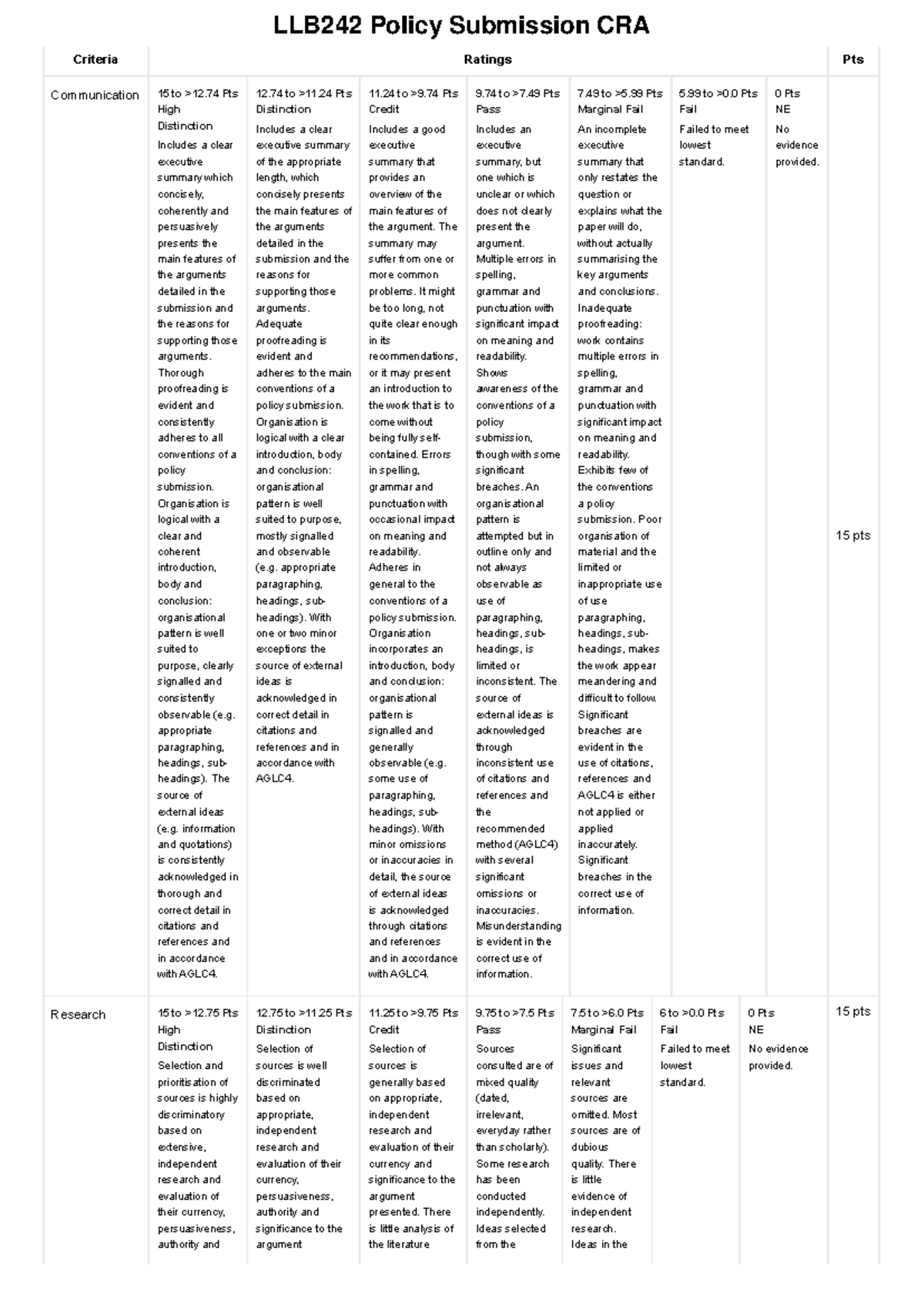
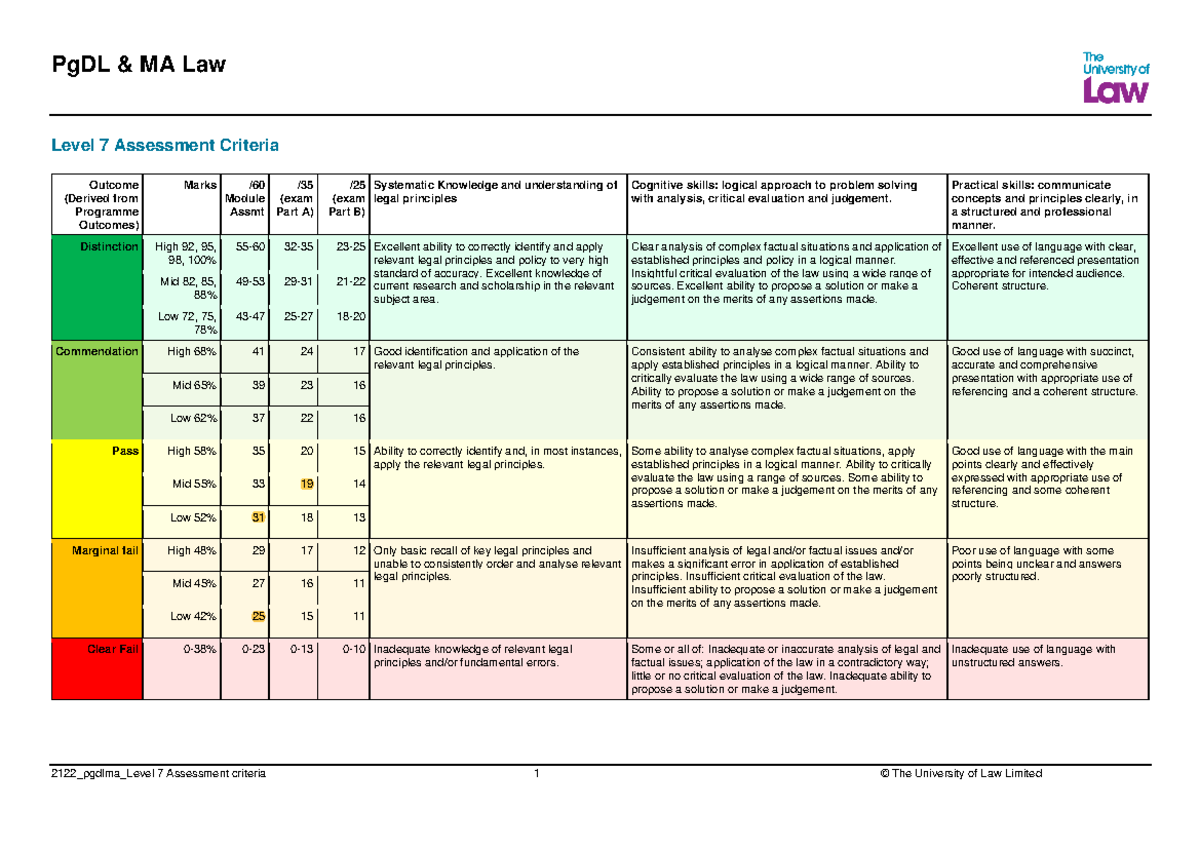
As you can see, the language for the higher bands uses words like "insightful," "excellent," "clear," and "persuasive." For the lower bands, you see "inadequate," "poor," and "unclear." While these words give a general sense of quality, they are not, by themselves, instructions. What does "insightful critical evaluation" actually look like in an answer? What does an "excellent and referenced presentation" contain?
This is where we move from a rubric (a tool for describing levels of quality) to a checklist (a tool for verifying the presence of specific features). A fantastic research paper on this process makes the distinction clear.
Co-constructing a rubric checklist with first year university ...
This paper explains the powerful difference between a rubric and a rubric checklist.
Please read the introduction to understand the core concept. Focus on the paragraph that begins, "A checklist is similar...". The authors state that a checklist lists the 'criteria or what counts' but doesn't describe the levels of quality, making it a separate but complementary tool.
Our goal is to take the high-distinction band of a rubric and break it down into a "what counts" checklist. This turns a vague target into a series of concrete, binary questions: "Did I do this? Yes/No."
3. The Translation Process: A Worked Example
Let's put this into practice. We will take a criterion from the first rubric image and translate the "High Distinction" descriptor into a checklist of observable features.
Criterion: Research (15 pts)
High Distinction (12.75 to 15 pts) Descriptor:
"Selection of sources is highly appropriate and based on extensive, independent research and evaluation of their currency, persuasiveness, authority and significance to the argument."
This is a dense sentence, but we can break it down into a series of actionable checklist items.
High Distinction "Research" Checklist:
- Extensive & Independent Research:
- Have I used sources beyond the ones explicitly provided in the module materials?
- Have I cited academic commentary (journal articles, textbook analysis) in addition to primary sources (cases, statutes)?
- Evaluation of Currency:
- Are my cases the most up-to-date and leading authorities on the point?
- If the law has recently changed, have I noted this and used the correct, current version of the statute/rule?
- Evaluation of Persuasiveness & Authority:
- For each legal point, have I cited the strongest available authority (e.g., a Supreme Court ruling over a High Court one; a binding precedent over a persuasive one)?
- Have I avoided citing a case for a general proposition when a more specific authority exists for the narrow point I'm making?
- Significance to the Argument:
- Does every single citation directly support the sentence it is attached to? (Self-edit: Could the marker ask "why is this case here?")
- Have I explained how the authority supports my point, rather than just "tacking on" a citation at the end of a sentence?
By creating this checklist before you write and using it to review your draft, you are reverse-engineering the marking process to your advantage.
4. Observing the Features in Practice
To see how this works, let's examine a resource that explicitly contrasts a "Pass" answer with a "High Distinction" answer. This will make the features on our checklist tangible.
[PDF] Law Student Survival Guide Step 6 Preparing for a Law exam
This guide provides an excellent comparison of different quality answers to the same problem.
Please read the section titled "What makes the difference..." (pages 147-150). As you read the "High Distinction answer," try to spot the features we just defined. For instance, notice how it doesn't just state "Phillip is a fiduciary." It considers the nuance: if he's a director, it's an established category; if he's a senior employee, it's less clear, and here is the authority for that situation (Consul Development). This demonstrates "evaluation of authority" and "significance to the argument" in action. Then, look at the "Problems with the Pass answer" and see how it maps directly to a failure to meet our checklist items.
The "Pass" answer makes conclusory statements. The "High Distinction" answer shows its work. It demonstrates why a conclusion is correct by breaking down the legal reasoning into steps and supporting each step with precise authority. This act of "showing your work" is perhaps the single most important observable feature of a top-tier answer.
A great micro-lesson on executing this "analytical move" comes from another video by the Learn Law Better channel. It introduces the simple but powerful technique of using the word "because" to force yourself to explain your reasoning.
How to Improve Your Exam Analysis
This video focuses on the core of legal analysis.
Watch from this segment on analysis. The presenter shows how to transform a weak, conclusory statement into a strong analytical paragraph by breaking down the elements and explaining why each is met, using the facts. This is what markers call "application" and it's a key competency.
Conclusion
In this lesson, we have demystified the marking process. You've learned that scoring in the 90%+ range is not about guesswork; it's a deliberate process of identifying and demonstrating the specific features of high-quality legal analysis.
Key Takeaways:
- Marking rubrics describe levels of quality using abstract language ("insightful," "persuasive").
- Your task is to translate the "High Distinction" band into a concrete checklist of observable, actionable features.
- This checklist should cover competencies like depth of research, precision of authority, nuance in legal argument, and explicit application of law to facts.
- A High Distinction answer shows its work, explaining the "why" behind every conclusion, whereas a Pass answer often states conclusions without sufficient justification.
You now possess the two foundational skills for top-tier performance: understanding what the question is asking (Lesson 1) and knowing the criteria by which your answer will be judged (Lesson 2).
In our next lesson, we will begin to apply these skills by looking at the specific structures required for different types of law assessments. We will distinguish the purpose and structure of a problem question answer, a short doctrinal answer, and a reflective answer, building a unique checklist for each.