Hello! Welcome back to our course on mastering FastAPI.
In our last lesson, we established a robust system for managing application settings and environment variables using Pydantic's BaseSettings. This gave us a secure and flexible way to configure our application for different environments. Now, we'll build upon our organized project structure by implementing a crucial architectural pattern.
This lesson addresses the learning outcome: Implement the repository pattern to decouple database logic from business logic.
This pattern is a cornerstone of modern, scalable application architecture. By learning to implement it, you'll create a clean separation between how your application talks to the database and what your application does with the data. This separation makes your code more testable, maintainable, and flexible.
Coming from Django, you're familiar with the ORM, which is itself a powerful abstraction over the database. The repository pattern takes this a step further. Instead of calling MyModel.objects.filter(...) directly within your business logic (which can lead to tangled code in complex apps), you'll create a dedicated layer that centralizes all data-access operations. This is a common practice in large Django projects too, and FastAPI's Dependency Injection system makes it particularly elegant to implement.
The Problem: Tightly Coupled Code
Imagine you're writing a path operation to create a new user. Without a clear separation of concerns, your route handler might look something like this:
@router.post("/users")
async def create_user(user: UserCreate, db: AsyncSession = Depends(get_db)):


    # 1. Check if user exists (Database logic)
    query = select(User).where(User.email == user.email)
    result = await db.execute(query)
    existing_user = result.scalars().first()
    if existing_user:
        raise HTTPException(status_code=400, detail="Email already registered.")


    # 2. Hash the password (Business logic)
    hashed_password = get_password_hash(user.password)


    # 3. Create the user object (Database logic)
    db_user = User(email=user.email, hashed_password=hashed_password)
    db.add(db_user)
    await db.commit()
    await db.refresh(db_user)

    return db_user
As the code from the "FastAPI: SOLID Principles and Design Patterns" article highlights, this endpoint mixes responsibilities: HTTP request/response handling, business validation, and direct database queries.
An endpoint with mixed responsibilities
This article provides a clear example of an endpoint with mixed responsibilities. Understanding this 'anti-pattern' is key to appreciating what the repository pattern solves.
Read the first code block and the analysis below it. Notice how data validation, business rules (checking for existing users), and direct database interaction are all mixed in one function.
This tight coupling makes the code difficult to test (you always need a database connection) and hard to maintain. If you change your database schema or switch ORMs, you'd have to hunt down and update every route that touches the database.
The Solution: The Repository Pattern
The repository pattern solves this by creating an abstraction layer that sits between your business logic and your data persistence mechanism (e.g., SQLAlchemy). It acts as an intermediary, exposing a simple, collection-like interface for accessing your data.
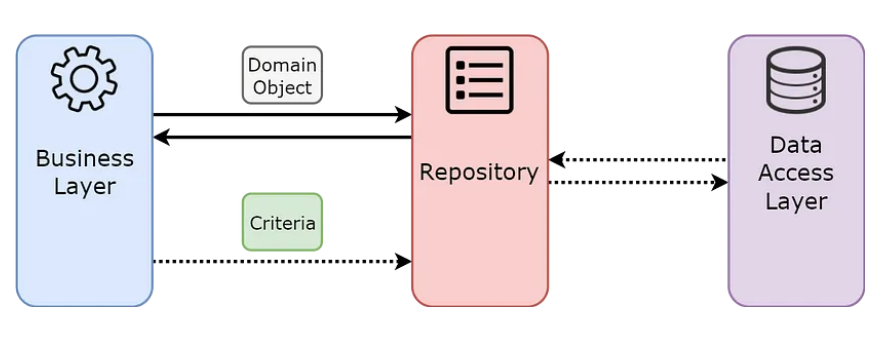
Your business logic will now ask the repository, "give me a user by this ID" or "save this new user," without needing to know anything about database sessions, SQL queries, or ORM objects.
Key benefits include:
- Decoupling: Your application's core logic is independent of the database technology.
- Testability: You can easily "mock" the repository in your tests with an in-memory version, making your tests faster and more reliable.
- Reusability: All queries related to a specific model are centralized in one place.
Building Your First Repository
Let's watch a video that provides an excellent, step-by-step guide to refactoring a tightly coupled API to use the repository pattern.
Using the Repository Pattern for better data access encapsulation (in Python)
This video from the 'microapis' channel is a practical guide to implementing the repository pattern in Python. It starts with a coupled codebase and systematically refactors it to be clean and testable.
Please watch from the beginning until 12:43. This covers the core implementation steps: 00:00 - 06:54: The introduction, explaining the 'why' behind the pattern and the problems with coupled code. 06:54 - 10:24: Creating the basic BookingsRepository class with placeholder methods (get, list, add, etc.) and making the database session a parameter. 10:24 - 12:43: Moving the actual database query logic from the API layer into the methods of the new repository class.
Let's summarize the key steps from the video with code.
Step 1: Define the Repository Class
First, you create a new file, for example, app/repositories/user_repository.py. This class will encapsulate all database operations for the User model. A crucial design choice is to pass the database session in the constructor. This is fundamental for dependency injection.
# app/repositories/user_repository.py

from sqlalchemy.ext.asyncio import AsyncSession
from sqlalchemy import select
from app.models.user import User  # Your SQLAlchemy model
from app.schemas.user import UserCreate # Your Pydantic schema

class UserRepository:
    def __init__(self, db: AsyncSession):
        self.db = db

    async def get_user_by_email(self, email: str) -> User | None:
        query = select(User).where(User.email == email)
        result = await self.db.execute(query)
        return result.scalars().first()

    async def create_user(self, user_data: UserCreate, hashed_password: str) -> User:
        db_user = User(email=user_data.email, hashed_password=hashed_password)
        self.db.add(db_user)
        await self.db.commit()
        await self.db.refresh(db_user)
        return db_user
Step 2: Refactor the Route to Use the Repository
Now, your create_user path operation becomes much cleaner. It no longer contains any direct database code. Instead, it delegates that responsibility to the repository.
To make this work, we use FastAPI's Depends to inject an instance of our UserRepository.
# app/routers/users.py

from fastapi import APIRouter, Depends, HTTPException
from sqlalchemy.ext.asyncio import AsyncSession
from app.dependencies import get_db, get_user_repository # We'll create get_user_repository next
from app.repositories.user_repository import UserRepository
from app.schemas.user import UserCreate, UserRead

router = APIRouter()

@router.post("/users", response_model=UserRead)
async def create_user(
    user: UserCreate,
    repo: UserRepository = Depends(get_user_repository)
):


    # Business logic now lives here or in a service layer
    db_user = await repo.get_user_by_email(email=user.email)
    if db_user:
        raise HTTPException(status_code=400, detail="Email already registered.")


    # Let's assume password hashing is handled in a service (next lesson!)
    # For now, we pass it to the repository
    hashed_password = "a_real_hashed_password" # Placeholder

    return await repo.create_user(user_data=user, hashed_password=hashed_password)
Step 3: Create the Dependency
In your app/dependencies.py file, you create a function that knows how to provide a UserRepository instance. This function itself depends on getting a database session.
# app/dependencies.py

from sqlalchemy.ext.asyncio import AsyncSession
from app.database import SessionLocal # Assuming you have this
from app.repositories.user_repository import UserRepository


# Dependency to get a DB session
async def get_db() -> AsyncGenerator[AsyncSession, None]:
    async with SessionLocal() as session:
        yield session


# Dependency to get the user repository
def get_user_repository(db: AsyncSession = Depends(get_db)) -> UserRepository:
    return UserRepository(db)
This chain of dependencies (get_user_repository depends on get_db) is managed automatically by FastAPI.
The Payoff: Clean, Isolated Testing
The true power of this pattern becomes evident when you write tests. You can now test your create_user endpoint without ever touching a real database.
The video you watched introduces the idea of using a "dummy" repository for testing. This is a crucial concept.
Using the Repository Pattern for better data access encapsulation (in Python)
Let's watch the final, and most important, part of the video. It demonstrates how the repository pattern enables isolated testing.
Watch from 26:35 to 33:21. Focus on: The creation of a dummy_bookings_repository that uses an in-memory list instead of a database. How the test setup injects this dummy repository instead of the real one. The result: tests that run instantly without needing a database connection.
To test our user creation endpoint, you would create an InMemoryUserRepository that mimics the real one but uses a simple dictionary.
# tests/repositories/in_memory_user_repo.py

class InMemoryUserRepository:
    def __init__(self):
        self._users = {}
        self._next_id = 1

    async def get_user_by_email(self, email: str):
        for user in self._users.values():
            if user.email == email:
                return user
        return None

    async def create_user(self, user_data, hashed_password):
        new_user_id = self._next_id
        new_user = User(id=new_user_id, email=user_data.email, hashed_password=hashed_password)
        self._users[new_user_id] = new_user
        self._next_id += 1
        return new_user


# In your test file (e.g., tests/test_users.py)
from app.main import app
from app.dependencies import get_user_repository
from fastapi.testclient import TestClient

client = TestClient(app)

def override_get_user_repository():
    return InMemoryUserRepository()


# Override the dependency for all tests in this module
app.dependency_overrides[get_user_repository] = override_get_user_repository

def test_create_user_success():
    response = client.post(
        "/users",
        json={"email": "test@example.com", "password": "password123"},
    )
    assert response.status_code == 200
    data = response.json()
    assert data["email"] == "test@example.com"
    assert "id" in data
This is FastAPI's dependency_overrides in action. It's a clean, powerful way to swap out dependencies for testing, and it's the direct result of structuring your application with patterns like the repository.
Connecting to Your Django Experience
This pattern brings the kind of structured data access that is often manually implemented in larger Django projects into a first-class, framework-supported pattern in FastAPI.
Django & FastAPI — Howto's and guidelines
This article is written specifically for developers moving from Django to FastAPI. It frames the repository and service patterns in a way that should feel familiar.
Read the sections 'Ideas around domain-driven design (DDD)' and 'Repositories'. Notice how it explicitly discusses moving away from the typical Django structure (models, views, serializers) towards a more layered approach using repositories to abstract the ORM.
Think of it this way:
- In a simple Django view, you might write
Book.objects.get(pk=book_id). - In a more complex application, to avoid repeating logic, you might create a
books/services.pyorbooks/queries.pyfile with a functionget_book(book_id). - The repository pattern formalizes this by creating a
BookRepositoryclass with aget(book_id)method, which is then injected as a dependency.
This formalization brings the significant benefits of explicit dependencies and easy testability that you've seen today.
Conclusion
You have now learned one of the most important patterns for building robust and scalable APIs. By isolating data access logic into a repository, you've made your application cleaner, more maintainable, and significantly easier to test.
Key Takeaways:
- The Repository Pattern's Purpose: To create an abstraction layer that decouples your business logic from the data persistence layer.
- Implementation: A repository is typically a class that takes a database session as a parameter and exposes methods for CRUD operations (e.g.,
get_by_id,create,list). - Integration with FastAPI: Use FastAPI's dependency injection system to provide repository instances to your path operations. This involves creating a dependency function that instantiates the repository with a database session.
- The Main Benefit is Testability: This pattern allows you to use
dependency_overridesto swap in a fake, in-memory repository during testing, enabling fast, isolated unit tests for your API endpoints.
Preview of the Next Lesson:
Our path operations are now much cleaner, but they still contain some business logic (like checking if a user exists). To achieve an even cleaner separation of concerns, we need another layer. In the next lesson, we will implement a service layer to encapsulate business logic, which will orchestrate calls between route handlers and the repositories we just built.