Introduction
In our last lesson, you successfully connected a .NET application to Azure Cache for Redis and mastered the fundamental get, set, and delete operations. You even saw a brief example of how these commands form the basis of a caching strategy.
Today, we will build directly on that foundation by formalizing the implementation of the cache-aside pattern. This is one of the most common and important caching strategies you'll encounter and a key topic for the AZ-204 exam. This lesson will guide you through structuring your application logic to load data into the cache on demand, a technique often called "lazy loading." We will examine C# implementations and discuss crucial real-world considerations to ensure your caching strategy is robust and effective.
What is the Cache-Aside Pattern?
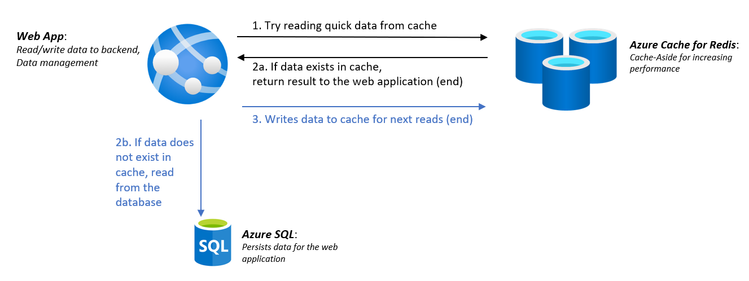
The cache-aside pattern is a strategy where your application code is responsible for managing the cache. When your application needs to read data, it first looks in the cache. If the data is found (a cache hit), it's returned immediately. If the data is not in the cache (a cache miss), the application reads the data from the primary data store (like a SQL database or Cosmos DB), adds it to the cache, and then returns it.
Let's begin by reviewing the official Microsoft documentation for a formal definition and a helpful diagram.
Cache-Aside Pattern - Azure Architecture Center
This article from the Azure Architecture Center provides a canonical description of the cache-aside pattern.
Read the "Context and problem" and "Solution" sections. Pay close attention to the flow diagram, as it clearly illustrates the three main steps of the read path: The application attempts to read from the cache. On a cache miss, it retrieves the item from the data store. The application adds the item to the cache before returning it.
The flow described in the article is a fundamental concept for building high-performance applications. The diagram below visualizes this interaction using common Azure services.
Implementing Cache-Aside in .NET
You've already seen the building blocks for this pattern. Now let's assemble them into a coherent implementation. Given your experience with C# and API development, we'll look at this from a practical, code-centric perspective.
The Basic Logic in an API Controller
In the previous lesson, you saw a video demonstrating the core logic. Let's revisit the specific segment where the cache-aside pattern is implemented within an API endpoint. This will serve as a practical refresher.
How Azure Redis Cache can make your .NET 7 API Super Fast!
This video by Israel Quiroz provides a clear, hands-on demonstration of implementing the cache-aside pattern inside a .NET API controller.
Watch the segment from implementing the pattern. Notice the clear logical flow in the get teams endpoint: It calls _redisCache.GetCacheData. It checks if the returned data is null. If it's null (a cache miss), it retrieves data from the repository. Crucially, it then calls _redisCache.SetCacheData to populate the cache before returning the data. If the data was not null (a cache hit), it returns the cached data immediately, skipping the database call entirely.
A Code-Based View and Handling Updates
To complement the video, let's examine a code sample from the official Microsoft documentation. This example uses the StackExchange.Redis library directly and also introduces a critical aspect of the pattern: cache invalidation.
When data is modified in the primary data store, the corresponding entry in the cache becomes stale. To maintain data consistency, you must remove the stale item from the cache. This forces the next read operation to fetch the fresh data from the data store and repopulate the cache.
Cache-Aside Pattern - Azure Architecture Center
This section of the Microsoft documentation provides a C# example using StackExchange.Redis.
Review the two methods in the code block: GetMyEntityAsync: This method perfectly implements the read-through logic of the cache-aside pattern, just like in the video. It checks for the item using StringGetAsync and, on a miss, fetches it and adds it back using StringSetAsync. Note the use of KeyExpireAsync to set an expiration time. UpdateEntityAsync: This method demonstrates cache invalidation. After updating the data store, it explicitly removes the item from the cache using KeyDeleteAsync.
Refactoring into a Reusable Pattern
As a senior software engineer, you know that repeating the same if/else caching logic in every data-retrieval method can lead to code duplication and maintenance issues. A much cleaner approach is to encapsulate this logic into a reusable component.
The following video demonstrates how to refactor the cache-aside logic into a generic extension method. This is an excellent practice for production code.
A Step-by-Step Guide for the Cache-Aside Pattern + Stampede Protection
This video from Milan Jovanović focuses on clean implementation and introduces an advanced, reusable approach to the cache-aside pattern.
Watch the segment from creating an extension method. The presenter creates a generic GetOrCreateAsync extension method for the IDistributedCache interface. This method accepts a cache key and a "factory" function that it will only execute on a cache miss. This abstracts away the cache-aside boilerplate code, making your API endpoints much cleaner.
Important Considerations
Implementing the cache-aside pattern involves more than just writing the core logic. You need to consider several factors to ensure it behaves correctly and efficiently in a production environment.
Data Lifetime and Expiration
Setting an expiration time (Time-To-Live or TTL) on your cached items is critical. It acts as a safety net against stale data. If your cache invalidation logic fails for any reason, the data will eventually be purged automatically.
The key is finding the right balance:
- Too short: The cache expires too quickly, leading to frequent cache misses and reducing the performance benefit.
- Too long: The risk of serving stale data increases.
The optimal expiration time depends entirely on how volatile your data is and your application's tolerance for staleness. This is a configurable trade-off you must make.
The "Cache Stampede" Problem
Consider what happens when a popular, cached item expires. If multiple users request that item at the exact same moment, they will all experience a cache miss simultaneously. All of these concurrent requests will then hit your database at the same time, potentially overwhelming it. This is known as a cache stampede or "thundering herd" problem.
A common solution is to use a locking mechanism to ensure that only the first request goes to the database to refresh the cache, while subsequent requests wait briefly for the cache to be repopulated.
The same video from Milan Jovanović provides an excellent overview of this problem and a practical solution using SemaphoreSlim in .NET.
A Step-by-Step Guide for the Cache-Aside Pattern + Stampede Protection
This segment discusses a common concurrency issue with caching and how to solve it.
Watch the part of the video covering cache stampede protection. The presenter explains the race condition and then implements a locking mechanism to mitigate it. While the specific implementation might be more advanced than required for the exam, understanding the problem is valuable for designing robust systems.
When to Use This Pattern
The cache-aside pattern is highly effective, but it's not a universal solution. According to the Microsoft documentation, it's best suited for scenarios with:
- Unpredictable resource demand: Since data is loaded on demand, you don't need to guess what data to pre-load into the cache.
- Read-heavy workloads: The pattern excels when data is read frequently but modified infrequently.
Conversely, it may not be suitable if:
- The dataset is static and small enough to fit entirely in the cache: In this case, it's better to "prime" the cache by loading all the data at application startup.
- The data is highly sensitive: Caching may introduce security risks that are unacceptable for certain types of data.
Conclusion
In this lesson, you've moved from basic cache operations to implementing a complete, robust caching strategy. You now understand the logic, implementation, and critical considerations of the cache-aside pattern.
Here are the key takeaways:
- The cache-aside pattern is a "lazy loading" caching strategy where the application logic explicitly manages reading from the data store and populating the cache.
- The core read logic is: check the cache, and on a miss, retrieve from the source, write to the cache, and then return.
- Cache invalidation is crucial for data consistency: when data is updated in the source, the corresponding cache entry must be deleted.
- For clean and maintainable code, encapsulate the cache-aside logic in a reusable service or extension method.
- In production, you must consider data expiration policies and concurrency issues like cache stampede.
In our next lesson, we will focus specifically on configuring data expiration policies in Azure Cache for Redis. You'll learn how to set different types of expirations programmatically to fine-tune the balance between performance and data freshness in your applications.