Welcome back. The last lesson separated a court’s authority over a kind of claim from its authority over a defendant and the question of venue. This lesson focuses on the first of those checks. You will learn two principal reasons a civil claim may qualify for federal subject-matter jurisdiction—a federal question or diversity of citizenship—and why qualifying for federal court does not necessarily rule out state court. Allow about 35–40 minutes for the lesson, video, and readings.
When the claim arises under federal law
Federal courts cannot hear a civil case merely because a plaintiff prefers them. One principal route into federal court is federal-question jurisdiction: the claim arises under the U.S. Constitution, a federal statute, or a treaty. For a straightforward example, imagine a federal statute that gives a person the right to sue an employer for a specified unlawful practice. A complaint asserting that statutory right presents a federal question.
Read the federal-courts guide’s short account of limited jurisdiction before considering the second route.
[PDF] Understanding the Federal Courts
Read this guide from the U.S. Courts to see why a federal claim can supply jurisdiction without a minimum dollar amount.
On printed page 7, in the discussion of federal courts’ limited jurisdiction, begin just after the paragraph explaining when a case is moot. Read the jurisdiction discussion, stopping after the examples of federal-question cases. Focus on the source of the claim, rather than the amount of money requested.
The distinction is between a claim based on federal law and a state-law claim with some federal detail in its story. A buyer’s ordinary breach-of-contract claim does not become a federal-question case simply because the contract mentions a federal regulation. Nor does a defendant’s plan to raise a federal-law defense ordinarily create federal-question jurisdiction. In the usual case, the federal basis must appear in the plaintiff’s properly pleaded claim.
Unlike diversity jurisdiction, federal-question jurisdiction has no general 75,000-dollar amount requirement. A qualifying federal claim seeking a modest sum can therefore be heard in federal court, assuming other applicable requirements are met. This does not mean the plaintiff has proved the alleged violation; jurisdiction determines whether the court may hear the claim, not who wins.
When citizenship and the amount permit federal court
The other principal route, diversity jurisdiction, allows federal courts to hear many claims based on state law. Here the starting point is not whether the claim invokes a federal statute. It is the citizenship of the parties and the amount in controversy.
Watch What Is Diversity Jurisdiction? from USLawEssentials for the two-part test. The video uses “where parties live” as shorthand; the more precise test for an individual is domicile, generally their established home.
What is Diversity Jurisdiction?
Watch USLawEssentials’ “What Is Diversity Jurisdiction?” for an introduction to citizenship and the amount requirement.
In party citizenship, notice that a corporation can be a citizen of two states. Continue through the example and the explanation of the amount in controversy. Keep both requirements in view; different-state citizenship alone is not enough.
For an ordinary diversity case, complete diversity means that no plaintiff shares state citizenship with any defendant. It is not enough that some opposing parties come from different states. An individual’s citizenship is generally determined by domicile, not simply by where that person happens to be staying. A corporation is a citizen of both its state of incorporation and the state of its principal place of business.
The amount in controversy must exceed 75,000 dollars. Exactly 75,000 dollars does not suffice. The amount is generally assessed from the claim at filing, subject to legal limits; it is not a requirement that the plaintiff ultimately recover more than 75,000 dollars.
Cornell Law School’s Diversity Jurisdiction states the complete-diversity rule precisely and explains why a qualifying state-law dispute need not be filed in federal court.
diversity jurisdiction | Wex | US Law | LII / Legal Information Institute
Read Cornell Law School’s definition for the precise citizenship test, then its explanation of the state-court option.
In the “diversity jurisdiction” entry, read from its opening definition through the paragraph on corporate citizenship: the basic test. Stop before the class-action paragraph, which describes a special rule. Then read the later paragraph beginning “Because diversity jurisdiction is a form of concurrent jurisdiction”: the court choice. Stop before the discussion of the Erie doctrine.
Consider an ordinary state-law contract claim against one defendant. If the plaintiff is a citizen of State A, the defendant is a citizen of State B, and the amount in controversy is 80,000 dollars, diversity could provide federal subject-matter jurisdiction. Change the amount to 600 dollars and it cannot provide that jurisdiction. Change the defendant’s citizenship to State A and it cannot provide it either, even at 80,000 dollars.
These are tests for whether federal court is available, not tests for whether the contract was breached.
Federal eligibility does not always mean federal exclusivity
State courts handle most ordinary contract and personal-injury disputes, including many that also meet the federal diversity test. This is called concurrent jurisdiction: more than one court system has authority over the kind of case. A plaintiff with a qualifying diversity claim can generally choose to file it in state court instead. In some circumstances a defendant may then seek to move the case to federal court by removal, which has additional rules beyond this lesson’s jurisdiction test.
Many federal-law civil claims can also be heard in state court. Federal question does not automatically mean federal court only. Some categories are assigned exclusively to federal courts, so the particular claim matters. A state court hearing a federal-law claim applies the relevant federal law; a federal court hearing a diversity case can decide a state-law claim. The courthouse system and the law supplying the claim are related, but they are not identical.
For a sense of the state courts’ broad role, return briefly to the federal-courts guide.
[PDF] Understanding the Federal Courts
Read the guide’s contrast between federal and state courts to place these jurisdiction tests in the wider civil-court system.
On printed page 7, after the discussion of bankruptcy, begin at “Although federal courts are located in every state.” Read the state-court contrast, ending with the list of cases state courts commonly handle.
The guide says that claims below the diversity amount must be pursued in state court. Read that statement in its diversity context: a smaller claim might still have an independent federal-question basis. Likewise, saying a claim can be heard in state court does not identify the correct state, county, or division. Personal jurisdiction and venue remain separate checks from the previous lesson.
Applying the two tests without confusing them
The supplied “6 Steps to Choosing the Right Court” graphic offers a quick visual starting point for thinking about federal and state courts.
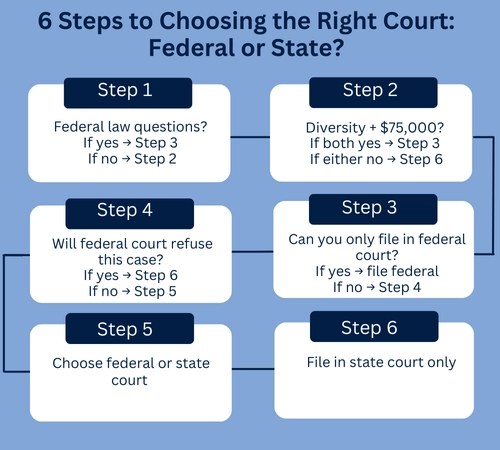
Use the graphic cautiously. Its “Diversity + $75,000?” box should say complete diversity and an amount exceeding 75,000 dollars. Its federal-law box requires a claim that arises under federal law, not merely any mention of federal law. And a path to federal court does not necessarily exclude state court.
For a simple claim, a reliable screening sequence is:
- Identify the claim’s legal basis. If the plaintiff’s claim arises under federal law, federal-question jurisdiction may be available regardless of the amount sought.
- If needed, test diversity independently. Check every plaintiff’s citizenship against every defendant’s, then check whether the amount in controversy exceeds 75,000 dollars. An ordinary state-law claim can qualify this way.
- Consider state court too. An ordinary state-law claim can generally be heard in an appropriate state court even if diversity also makes federal court available. Many federal-law claims can also be heard there, unless jurisdiction is exclusive to federal court.
Return to the 600-dollar table dispute from the previous lesson. On the facts given, it is an ordinary state-law contract claim. If buyer and seller are citizens of the same state, neither route supplies federal jurisdiction. If they are citizens of different states, diversity still fails because 600 dollars does not exceed the threshold. An appropriate state court remains the ordinary forum. None of those conclusions establishes whether the table was delivered.
Conclusion
Federal question asks whether the plaintiff’s claim arises under federal law; it has no general diversity-style dollar threshold. Diversity can bring an ordinary state-law claim into federal court when opposing sides are completely diverse in citizenship and the amount in controversy exceeds 75,000 dollars. In either situation, federal eligibility does not automatically make state court unavailable, and subject-matter jurisdiction does not settle personal jurisdiction, venue, or the merits.
Next, you will follow a claim into court: how filing a complaint and serving the defendant formally begin an ordinary civil lawsuit.