Hello. In the previous lesson, the buyer’s statement that a table was never delivered was an allegation, not a finding. Before a court can decide whether that allegation is supported, there is a separate issue: which court may hear the case? This lesson separates three checks that legal news often compresses into the phrase “the case was filed in court”: subject-matter jurisdiction, personal jurisdiction, and venue. Allow about 35–40 minutes, including the video and readings.
Three checks, not one
A plaintiff generally chooses where to file a lawsuit, but that choice does not give the chosen court every authority it needs. The three checks concern different aspects of the proposed court:
| Check | What it tests |
|---|---|
| Subject-matter jurisdiction | May this court hear this kind of claim? |
| Personal jurisdiction | May this court exercise authority over this defendant? |
| Venue | Is this geographic place a proper location for the case? |
Start with the broad distinction in Studicata’s Civil Procedure: Introduction to Jurisdiction and Venue. The video treats jurisdiction as a question of authority and venue as a question of geographic placement.
Civil Procedure: Introduction to Jurisdiction and Venue
Watch the opening of Studicata’s “Civil Procedure: Introduction to Jurisdiction and Venue” for a framework that keeps court authority separate from location.
Watch jurisdiction and venue from the opening through the explanation of federal judicial districts. Then watch case categories, where the speaker contrasts the kinds of cases state and federal courts can generally hear. Stop when the discussion turns to particular federal claims; the next lesson will examine those rules.
The useful distinction is authority versus location. Subject-matter and personal jurisdiction are both about a court’s power, though they test different things. Venue instead addresses the proper place within a court system for litigation. A court can have authority over the claim and defendant while the plaintiff has still chosen the wrong county or federal judicial district.
Subject-matter jurisdiction: the kind of case
Return to the $600 table dispute. Assume the buyer alleges an ordinary breach of contract. A state court with broad civil authority can generally hear that kind of claim. A specialized court may have narrower authority: a small-claims court, for example, can hear only cases within its state’s applicable limits.
Federal courts are different. They have limited subject-matter jurisdiction: there must be a legal basis for a federal court to hear the claim. The two main bases you will study next are a claim arising under federal law (federal-question jurisdiction) and a qualifying dispute between citizens of different states (diversity jurisdiction). An ordinary $600 state-law contract claim between people from the same state does not become a federal case simply because the plaintiff prefers a federal courthouse. Conversely, a claim’s small dollar value does not, by itself, rule out federal-question jurisdiction.
Read Cornell Law School’s Subject Matter Jurisdiction for the definition and the state–federal contrast.
subject matter jurisdiction | Wex | US Law | LII / Legal Information Institute
Read Cornell Law School’s explanation to identify what subject-matter jurisdiction authorizes and why a state court’s broad authority differs from a federal court’s limited authority.
At the top of “Subject Matter Jurisdiction,” read from the definition and comparison, including the subsection “Personal Jurisdiction and Subject Matter Jurisdiction.” Then read from the paragraph beginning “While litigating parties may waive personal jurisdiction” through the end of “Limited Jurisdiction and General Jurisdiction,” ending with the state-court examples. Focus on the difference between a court’s authority over a category of claim and its authority over a party; leave the detailed federal-court grounds for the next lesson.
One consequence matters even before trial: the parties cannot create subject-matter jurisdiction by agreement. If a court lacks authority to hear that category of case, both sides’ willingness to proceed there does not supply it. Courts may raise the issue themselves. That differs from personal jurisdiction, to which a defendant can generally consent or whose objection the defendant can forfeit by failing to raise it properly.
“General jurisdiction” can cause confusion here because lawyers use it in two different discussions. A state court of general subject-matter jurisdiction can hear a broad range of claims. General personal jurisdiction, discussed below, concerns a court’s authority over a particular defendant even when the claim is unrelated to the forum. The shared word general does not make these the same rule.
Personal jurisdiction: the connection to the defendant
Suppose a buyer lives in State B and wants to sue the seller there. Even if a State B court can hear contract claims, it does not necessarily have authority over this seller. Personal jurisdiction tests the court’s authority over the defendant, not whether the plaintiff has a plausible complaint or lives nearby.
Watch the later portion of the same video. Its car-accident example shows why a plaintiff’s connection to a state does not automatically establish a defendant’s connection to it.
Civil Procedure: Introduction to Jurisdiction and Venue
Return to “Civil Procedure: Introduction to Jurisdiction and Venue” for its explanation of why the defendant’s ties to a state matter.
Watch defendant connections, beginning where the speaker introduces personal jurisdiction and continuing through the discussion of contacts with the forum state. Focus on the distinction between where a plaintiff wants to sue and where the defendant can fairly be required to answer the suit.
Two forms of personal jurisdiction help organize the issue:
- General personal jurisdiction ordinarily permits claims against an individual in the state where that person is domiciled—roughly, the person’s established home. A corporation is ordinarily subject to general jurisdiction where it is incorporated and where it has its principal place of business. The particular lawsuit need not arise from activity there.
- Specific personal jurisdiction is tied to the particular claim. It may exist when the defendant deliberately establishes relevant contacts with the forum state and the claim arises out of or relates to those contacts, subject to the applicable law and due-process limits.
For the table dispute, imagine that the seller lives in State A but deliberately sells and ships the table to a buyer in State B. A claim that the seller failed to deliver it there has a connection to the seller’s State B dealings; specific personal jurisdiction may be available in State B. Change just one fact: the transaction and alleged non-delivery occurred entirely in State A, and the buyer later moved to State B. The buyer’s move alone ordinarily does not establish the seller’s contacts with State B.
The supplied diagram is a useful vocabulary map, but it simplifies some rules.
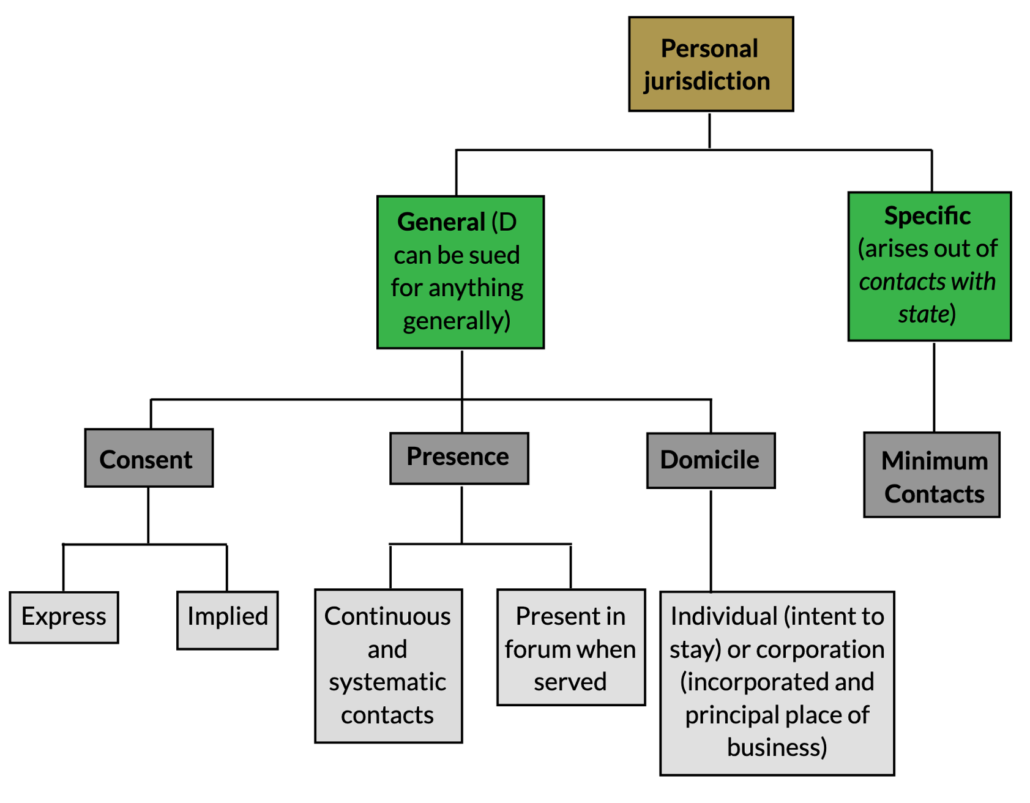
In particular, doing regular business somewhere does not automatically make a corporation subject to general jurisdiction there for every claim. The ordinary general-jurisdiction locations are its state of incorporation and principal place of business. Consent and service on an individual while present in a state can also matter, but they are distinct grounds with their own rules. For this lesson, the central distinction is between authority based on the defendant’s strong, general connection to a forum and authority tied to the defendant’s contacts relevant to this lawsuit.
Venue: the proper geographic place
Once a court system has authority over the type of case and the defendant, the plaintiff still has to consider venue. In a state-court system, venue commonly concerns the proper county; in federal court, it commonly concerns the proper judicial district. Rules vary, but frequently relevant places include where the defendant resides and where a substantial part of the events occurred. More than one location can be proper.
The California Courts’ Jurisdiction and Venue: Where to File a Case presents those distinctions from one state court system’s perspective. Its county examples illustrate the idea; they are not a universal venue rule for every state.
Jurisdiction and Venue: Where to file a case | California Courts | Self Help Guide
Read the California Courts Self-Help Guide to see how court authority and geographic filing rules are treated as separate decisions.
In “Jurisdiction,” read from the opening explanation. Then go to “Venue” and read from the venue explanation and example, stopping after the example involving several possible counties. Focus on why different counties might be proper, rather than memorizing their names.
Venue is not another name for subject-matter jurisdiction. A court may be authorized to decide contract claims and have authority over the seller, yet the chosen county may not satisfy the applicable venue rule. Nor does choosing a proper county, by itself, establish personal jurisdiction. Venue objections can generally be forfeited if not raised at the required time; the response to an improper venue may include moving the case rather than deciding who wins the underlying dispute.
Putting the checks together
Place the original table dispute entirely in State A. Assume the seller lives in County East, the disputed delivery was to County West, and State A’s venue rule permits filing either where the defendant resides or where a substantial part of the events occurred. The buyer is considering a State A court in County West.
First, an ordinary state court with authority over civil contract claims generally has subject-matter jurisdiction over this kind of dispute. The precise choice between a small-claims division and another civil court depends on that state’s rules.
Second, because the seller is domiciled in State A, a State A court ordinarily has personal jurisdiction over the seller. That conclusion concerns the defendant’s connection to the state, not the buyer’s evidence of non-delivery.
Third, County West is a potentially proper venue under our assumed rule because the disputed delivery occurred there. County East might also be proper because the seller lives there. The possibility of two proper counties is not a contradiction: venue rules need not identify only one location.
Now imagine the buyer files the same $600 state-law contract claim in federal court instead. The seller’s connection to State A and the choice of a sensible district do not answer the new subject-matter jurisdiction problem. Each check must be satisfied on its own terms. Equally, a proper court location says nothing about whether the table was delivered: these are questions about where the allegation may be adjudicated, not findings about whether it is true.
Conclusion
When evaluating a proposed court, keep three separate questions in view: the court’s authority over the kind of claim (subject-matter jurisdiction), its authority over the defendant (personal jurisdiction), and the proper geographic place for the lawsuit (venue). A plausible answer to one does not substitute for the others, and none proves the plaintiff’s allegations.
Next, you will examine the two principal routes by which a civil claim may qualify for federal subject-matter jurisdiction—federal question and diversity—while keeping in mind that state courts may also be available.