Hello again! Now that we have a solid project foundation with CMake, we can shift our focus from the build system to the C++ code itself. Your goal of building a high-performance whiteboard application demands not only speed but also robustness. In C++, one of the most critical aspects of achieving both is effective memory management.
This lesson tackles a cornerstone of modern C++: replacing manual memory management with smart pointers. We will explore std::unique_ptr and std::shared_ptr, two powerful tools that automate resource cleanup, prevent common bugs like memory leaks, and make your code safer and easier to reason about. For someone with your interest in systems programming and performance, we'll go beyond just the "what" and "how," and dig into the "why"—including the performance implications of each choice.
The Problem with Manual Memory Management
As someone with a background in computer science, you're undoubtedly familiar with allocating memory on the heap using new and deallocating it with delete. While this gives you direct control, it's notoriously error-prone. A forgotten delete leads to a memory leak. Deleting the same pointer twice leads to undefined behavior and likely a crash. Handling this correctly in the presence of exceptions is even harder.
This video gives a perfect illustration of how quickly things can go wrong with manual memory management.
unique_ptr: C++'s simplest smart pointer
The mCoding channel provides excellent, in-depth C++ tutorials. This segment sets the stage perfectly by demonstrating the common pitfalls of using raw pointers in a practical scenario.
Watch the beginning of the video, from the introduction of smart pointers to the detailed breakdown of potential bugs. Pay attention to how easily memory leaks and double-deletion errors can occur in what seems like straightforward code.
The fundamental problem is that ownership is not explicit. Who is responsible for calling delete? When? Smart pointers solve this by codifying ownership rules directly in the type system, using a core C++ principle called RAII.
RAII: The Foundation of Smart Pointers
RAII stands for Resource Acquisition Is Initialization. It's a fundamental C++ idiom that binds the lifetime of a resource (like heap-allocated memory, a file handle, or a network socket) to the lifetime of an object.
- Acquisition: You acquire the resource in the object's constructor.
- Use: You use the resource via the object's methods.
- Release: The resource is automatically released in the object's destructor when it goes out of scope.
This guarantees that the resource is cleaned up, no matter how the function exits—whether by a normal return, a break, or an exception being thrown. Smart pointers are the standard library's primary implementation of RAII for memory management.
This PDF provides a concise and clear explanation of the philosophy behind smart pointers.
Read Chapter 1, which covers the dangers of raw pointers and then introduces the RAII model as the solution. This formalizes the concepts we've just discussed.
std::unique_ptr: Exclusive Ownership and Zero-Cost Abstraction
The simplest and most common smart pointer is std::unique_ptr. It models exclusive ownership: only one unique_ptr can own a resource at any given time.
Key characteristics of std::unique_ptr:
- No Copying: You cannot copy a
unique_ptr. This is enforced at compile time and prevents you from accidentally creating two owners for the same resource. - Moving: You can transfer ownership from one
unique_ptrto another usingstd::move. The original pointer becomes null. - Performance: A
std::unique_ptris, by default, the exact same size as a raw pointer and has no performance overhead. It is a true zero-cost abstraction.
The "magic" behind unique_ptr is surprisingly simple. The best way to understand it is to see how you could implement it yourself.
unique_ptr: C++'s simplest smart pointer
This is the core of the mCoding video. It first refactors the raw pointer example to use std::unique_ptr and then, most importantly, builds a simplified unique_ptr from scratch. For someone interested in systems programming, this demystification is invaluable.
First, watch how the problematic code is cleaned up using std::unique_ptr from this section. Next, and most importantly, watch the implementation of a custom unique pointer from this key segment. This will show you that there's no hidden complexity: it's just a wrapper class with a raw pointer member, a destructor that calls delete, deleted copy operations, and move operations that transfer the pointer. Finally, see how the convenience operators are implemented from this part to make it behave just like a raw pointer.
As the video demonstrates, std::unique_ptr is fundamentally a lightweight wrapper. Its destructor automatically calls delete on the wrapped pointer. Because its copy constructor and copy assignment operator are deleted, the compiler forces you to be explicit about ownership transfer via move semantics.
The preferred way to create a unique_ptr is with std::make_unique (available since C++14):
// Instead of: MyClass* ptr = new MyClass(arg1, arg2);
// And then wrapping it...

// Do this:
auto my_object_ptr = std::make_unique<MyClass>(arg1, arg2);

// You can use it like a raw pointer
my_object_ptr->doSomething();
Using std::make_unique is cleaner and provides better exception safety in complex expressions.
std::shared_ptr: When Ownership Must Be Shared
Sometimes, a single object needs to be kept alive by multiple, non-hierarchical owners. For example, in your whiteboard app, multiple UI elements might need to reference a shared resource like a font or a texture. When the last reference is gone, the resource should be freed. This is the job of std::shared_ptr.
std::shared_ptr implements shared ownership via reference counting. Internally, in addition to the pointer to the managed object, it also points to a separate control block on the heap.
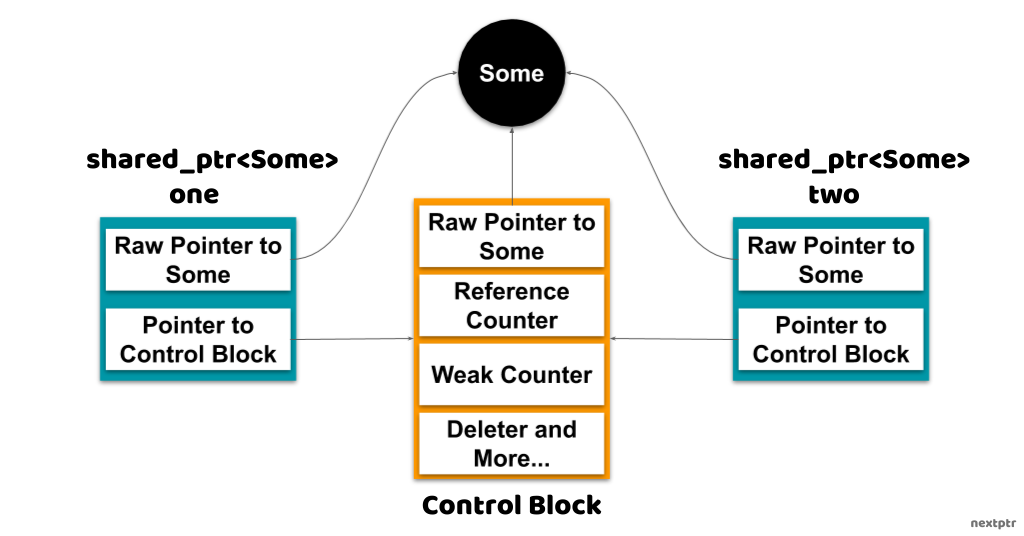
The control block contains:
- A strong reference count: The number of
shared_ptrs owning the object. - A weak reference count: For a related pointer,
std::weak_ptr, used to break ownership cycles (a more advanced topic). - A pointer to the managed object itself.
- Optionally, a custom deleter.
When a shared_ptr is copied, the reference count is atomically incremented. When a shared_ptr is destroyed or reset, the count is decremented. When the count reaches zero, the managed object is deleted.
This mechanism provides great flexibility but comes at a cost, which is critical to understand for performance-sensitive applications.
Memory and Performance Overhead of Smart Pointers
This article from the "Modernes C++" blog directly addresses the performance questions that are crucial for your project goals. It provides concrete numbers.
Read the entire article. Pay close attention to the sections on memory overhead of unique_ptr and shared_ptr. Then, examine the test setup and results, which benchmark raw pointers against different smart pointer creation methods. The final conclusion is powerful.
As the article highlights, the costs of std::shared_ptr are:
- Memory Overhead: A
shared_ptris twice the size of a raw pointer (one pointer to the object, one to the control block). - Allocation Overhead: Creating a
shared_ptrwithnew(e.g.,std::shared_ptr<T>(new T)) requires two heap allocations: one for the objectTand another for the control block. This is less efficient. - Runtime Overhead: Incrementing and decrementing the reference count must be atomic operations to be thread-safe. Atomic operations are more expensive than simple integer increments, introducing a small but non-zero runtime cost every time a
shared_ptris copied or destroyed.
To mitigate the allocation overhead, you should always prefer std::make_shared:
// Avoid: two heap allocations
std::shared_ptr<MyClass> ptr1(new MyClass());

// Prefer: one heap allocation for both object and control block
auto ptr2 = std::make_shared<MyClass>();
std::make_shared performs a single, larger allocation to hold both the object and the control block contiguously in memory, which is significantly more efficient.
Golden Rules for Using Smart Pointers
Given the trade-offs, how should you use smart pointers in practice?
This PDF provides excellent practical guidance that will form the basis of your day-to-day C++ development.
Please read the following sections: Chapter 7, "Practical Coding Techniques," especially the part on passing smart pointers. This is a critical concept for performance. Chapter 9, "Patterns, Anti-Patterns, and Best Practices," focusing on the Golden Rules. Finally, review the first case study in Chapter 10, as it's directly applicable to the kind of graphics programming you'll be doing.
Here's a summary of the most important rules:
- Use smart pointers to represent ownership. This is their purpose.
- Prefer
std::unique_ptrby default. It's the most lightweight and efficient option. Only usestd::shared_ptrwhen you have a clear need for shared, non-hierarchical ownership. - Always use
std::make_uniqueandstd::make_sharedto create smart pointers. - When passing to functions, think about the function's intent:
- Does the function need to take ownership? Pass a
unique_ptrby value:void take(std::unique_ptr<T> p);. - Does the function need to share ownership? Pass a
shared_ptrby value orconst&:void share(std::shared_ptr<T> p);. - Does the function only need to use the object without affecting its lifetime? Pass a raw pointer (
T*) or a reference (T&orconst T&). This is the most common and performant case. Do not pass a smart pointer if you are not manipulating ownership.
- Does the function need to take ownership? Pass a
Conclusion
You've now covered one of the most significant features of modern C++. By embracing smart pointers, you eliminate an entire class of common memory management bugs, making your code safer, more expressive, and easier to maintain. Your understanding of their internal workings and performance characteristics will be a distinct advantage as you build your high-performance whiteboard application.
Key Takeaways:
- RAII is the guiding principle: resource lifetime is tied to object scope.
std::unique_ptrrepresents exclusive ownership. It's a zero-cost abstraction and should be your default choice for managing dynamic memory.std::shared_ptrrepresents shared ownership through atomic reference counting. It's powerful but has memory and performance costs that you must be aware of.- Always use
std::make_uniqueandstd::make_sharedfor creation. - Pass smart pointers to functions only when you need to manipulate ownership. For non-owning access, use raw pointers or references.
In our next lesson, we will broaden our understanding of RAII. We've seen how it applies to memory with smart pointers, but its true power lies in managing all kinds of resources—files, threads, locks, and more. We will explore how to implement the RAII idiom in your own classes to create truly robust and exception-safe components.