Welcome to your first lesson. This course is designed to quickly advance your command of English perfect tenses, focusing on their use in professional IT contexts. We'll start by establishing the fundamental building block for all the tenses you need to master.
Today's lesson addresses a single, crucial concept: the core structure shared by all perfect tenses. By the end of our session, you will be able to recognize this pattern instantly, which will provide a solid foundation for constructing the more complex sentences outlined in your goal, such as those involving the Past Perfect and Present Perfect Continuous.
The Anatomy of Perfect Tenses
At their core, all perfect tenses—whether present, past, or future—are compound verb forms. They are always constructed from two essential components:
- An auxiliary verb, which is a form of
to have(specificallyhave,has, orhad). - The past participle of the main verb.
The formula is always: form of 'to have' + past participle
Let's look at the simplest version, the Present Perfect, which you're already familiar with. This structure is clearly laid out in the following chart.
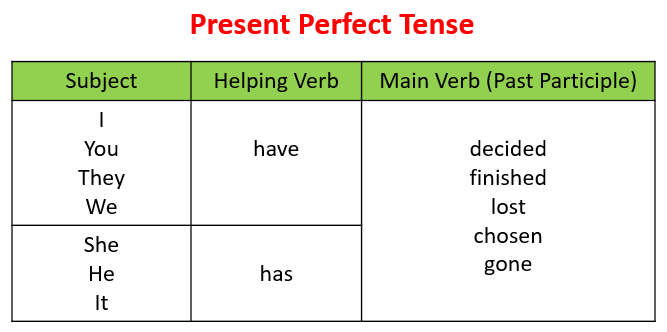
This table illustrates the core structure of the Present Perfect tense: a subject, followed by the auxiliary verb 'have' or 'has', and then the main verb in its past participle form.
As you can see, the choice between have and has depends on the subject. We can adapt the verbs in the chart to an IT context:
- I / you / we / they have deployed the new build.
- She / he / it has completed the data migration.
This two-part structure is the key identifier of a perfect tense.
Past Participle vs. Simple Past
You might notice that for regular verbs like decide or finish, the past participle (decided, finished) looks identical to the Simple Past form. So, what's the difference? The crucial distinction is that a past participle cannot function as the main verb of a sentence on its own; it requires an auxiliary verb.
The following short video provides a clear explanation of this concept.
Past Tense Verbs VS Past Participles | EasyTeaching
This video from EasyTeaching clearly distinguishes between past tense verbs and past participles, which is essential for understanding the structure of perfect tenses.
Please watch the section from the explanation of how past participles require an auxiliary verb. Then, continue watching from the discussion on irregular verbs, where the difference between the simple past and past participle forms becomes visually obvious.
To summarize the video's main point with an IT example:
- Simple Past: She wrote the deployment script. (The verb
wrotestands alone.) - Present Perfect: She has written the deployment script. (The past participle
writtenrequires the auxiliaryhas.)
Using She written the deployment script would be incorrect because the past participle is missing its auxiliary verb.
A Consistent Structure Across Tenses
This fundamental structure remains consistent even when we move from the present to the past or future. The only element that changes is the auxiliary verb to have.
- Present Perfect:
have/has+ past participle - Past Perfect:
had+ past participle - Future Perfect:
will have+ past participle
The following resource provides a concise overview of this principle.
Present Perfect & Past Perfect in Professional Communication - insightworkspublishing.com
This guide from Insight Works Publishing focuses on professional communication and clearly breaks down verb structures. We will use it to confirm the consistent pattern across tenses.
In the article, begin by reading the section What Are These Tenses? to see how both Present and Past Perfect tenses are defined by the same core structure. Then, scroll down to the table in section 6, "Comparison: Present Perfect vs. Past Perfect," and focus on the first two rows, Feature, Auxiliary, and Reference point. This table clearly shows that only the auxiliary verb changes.
Let's apply this to a practical scenario:
- Present Perfect: The DevOps team has optimized the database.
- (Result relevant now: performance is good.)
- Past Perfect: The DevOps team had optimized the database before the traffic spike.
- (Action was completed before another past event.)
- Future Perfect: By tomorrow, the DevOps team will have optimized the database.
- (Action will be complete by a future point in time.)
Notice that the past participle, optimized, remains unchanged in all three sentences. Only the auxiliary verb (has, had, will have) is modified to shift the timeframe. This structural consistency is what makes the perfect tenses a systematic and learnable family of verbs.
A clear, if unusual, example of this rule is the phrase "had had," which is grammatically correct.
For example: We had had multiple alerts about the memory leak before the server finally crashed.
Here, the first had is the auxiliary verb for the Past Perfect, and the second had is the past participle of the main verb to have.
Summary & Next Steps
This lesson established the foundational pattern for all perfect tenses.
Key Takeaways:
- The structure of perfect tenses is always a form of the auxiliary verb
to have(have,has,had) followed by the past participle of the main verb. - The auxiliary verb changes to set the tense (present, past, future), while the past participle form of the main verb remains constant.
- A past participle cannot stand alone as the main verb of a sentence; it requires its auxiliary partner.
In the next lesson, we will focus on the second ingredient of this formula: the past participle. You will practice forming the past participles of common IT-related verbs, including both regular (deploy -> deployed) and irregular (write -> written) forms, to ensure you can build these tenses accurately and efficiently.