In our previous lesson, we established the core structure of all perfect tenses: a form of the auxiliary verb to have combined with a past participle. Now, we will focus on mastering that second component. This lesson is dedicated to forming the past participle of the verbs you use most frequently in a technical context. We will cover both the predictable regular verbs and the more complex irregular ones, ensuring you can construct perfect tenses with accuracy and speed.
Regular Verbs: The -ed Rule
For the majority of English verbs, forming the past participle is straightforward: you simply add -ed to the base form. These are known as regular verbs. In an IT context, many of the most common action verbs fall into this category.
deploy->deployedtest->testedimplement->implementedrefactor->refactored
While the basic rule is simple, there are a few consistent spelling variations to be aware of. The following resource from the Duolingo blog provides a clear and concise explanation of these rules.
What Are Past Participles in English?
This section outlines the standard spelling rules for forming regular past participles.
Please read the part under the heading "Regular verbs." Focus on the four main rules presented in the tables: adding -ed, adding -d to verbs ending in -e, changing -y to -ied, and doubling the final consonant.
To see these regular verbs in action, you can explore the resource below. It's a collection of action verbs for software engineering resumes, and you'll notice that the vast majority are regular past participles.
Software Engineering Action Verbs For Your Resume
This resource provides extensive lists of IT-specific verbs, almost all of which are regular past participles. Skimming these lists will help you build your technical vocabulary.
Take a few minutes to look over the lists of verbs for different roles. For example, review the lists for Software Developers, DevOps, and Full Stack Developers. Note how many of them simply end in -ed.
Irregular Verbs: Breaking the Pattern
While regular verbs provide a predictable structure, many of the most essential verbs in English are irregular. They do not form their past participle by adding -ed. Instead, they have unique forms that must be learned.
In a programming context, you handle exceptions and unique cases with specific logic. Similarly, English grammar has its own set of "exceptions" that follow distinct, non-standard rules. The verb forms can be thought of as structured data, as shown in this JSON snippet for some fundamental verbs.
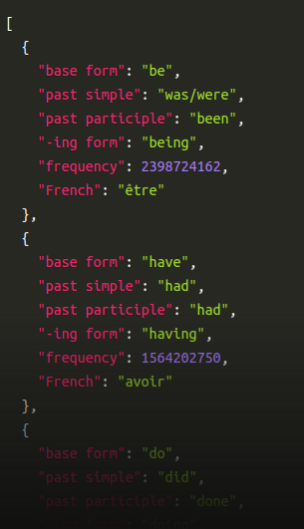
Memorizing a long list of irregular verbs can be inefficient. A better approach is to recognize that even irregular verbs often fall into predictable patterns. The following video offers an excellent guide to learning these patterns, making the process more systematic.
How to Learn Past Tense IRREGULAR VERBS... the EASY Way!
This video from 'English with Emma' breaks down irregular verbs into logical groups, which is a much more effective learning strategy than simple memorization.
Watch the video from this section on patterns. Pay close attention to the groups the instructor identifies: The vowel-change pattern (e.g., sing-sang-sung). The no-change pattern (e.g., put-put-put). The -en ending pattern (e.g., break-broke-broken). The "unique" verbs that follow their own rules.
Here are some of the most critical irregular verbs in software development, grouped by the patterns discussed in the video:
1. Vowel Change Pattern (i-a-u)
begin->began->begun- The team has begun the final testing phase.
run->ran->run(Note: the past participle returns to the base form)- We have run the script three times without errors.
2. No Change Pattern
set->set->set- I have set the environment variables.
cut->cut->cut- He has cut deployment time in half.
cost->cost->cost- The server upgrade has cost more than we budgeted.
3. Past Participle Ends in -en
write->wrote->written- She has written the documentation for the new API.
drive->drove->driven- Adoption of the new framework has been driven by the development team.
4. Other Common Patterns & Unique Verbs
build->built->built- We have built a new microservice for user authentication.
find->found->found- I think I have found the source of the memory leak.
make->made->made- The lead developer has made the final decision.
lead->led->led- He had led the project from the start.
sell->sold->sold- The startup has sold its platform to a larger tech company.
Quick Practice
To solidify your understanding, complete the following table. What is the past participle for each of these common technical verbs?
| Base Verb | Past Participle |
|---|---|
code |
|
deploy |
|
build |
|
write |
|
run |
|
set |
|
find |
|
test |
|
architect |
|
see |
Answers
coded,deployed,built,written,run,set,found,tested,architected,seen
Summary & Next Steps
This lesson has equipped you to form the past participle, the second essential component of any perfect tense.
Key Takeaways:
- Regular verbs form their past participle by adding
-ed, with minor spelling adjustments. - Irregular verbs do not follow the
-edrule but often fall into learnable patterns (e.g., vowel changes, no change,-enendings). - Recognizing these patterns is more efficient than rote memorization.
- Many key verbs in IT, like
build,write,run, andset, are irregular.
Now that you can confidently form past participles and recall the auxiliary + past participle structure, you have all the necessary building blocks. In the next lesson, we will combine these elements to construct sentences in the Present Perfect, Present Perfect Continuous, and Present Perfect Passive, applying them to solve the kinds of communication challenges you encounter in your work.