Welcome to the next lesson in our series on perfect tenses. In our previous session, we mastered the Past Perfect Simple to describe an action that was completed before another event in the past. Now, we'll build on that by exploring its counterpart: the Past Perfect Continuous.
This lesson focuses on how to describe an ongoing past action that was in progress up until another past event occurred. This is perfect for scenarios like, "The memory leak had been growing for days before the system finally crashed." By the end of this lesson, you will be able to confidently construct such sentences to describe the duration and interruption of past activities in a technical context.
The Core Concept: An Ongoing Action Interrupted
While the Past Perfect Simple marks a finished event, the Past Perfect Continuous emphasizes the duration of an action that was happening before another event in the past. This second event often interrupts or marks the end of the ongoing action.
Think of it like this:
- Ongoing Past Action: A data migration script is running. This happens over a period of time.
- Interrupting Past Event: The network connection drops. This is a specific point in time.
To connect these, we use the Past Perfect Continuous for the ongoing action and the Simple Past for the interruption: "The data migration script had been running for three hours when the network connection dropped."
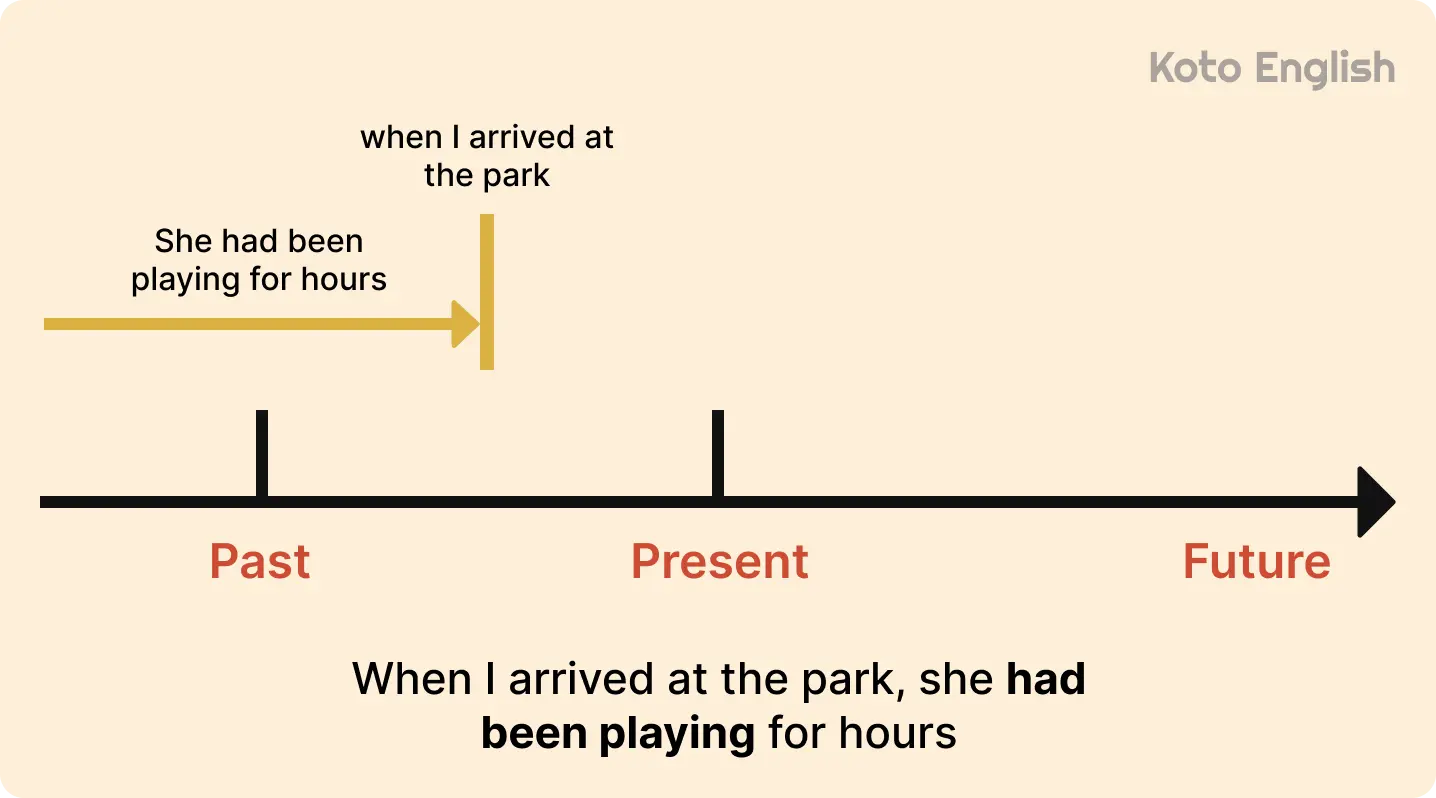
This timeline visualizes the concept perfectly. The long arrow represents the ongoing action, and the vertical bar is the interrupting event.
Form and Usage
The structure of the Past Perfect Continuous is consistent and straightforward:
Subject + had been + Present Participle (verb-ing)
This structure does not change based on the subject (I/you/we/they/he/she/it all use had been).
For a detailed breakdown of the structure and its primary uses, please consult the Grammarly article, "Past Perfect Continuous Tense."
Past Perfect Continuous Tense: How to Use It, With Examples | Grammarly
This article provides a clear, structured explanation of the tense.
First, read the section on the formula to confirm the structure. Then, read the section titled "Uses of the past perfect continuous tense", focusing on the first three bullet points: expressing duration, showing cause-and-effect, and providing context for an interrupted event.
As the article explains, this tense is excellent for:
- Emphasizing duration: "The team had been pushing commits all night before the final release."
- Showing cause of a past result: "The application was sluggish because a background process had been consuming too much CPU."
- Describing an interrupted action: "We had been refactoring the legacy module when management paused the project."
Key Distinctions: Choosing the Right Tense
The main challenge is often deciding between the Past Perfect Continuous and other similar past tenses. Let's clarify the most important distinctions.
Past Perfect Continuous vs. Past Perfect Simple
This choice depends on whether the first past action was ongoing or completed.
- Past Perfect Simple (Completed): The action finished before the second past event.
- "We had deployed the patch when the client called." (The deployment was finished.)
- Past Perfect Continuous (Ongoing): The action was in progress up until the second past event.
- "We had been deploying the patch when the client called." (The deployment was in progress; it was interrupted.)
This video from Oxford English Now clearly explains this difference. Pay close attention to the contrast between a completed action and a continuing one.
Past perfect simple or past perfect continuous? I had worked or I had been working
This video directly compares the simple and continuous forms of the Past Perfect.
Watch the section that contrasts a completed installation with an ongoing one, from "with action verbs" to "continuing activity." Then, watch the following point about focusing on duration.
Past Perfect Continuous vs. Past Continuous
This distinction is about the timing of the two past events.
- Past Continuous (Simultaneous): The two actions happened at the same time.
- "I was monitoring the server logs when the error appeared." (The monitoring was happening at the exact moment the error appeared.)
- Past Perfect Continuous (Sequential): The ongoing action happened for a period before the second event.
- "I had been monitoring the server logs for an hour when the error appeared." (This emphasizes the one hour of monitoring that led up to the appearance of the error.)
The resource "Past Perfect Continuous Tense" from ENGLISH PAGE provides excellent comparative examples.
Past Perfect Continuous Tense | ENGLISH PAGE
This resource offers a side-by-side comparison that clarifies the difference in meaning.
Focus on the section titled Past Continuous vs. Past Perfect Continuous. Note how the first example emphasizes the action at that exact moment, while the second emphasizes the duration leading up to that moment.
Important Note: Stative Verbs
Remember that verbs describing states, not actions, cannot be used in continuous tenses. These are called stative verbs (e.g., know, believe, own, understand, belong). With these verbs, you must use the Past Perfect Simple instead.
- Incorrect: The legacy system
had been belongingto the finance department for years. - Correct: The legacy system had belonged to the finance department for years.
Practice
Choose the most appropriate tense (Past Continuous, Past Perfect Simple, or Past Perfect Continuous) for the verbs in parentheses.
- The cron job
(to run)for over twelve hours when it finally(to throw)a timeout exception. - The DevOps engineer
(to fix)the build script when her manager(to ping)her on Slack. - By the time the security team
(to discover)the vulnerability, the attacker already(to exfiltrate)the data.
Answers
- The cron job had been running for over twelve hours when it finally threw a timeout exception. (The focus is on the long duration of the running job before the final event.)
- The DevOps engineer was fixing the build script when her manager pinged her on Slack. (The two actions happened at the same time; the ping interrupted the act of fixing.)
- By the time the security team discovered the vulnerability, the attacker had already exfiltrated the data. (The exfiltration was a completed action before the discovery.)
Conclusion
In this lesson, we focused on the Past Perfect Continuous tense to describe ongoing past actions that were interrupted or led up to another past event.
Key takeaways:
- The Past Perfect Continuous (
had been+verb-ing) emphasizes the duration of an action before another past event. - It contrasts with the Past Perfect Simple, which describes a completed action before another past event.
- It differs from the Past Continuous, which describes two actions happening at the same time.
- Stative verbs (like
know,own) are not used in this tense.
Our next lesson will shift our perspective forward in time. We will learn to use the Future Perfect to talk about actions that will be completed by a specific point in the future—an essential tense for discussing deadlines and project milestones.