Hello! In our previous lessons, we built a solid foundation for the perfect tenses. We established their core structure and explored how the Present Perfect and Past Perfect tenses help us connect events in time.
Today, we shift our gaze from the past and present to the future. This lesson focuses on the Future Perfect tense. You will learn how to use it to state precisely that an action will be completed before a specific deadline. This is an incredibly useful tool in a professional IT environment, where so much of our work is driven by sprints, release schedules, and migration deadlines.
The Core Idea: Looking Back from the Future
The main function of the Future Perfect is to describe an action that will be finished before a certain point in the future. It’s like standing at a future date on a timeline and looking back at a completed task.
The structure is consistent and builds on what you already know about perfect tenses:
Subject + will have + past participle
Let's watch a very quick video from BBC Learning English that introduces this concept.
Future perfect, or future perfect continuous? Ask BBC Learning English
This short video will quickly show you the basic structure and purpose of the Future Perfect.
Pay close attention to how the tense is formed from the introduction and how it's used to talk about completed tasks in the examples that follow.
As the video showed, the key is connecting a completed action to a future endpoint.
Deadlines and Sprint Goals
In software development, we constantly work with deadlines. The Future Perfect is the ideal tense for communicating about work that is expected to be finished by a specific time.
Take a look at this Azure DevOps sprint board.

Using this context, we can form clear statements about completed work. If today is January 25, we can say:
- By January 31, the team will have completed all the work for Sprint 2.
- By the end of the sprint, Jia-hao Tseng will have fixed the 'Time zone bug' and clarified the timezone issue.
Notice the use of the word by. This is a powerful signal word for the Future Perfect. It sets the deadline before which the action will be complete.
Now consider a real-world notification from a cloud provider.
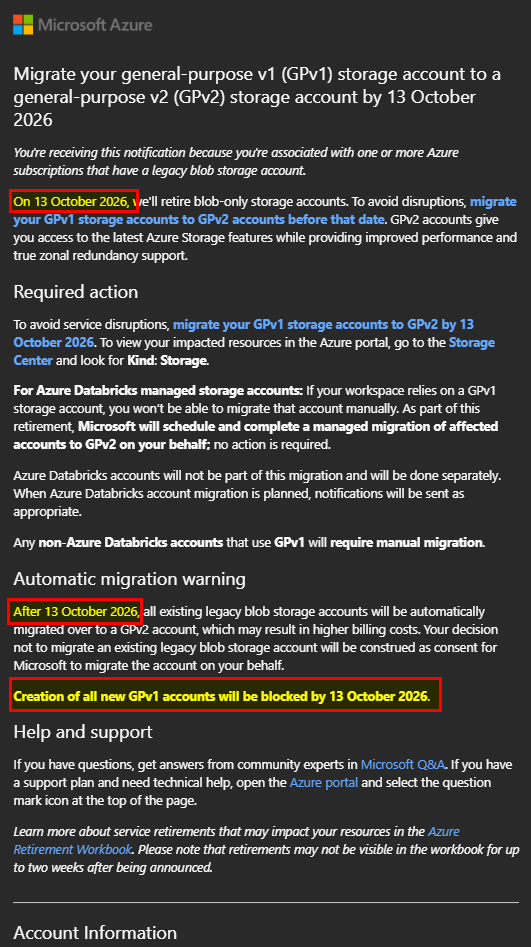
This notice is full of deadlines, making it perfect for practicing the Future Perfect:
- By 13 October 2026, Microsoft will have retired all legacy GPv1 storage accounts.
- The creation of all new GPv1 accounts will have been blocked well before the final retirement date.
That second example uses the Future Perfect Passive (will have been + past participle). Since you're already familiar with the passive voice, you can see how it works here. The focus is on the action (blocking the accounts), not who performs it (Microsoft). This is common in formal, technical announcements.
Forming Future Perfect Sentences
Now that you've seen the Future Perfect in context, let's formalize its structure for positive, negative, and interrogative sentences.
Future Perfect Tense: How to Master It
The article "Future Perfect Tense: How to Master It" provides a very clear breakdown of the grammatical formulas.
First, review the mechanics to reinforce the structure. Then, study the table in the section "Future Perfect tense examples", which lays out the formulas for positive, negative, and question forms with clear examples.
Future Perfect vs. Future Simple
A common point of confusion is when to use the Future Perfect versus the simpler Future Simple tense. The choice depends on what you want to emphasize.
- Future Simple: States that an action will happen in the future.
- We will deploy the patch. (This is our plan.)
- Future Perfect: Emphasizes that an action will be complete before a future moment.
- We will have deployed the patch by the time the morning traffic hits the servers. (The deployment will be finished before the traffic arrives.)
The following video explains this distinction and also introduces another key phrase, "by the time".
Future Perfect & Future Perfect Continuous + TEST | I will have lived OR I will have been living???
This video from Arnel's Everyday English gives excellent context on why the completion of the action is important, and how the Future Perfect differs from the Future Simple.
First, watch the section from 4:45 to 6:27, where the presenter explains why the completion before a future time is the important detail. Next, watch the segment on common phrases from 7:30 to 8:08. This covers the very useful structure "by the time + subject + present simple verb". Finally, watch the comparison with Future Simple from 10:33 to 11:34 to solidify your understanding of when to use each tense.
Practice
Let's apply what you've learned. Look again at the "Fabrikam Team" sprint board. Sprint 3 is planned for February. Write one sentence using the Future Perfect to describe a task that you imagine the team completing before the end of February. For example, think about a new feature or a significant bug fix.
Key Takeaways
- The Future Perfect is formed with
will have+ past participle. - Its core purpose is to describe an action that will be completed before a specific deadline or another event in the future.
- It is essential for communicating about deadlines, project milestones, and release schedules in a professional IT setting.
- Key signal phrases include
by(a specific time) andby the time(another event occurs).
In our next and final lesson, we will look at the Future Perfect Continuous. While the Future Perfect emphasizes the completion of an action, the Future Perfect Continuous emphasizes the duration of an action up to a certain point in the future. For example: "By the end of the day, I will have been debugging this code for eight hours."