Hello! Welcome to your first lesson. I'm excited to begin this journey with you into the deeper structures of mathematics.
Our goal today is to start at the very beginning of algebra by exploring two of its most fundamental rules: the commutative and associative properties. You've likely used these rules for years without thinking much about them, but since your goal is to understand the "why" behind the math, we're going to examine them closely. We will define what they are, see why they are significant, and even take a look at how mathematicians can prove they are true starting from even simpler ideas.
These properties are the first pillars of the algebraic system we'll be building throughout this course. Let's begin.
1. Defining the Properties: What Are They?
At their core, the commutative and associative properties are simple rules about how addition and multiplication behave. A great way to get a quick, clear introduction is to watch a short video that illustrates them.
The Distributive Property ,Associative Property,and Commutative Property Explained Clearly
Please watch the following two segments from the video 'The Distributive Property, Associative Property, and Commutative Property Explained Clearly' by MooMooMath and Science. These clips will give you a straightforward definition and simple examples for each property.
First, watch the section on the Associative Property from timestamp 2:22 to 5:17. Then, watch the section on the Commutative Property from 5:17 to 7:15. Pay attention to the core idea behind each property and the examples used.
As the video explained, we can define these properties formally:
The Commutative Property
This property is about the order of numbers in an operation. The word "commute" means to travel or move around, which is a good way to remember it. For any numbers and :
- Commutative Property of Addition:
- Commutative Property of Multiplication:
It simply means you can swap the order of the numbers, and the result remains the same. (e.g., and ).
The Associative Property
This property is about the grouping of numbers when you have more than two. The word "associate" refers to who you group up with. For any numbers , , and :
- Associative Property of Addition:
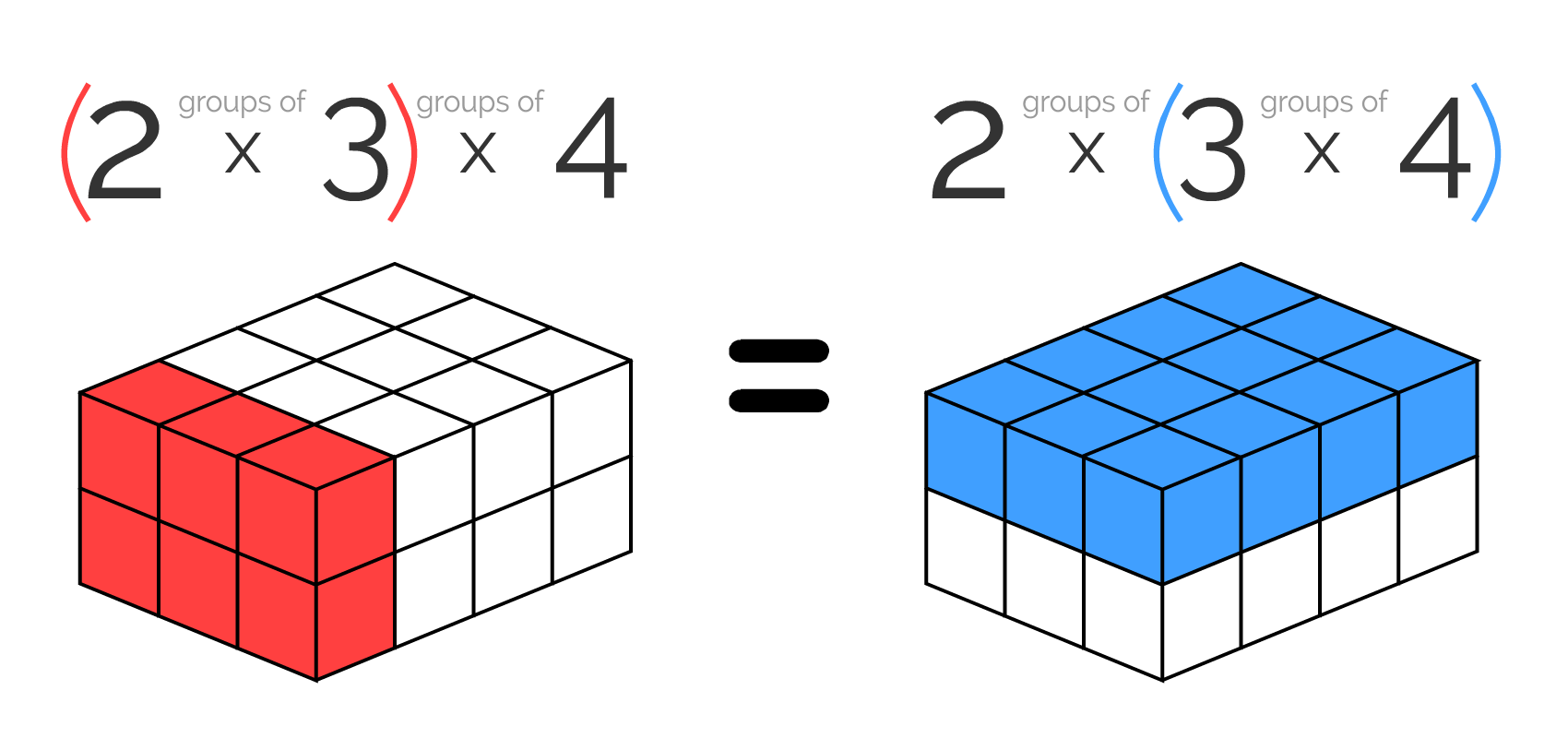
- Associative Property of Multiplication:
It means that when you are only adding or only multiplying, you can move the parentheses around, and the result remains the same.
A helpful way to visualize the associative property of multiplication is to think about volume.
2. The Significance: Why Do We Need to Name These Properties?
At first glance, these properties might seem "obvious." You've known for years that is the same as . So why do mathematicians give them special names and call them out as fundamental rules?
The reason is that these properties are not universal. They don't apply to all operations. The fact that they work for addition and multiplication is a special and powerful feature of our number system.
Consider these counterexamples:
- Subtraction is not commutative: , but . The order clearly matters.
- Division is not associative: . But . The grouping clearly matters.
- Exponentiation is neither:
- It's not commutative: , but .
- It's not associative: , but .
By defining the commutative and associative properties, we are formally stating the "rules of the game" for algebra. These rules allow us to manipulate expressions with confidence. When you simplify (2x + 5) + 3x to 5x + 5, you are implicitly using both the associative property to regroup as (2x + 3x) + 5 and the commutative property to reorder 3x + 2x if needed.
Test your understanding!
Let's define a new, made-up operation, which we'll denote with the symbol . For any two numbers and , the operation is defined as:
For example, .
Is this operation commutative? Is it associative? Justify your answers with examples.
Show answer
Commutativity:
The operation is not commutative.
For an operation to be commutative, must equal .
Let's test it with and :
Since , the operation is not commutative.
Associativity:
The operation is not associative.
For an operation to be associative, must equal .
Let's test it with :
Since , the operation is not associative.
This exercise shows that we cannot take these properties for granted. They are special features of certain operations like standard addition and multiplication.
3. A Deeper Look: Where Do These Rules Come From?
This brings us to the core of your goal: to understand the foundations. In a typical algebra class, the commutative and associative properties are presented as axioms—statements we accept as true without proof. They form the basis from which we prove other things.
However, at a more fundamental level of mathematics, one can ask: can we prove that addition and multiplication are commutative and associative? The answer is yes, but to do so, we must start with even simpler axioms.
This is the domain of foundational mathematics, which builds our entire number system from the ground up. A famous set of axioms for this is the Peano axioms, which define the natural numbers (). They start with just two concepts:
- There is a number called
0. - Every number
nhas a unique "successor" (think of it asn+1).
From this incredibly simple starting point, one can formally define addition and multiplication and then prove that our familiar properties hold.
To give you a true sense of what this looks like, we will examine the proof for the associative law of addition.
The following resource, from a course on number systems, formally proves the properties we are discussing. We will focus on the proof of the Associative Law of Addition. Don't worry about understanding every single symbol, but focus on the logical progression.
Please read the section titled '4. Addition' in this PDF. Pay close attention to Theorem 7 (Associative Law) and its proof. Notice how the proof uses a technique called 'induction'.
Let's break down the logic of that proof for x + (y + z) = (x + y) + z.
-
The Strategy: The proof uses mathematical induction on the variable . This is a powerful proof technique you'll encounter in programming and higher math. It works in two steps:
- Base Case: Prove the statement is true for the very first number, .
- Inductive Step: Assume the statement is true for some arbitrary number , and then use that assumption to prove it must also be true for the next number, the successor of (which we can call ).
-
Base Case (z=0):
The proof shows that . This is easy to verify. From the definition of addition in this system, adding 0 to anything leaves it unchanged. So, and . The equation becomes , which is true. -
Inductive Step:
This is the core of the argument.- We assume the property holds for some number . This is our inductive hypothesis:
x + (y + z) = (x + y) + z. - Our goal is to prove it holds for the next number,
σ(z)(or ). We want to show:x + (y + σ(z)) = (x + y) + σ(z). - The proof in the PDF then uses a chain of equalities, applying definitions from earlier in the text (like
m + σ(n) = σ(m+n), which is Lemma 5) and the inductive hypothesis to transform the left side of the equation into the right side.
- We assume the property holds for some number . This is our inductive hypothesis:
This might seem complex, and it is! The key takeaway is not to memorize the proof, but to appreciate the process: mathematicians do not take even the most "obvious" rules for granted. They can be built up and proven with rigorous logic from an extremely minimal set of starting assumptions. The same PDF goes on to prove the commutative properties for addition and multiplication using similar methods.
Summary and Next Steps
In this lesson, we established the first foundational rules of algebra.
- Key Takeaways:
- The Commutative Property states that the order of operands does not matter for addition and multiplication ().
- The Associative Property states that the grouping of operands does not matter for addition and multiplication ().
- These properties are significant because they are not universal; they don't apply to operations like subtraction or division. Their existence for addition and multiplication enables algebraic manipulation.
- While we treat these properties as axioms in algebra, they can be formally proven from a more basic set of axioms (like the Peano axioms) that define the number system itself.
We have now explored two properties that govern operations of a single type (all addition or all multiplication). In the next lesson, we will investigate the Distributive Property, which is arguably even more powerful because it's the rule that formally connects addition and multiplication.