Hello! Welcome to your third lesson.
In our first two lessons, we built a solid understanding of the rules that govern how numbers interact within addition and multiplication (commutative and associative properties) and how these two operations are connected (the distributive property). We saw that these are not just arbitrary rules, but foundational axioms.
Today, we will complete our set of foundational axioms by defining two concepts that might seem obvious but are mathematically profound: identity and inverse elements. This lesson will answer the questions:
- What makes the numbers 0 and 1 so special?
- What does it mathematically mean to "undo" an operation?
By the end of this lesson, you will be able to define identity and inverse elements for both addition and multiplication, and you will understand their crucial role in the structure of algebra. This will complete the set of Field Axioms, giving us all the tools we need to start proving more complex algebraic rules.
1. Identity Elements: The "Neutral" Numbers
In any system with an operation, an identity element is a special value that leaves any other element unchanged when you combine them. It’s the "neutral" or "do nothing" element for that operation.
The Additive Identity: Zero
In the world of addition, the identity element is the number 0. The Additive Identity Property states that for any number , adding zero to it does not change its value.
Formally, we state this as an axiom:
There exists a unique number, which we call 0, such that for any real number :
Basic Number Properties for Algebra
The 'Professor Dave Explains' channel provides a quick and clear summary of this property.
Please watch from 3:30 to 3:56. The video defines the additive identity property with simple examples.
Why is the additive identity unique?
Your goal is to understand the "why," so let's prove that there can only be one number that acts like 0. This is a classic and elegant proof.
- Assumption: Let's imagine there are two different additive identities, let's call them and .
- Applying the definition:
- Since is an additive identity, if we add it to , it shouldn't change . So, .
- Since is an additive identity, if we add it to , it shouldn't change . So, .
- Connecting the steps:
- We have two statements: and .
- From our first lesson, we know that addition is commutative, which means .
- Therefore, their results must be equal: .
- Conclusion: Our initial assumption that there could be two different additive identities led us to the conclusion that they must be the same. This proves that the additive identity is unique.
The Multiplicative Identity: One
Similarly, multiplication has an identity element: the number 1. The Multiplicative Identity Property states that for any number , multiplying it by one does not change its value.
Formally, this axiom is:
There exists a unique number, which we call 1, such that for any real number :
Basic Number Properties for Algebra
Let's see the same quick explanation for the multiplicative identity.
Now watch from 3:56 to 4:08. Notice the parallel structure to the additive identity.
The proof for the uniqueness of the multiplicative identity follows the exact same logic as the one for the additive identity, just by replacing + with · and 0 with 1.
2. Inverse Elements: "Undoing" an Operation
Now that we have identity elements, we can define inverses. An inverse is an element that, when combined with another element, "reverses" the operation and gets you back to the identity element.
Inverse elements for Binary operations : ExamSolutions Maths Revision
This video from ExamSolutions gives a great general definition of an inverse element before diving into the specifics of addition and multiplication. This abstract view is a powerful way to understand the underlying concept.
Please watch the first minute of the video (0:00 - 1:01). Focus on the core idea: an element combined with its inverse under an operation yields the identity element for that operation.
The Additive Inverse: The "Opposite"
The additive inverse of a number is the number that, when added to , gives you the additive identity, 0. We call this number .
The formal axiom is:
For every real number , there exists a unique number , called the additive inverse of , such that:
Inverse elements for Binary operations : ExamSolutions Maths Revision
The ExamSolutions video continues by applying this concept to addition.
Continue watching from 1:01 to 2:16. Notice how finding the inverse of 4 means asking, "What do I add to 4 to get back to 0?"
Just like with identities, each number has only one unique additive inverse. The proof for this is a great exercise in using the axioms we've already established.
Test your understanding! (Proof Walkthrough)
Let's prove that the additive inverse of a number a is unique. Try to follow the logic.
Suppose a number a has two different additive inverses, b and c.
- By the definition of an additive inverse, what must
a + bequal? - By the same definition, what must
a + cequal? - If both expressions equal the same thing, what can you say about
a + banda + c? - Now, if
a + b = a + c, can you use the axioms we've learned (associativity, identity, inverse) to prove thatbmust equalc? Hint: Start by adding the additive inverse ofa(which is-a) to both sides of the equation.
Show answer
Let's walk through the proof step-by-step.
- Assumption: Suppose
ahas two additive inverses,bandc. - Definition: This means
a + b = 0anda + c = 0. - Equality: Therefore,
a + b = a + c. - Proof:
a + b = a + c(Our starting point)(-a) + (a + b) = (-a) + (a + c)(Add-ato both sides)((-a) + a) + b = ((-a) + a) + c(Associative Property)0 + b = 0 + c(Definition of Additive Inverse)b = c(Definition of Additive Identity)
- Conclusion: We've shown that the two supposed "different" inverses must be the same. The additive inverse is unique.
The Multiplicative Inverse: The "Reciprocal"
The multiplicative inverse of a number is the number that, when multiplied by , gives you the multiplicative identity, 1. We call this number or .
The formal axiom is:
For every non-zero real number , there exists a unique number , called the multiplicative inverse of , such that:
Inverse elements for Binary operations : ExamSolutions Maths Revision
Finally, let's see how this applies to multiplication.
Watch from 2:16 to 3:43. Pay close attention to the crucial exception mentioned: Why does 0 not have a multiplicative inverse?
The exclusion of zero is not arbitrary. It's a logical necessity. If 0 had a multiplicative inverse, say , then by definition 0 · x would have to equal 1. But we know that multiplication by zero always results in zero. Since 0 ≠ 1, no such number can exist.
3. The Complete Picture: The Field Axioms
We have now defined all the core axioms for addition and multiplication that govern the real numbers. These are known as the Field Axioms.
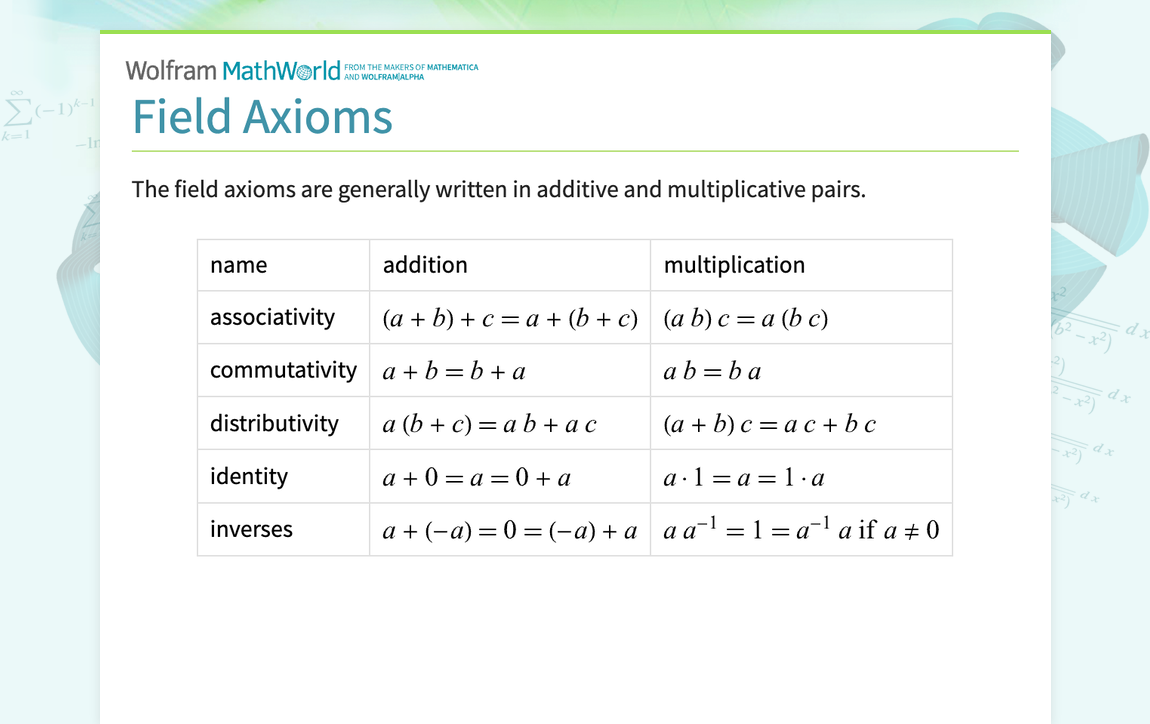
Take a moment to look at this table. You have now studied every single rule listed here.
- Associativity & Commutativity (Lesson 1): Rules for grouping and ordering within one operation.
- Distributivity (Lesson 2): The rule for how addition and multiplication interact.
- Identity & Inverses (This Lesson): Rules that define neutral elements (0, 1) and how to "undo" operations.
These axioms are incredibly powerful. They are the complete foundation from which we can build all of algebra. For instance, the concepts of subtraction and division are not new axioms; they are defined using inverses.
Applying the Axioms for the Real Numbers
This short text formalizes the connection between inverses, subtraction, and division.
Read the second paragraph, starting with 'There are several uniqueness results...'. Focus on how subtraction is defined as adding the additive inverse (b - a = b + (-a)) and division is defined as multiplying by the multiplicative inverse (b/a = b * a^-1).
This is a key insight: subtraction is not a fundamental operation. It is simply a shorthand for adding the additive inverse. Likewise, division is multiplying by the multiplicative inverse. This is why understanding inverses is so critical.
Summary and Next Steps
In this lesson, we completed our tour of the foundational axioms of algebra.
- Key Takeaways:
- Identity Elements are "neutral" numbers that don't change other values under an operation. The additive identity is 0, and the multiplicative identity is 1.
- Inverse Elements "undo" an operation by returning the identity element.
- The additive inverse of is , because .
- The multiplicative inverse of a non-zero is (or ), because .
- Subtraction and division are not fundamental operations but are defined using additive and multiplicative inverses, respectively.
We now have our complete axiomatic toolkit. In the next lesson, we will put it to work immediately. We will use these axioms—and only these axioms—to formally prove the rules for operating with negative numbers, such as why (-a)(-b) = ab. This will be our first major application of the logical structure we've built.