Introduction
Welcome back! In our last lesson, you architected the skeleton of a nurture sequence, defining its goal, audience, triggers, and logical flow. You built the 'why' and the 'when' for your automated conversation. Now, we're going to give it a voice.
Today's lesson focuses on the 'what': drafting the copy for a key email within a nurture sequence designed to convert a lead to the next stage. Strong, persuasive copy is what breathes life into your automation strategy. It's the critical link between your strategic framework and the lead's decision to take action, ultimately moving them closer to becoming a customer.
1. The Core Philosophy: Educate, Don't Just Sell
Before we put pen to paper (or fingers to keyboard), it's crucial to adopt the right mindset. A nurture email's primary job is not to make a hard sell. Most leads aren't ready for that. As you know from your experience as a Content Lead, the goal is to build trust and authority by providing value.
The reason most leads don't convert isn't because of price or a lack of interest; it's often due to what marketer Nicolas Cole calls an "education deficit." They don't yet fully understand their problem or how your solution uniquely solves it. Your email's job is to close that gap.
This 20-Email Sequence Made Me Millions of Dollars
In this clip from 'This 20-Email Sequence Made Me Millions of Dollars,' Nicolas Cole explains this core concept of the 'education deficit.' Understanding this will frame your entire approach to writing nurture copy.
Watch from the beginning to 01:36. Pay close attention to his distinction between an 'education problem' and a 'sales problem'.
Every email in your sequence should be an educational touchpoint that empowers the reader. You can do this by:
- Helping them better understand their own pain points.
- Debunking common myths or mistakes.
- Showing them what a better future looks like.
- Providing proof that you can help them get there.
2. A Framework for a High-Converting Nurture Email
Now, let's get tactical. While the goal is education, a powerful nurture email needs structure. One of the most effective copywriting frameworks for this is the Problem-Agitation-Solution model, tailored for an email format.
Joanna Wiebe, a leading conversion copywriter, has developed a brilliant template for exactly this purpose. We will use her "Hard Thing Template" as our guide for deconstructing and then writing a nurture email.
Free Copywriting Tutorial! How to Write a Lead Nurturing Email
This tutorial, 'How to Write a Lead Nurturing Email,' walks through a structured process for crafting an email that moves a prospect from being problem-aware to solution-aware. We'll watch a few key clips to understand the building blocks.
First, watch from 03:26 to 05:13 to understand the essential ingredients you need before you start writing. Then, watch from 06:04 to 07:30 to see how to craft a subject line that sparks curiosity.
Let's break down the components of this framework:
a) The Subject Line & H1: The One-Two Punch
As you just saw, the goal is to open with a question that voices the reader's internal struggle.
- Subject Line: An open-ended question based on your value proposition. Example:
How do you measure content ROI? - H1 (Headline 1): A follow-up question that agitates the problem by highlighting a common wrong way of doing things. Example:
Still counting page views?
This combination immediately validates the reader's problem and makes them feel understood.
b) The Opening: Empathize and Agitate
The first few lines of your email body should hold up a mirror to the reader's reality.
- Empathize: Describe their current situation and the frustrations they face. Show them you understand their world.
- Agitate: List the "failed solutions" they've likely tried. This builds rapport and underscores the difficulty of the problem.
For example, continuing from above:
"Outside of the marketing department, it's tough to get leadership to see the value of content beyond simple traffic metrics. You've tried building dashboards that show engagement, you've presented reports on keyword rankings, but the question always comes back to: 'How does this drive revenue?'"
c) The Pivot & H2: Introduce the "Better Way"
This is the turning point of the email. You've established the problem; now you introduce the beginning of the solution.
- H2 (Headline 2): A direct answer to the question in your subject line. This is your core teaching point. Example:
Start by tracking content-influenced pipeline. - Explain the "Better Way": Briefly elaborate on what your H2 means. Define the concept. Explain why it's a more effective approach than the "failed solutions" you mentioned earlier.
d) The Solution & Proof: Connect to Your Offer
Now, you connect the "better way" to your specific offer (e.g., the webinar, case study, or demo you're promoting).
- Introduce Your Asset: Show how your offer helps them implement the "better way." Example:
You can learn how to set this up in our upcoming webinar, 'From Clicks to Cash'. - Provide Proof: Offer a small, tangible piece of evidence. This could be a statistic, a testimonial, a screenshot, or a GIF showing a positive result.
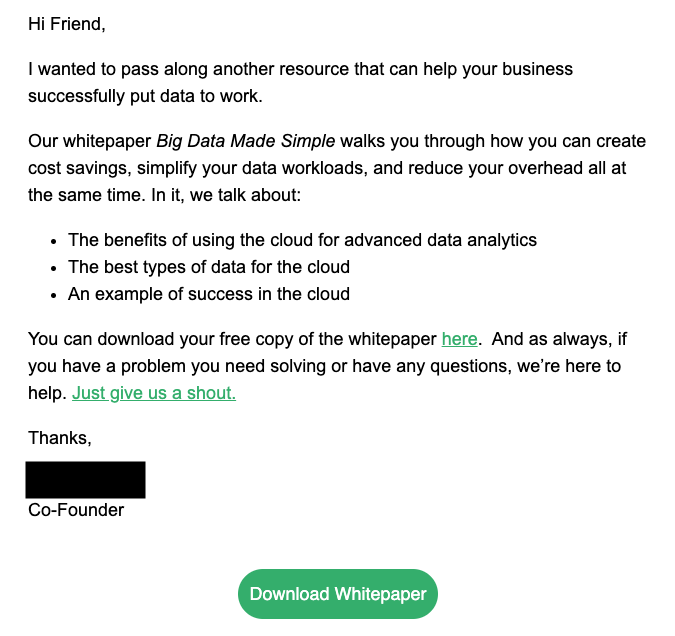
e) The Call-to-Action (CTA): A Clear Next Step
Your email must have one, and only one, primary CTA. This should be a low-friction action that logically follows the content of the email.
- Be Specific: Instead of "Click Here," use action-oriented language that describes the value.
- Examples: "Register for the Webinar," "Read the Full Case Study," "Watch the 2-Minute Demo."
The article "Top B2B Lead Nurture Email Examples" provides excellent visual examples of how these elements come together for different types of emails (educational, social proof, event invites).
Top B2B Lead Nurture Email Examples to Boost Conversions
To see more examples of these principles in action, please review this resource from AI bees. It categorizes emails by their purpose within the funnel and highlights the key elements for each.
Skim through the examples in 'Stage 2: Education & Consideration' and 'Stage 3: Decision & Conversion.' For each example (like Educational, Social Proof, Free Trial), notice how the copy focuses on a single goal and provides a clear CTA.
3. Activity: Draft Your Conversion-Focused Email
Now it's your turn to apply this framework. In the last lesson, you designed a nurture sequence for a lead who downloaded your e-book, "The B2B Marketer's Guide to Building a Content Engine."
Your task is to write the full copy for Email #2 in that sequence. The purpose of this email is to bridge the gap between the high-level e-book and a more specific, solution-oriented offer (like a webinar or a case study).
Your Goal: Move the lead from general interest in the "content engine" concept to considering a specific strategy for proving its value.
Use the template below, which is based on the framework we've just discussed. Feel free to consult the templates and subject line ideas in the Salesmate resource, "Lead nurturing email examples and templates" (resource LINK, section 5), for inspiration.
Nurture Email Copy Template (Email #2)
Subject Line:
- Write an open-ended question related to a specific challenge of building a content engine (e.g., "What's the true ROI of your content?").
[H1] Headline:
- Write a question that highlights a common but ineffective way of dealing with the challenge (e.g., "Still measuring success in 'likes' and 'shares'?").
Body - Part 1 (Empathy & Agitation):
- Acknowledge the reader's challenge. Describe the frustration of creating great content but struggling to prove its business impact. Mention solutions they might have tried that didn't work (e.g., complex spreadsheets, vanity metrics).
[H2] Headline:
- State the "better way"—the core educational point of your email (e.g., "Start by mapping content to pipeline.").
Body - Part 2 (The Pivot & Solution):
- Briefly explain what your H2 means. Then, connect this concept to the next logical step in their journey—the asset you are promoting in this email (e.g., a case study showing how a company did this, or a webinar that teaches it).
Body - Part 3 (Proof):
- Include a specific piece of proof. This could be a compelling quote from the case study, a key statistic, or a powerful testimonial related to your solution.
Call-to-Action (CTA):
- Write a clear, compelling CTA button text that directs them to the asset (e.g., "Read the Case Study" or "Save My Spot for the Webinar").
(Please take about 20 minutes to complete this activity. Focus on crafting a clear, value-driven message that guides the reader, rather than pushing them.)
Conclusion
Great work today. You've transitioned from architect to author, learning how to craft the persuasive copy that powers your content engine. By focusing on education and using a proven structure, you can write emails that not only get opened but also build trust and drive action.
Key Takeaways:
- Educate, Don't Sell: The most effective nurture emails close the "education deficit" by helping leads better understand their problems and potential solutions.
- Structure is Key: A Problem-Agitation-Solution framework provides a reliable blueprint for crafting a persuasive message.
- One Goal, One CTA: Every email should guide the reader toward a single, clear, low-friction next step.
- Prove Your Value: Back up your claims with tangible proof like data, testimonials, or examples to build credibility.
Preview of the Next Lesson:
You've now designed an email nurture sequence and drafted a key piece of copy for it. You're building a powerful system for converting leads. But how do you keep the top of your funnel full and engage your audience more broadly? In our next lesson, we will explore a vital channel for B2B marketing: "Define a content posting cadence and format mix for LinkedIn to engage a B2B audience." We'll shift our focus to distribution and learn how to use your content to build authority and community on a key professional platform.