Introduction
Welcome to the final module of our course! In our previous lessons, you mastered the critical skill of measuring and communicating the business impact of your content. By learning to present performance results in revenue-focused terms, you've taken a significant step toward demonstrating strategic value to leadership.
This module, "Developing Personal Thought Leadership," is the natural next step. It's about evolving from someone who reports on strategy to someone who shapes it. Today's lesson focuses on the foundational element of this journey: Define a personal thought leadership position based on unique expertise and a distinct point of view. We will explore how to identify your specific area of authority and cultivate a unique perspective that makes you stand out. This is the cornerstone of building the strategic influence you're aiming for.
To begin, let's look at a simple model for what constitutes effective thought leadership.

1. What Is a Point of View (POV)?
Before we dive into developing your position, let's clarify what we mean by a "point of view" in this context. It's more than just an opinion; it's a structured, defensible perspective that forms the core of your thought leadership. It's the "insight" component from the diagram above.
A great way to think about it is that a true POV is a statement that could spark a conversation or even a healthy debate. It's not a simple statement of fact that everyone already agrees on.
True Authority Requires a POV. Here’s How to Find It.
To build a solid understanding of this concept, let's read a short piece from the marketing agency Greentarget. Their article 'True Authority Requires a POV' offers a clear and powerful definition.
Please read the introduction and the section titled 'Defining POV in the professional services context'. Focus on the idea that a POV is a 'statement that others might disagree with' and how your unique experience makes your perspective compelling.
As the article notes, a strong POV doesn't have to be combative. It can simply be a fresh angle, a different priority, or a unique way of explaining a concept, all made credible by your specific experience.
2. Step 1: Identifying Your Niche of Expertise
A powerful point of view must be built on a foundation of genuine expertise—the "Knowledge" component of our model. You can't be a thought leader on a topic you don't deeply understand. The key is to find the intersection of three things:
- Your genuine knowledge and experience.
- The critical problems and interests of your target audience.
- The current market conversation and its gaps.
The following video provides a structured way to think through this process.
How To Become A Thought Leader | Brian Tracy
The first step is to pinpoint the specific area where you will build your authority. In this video, 'How To Become A Thought Leader,' Brian Tracy explains how to identify your niche.
Watch the section 'Identify your Niche' (00:54 - 02:29). Pay close attention to the process: starting with your own knowledge, researching your audience's pain points, and then asking key questions to find your 'unique spin'.
This audience-centric approach is vital. It ensures your thought leadership will be relevant and valuable. Let's watch one more short clip to reinforce this point.
4-Step Thought Leadership Strategy ANYONE Can Use
The video '4-Step Thought Leadership Strategy' from Exposure Ninja drives home the importance of starting with your audience.
Watch the segment on the first step, 'identify the topics that you want to be known for' (00:49 - 02:31). Notice the example of the wedding photographer—they shouldn't talk about camera lenses (their passion) but about what their clients care about (looking great in photos).
Thinking about your own background, you have a unique combination of skills: a technical foundation from your Master's in Computer Application and practical storytelling experience as a Content Lead. Your niche could lie at the intersection of these fields—perhaps "A Systems-Thinking Approach to Content Marketing" or "Data-Driven Storytelling for B2B."
3. Step 2: Developing Your Distinct Point of View
Once you've identified your niche, the next step is to cultivate your "Insight." This is what separates an expert from a thought leader. It involves moving beyond reciting best practices and developing a core thesis or a unique angle that challenges the status quo.
The following resource provides a fantastic set of questions to help you unearth this unique perspective.
Craft a Winning Thought Leadership Content Strategy
The article 'Craft a Winning Thought Leadership Content Strategy' from Fame.so offers an excellent, practical framework for finding your unique angle.
Read the sections titled 'Defining Your Unique Point of view' and 'Finding Your Core Content Thesis'. Focus intently on the three powerful questions it suggests for digging up your unique angle. These questions are the heart of this lesson.
To make this tangible, let's pull out those three crucial questions from the article. Take a moment to genuinely reflect on each one in the context of your chosen niche (e.g., content marketing for B2B tech):
- What widely-held industry belief do I fundamentally disagree with?
- (Example: Many believe more content is better. Perhaps you believe in producing far less content but integrating it more deeply with the product and sales process.)
- What frustrating problem does my audience face that no one is properly addressing?
- (Example: Everyone talks about 'aligning with sales,' but no one provides a technical workflow for how content requests and feedback should be managed between teams.)
- If I could only teach my audience one thing, what would it be?
- (Example: The single most important thing is not the content itself, but the distribution system you build for it.)
Answering these questions moves you from generic advice to a memorable, defensible stance that forms the foundation of your thought leadership.
4. Activity: Draft Your Positioning Statement
Now, let's bring your Knowledge and Insight together with some Organization. A positioning statement is a concise, structured way to define your thought leadership stance. We'll use a standard template and adapt it for your personal brand.
Estimated time: 20 minutes
Review this template, which is typically used for product positioning but works perfectly for defining a personal brand.
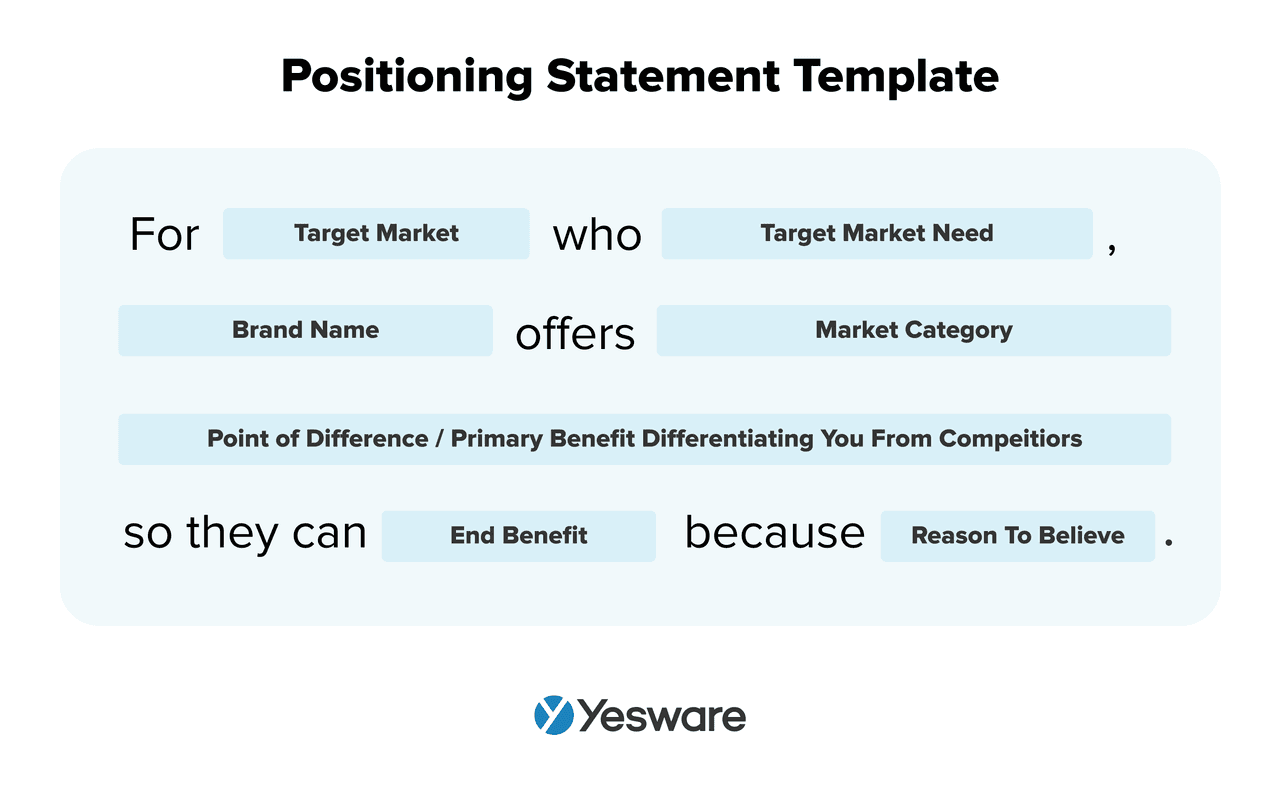
Here is how the template fields map to the concepts we've discussed:
- For (Target Market): Your specific audience (e.g., B2B marketing leaders at SaaS companies).
- Who need (Target Market Need): The primary pain point you solve (e.g., to prove the ROI of their content programs).
- (Brand Name) is a (Market Category): This is you! (e.g., Jane Doe is a B2B content strategist).
- That provides (Point of Difference / Primary Benefit): Your core thesis or unique POV from the previous step. This is the most important part.
- So that (End Benefit): The ultimate positive outcome for your audience (e.g., so they can build a content engine that earns budget and a seat at the leadership table).
- Unlike/As Opposed to (Competitors): The conventional wisdom or other experts you are differentiating from.
- We/I do this by (Reason to Believe): Your unique background and expertise that makes your POV credible (e.g., by applying principles from software development to create scalable content systems).
Your Task:
Based on your reflections from the previous steps, draft your own thought leadership positioning statement by filling in the blanks of the template. Don't worry about perfection; this is a first draft. Focus on being specific and authentic. Think about how your MCA and Content Lead experience gives you a "reason to believe" that others may not have.
Example:
For B2B marketing managers at Series B tech companies who need to scale their content production without hiring a massive team, my perspective is that of a systems-driven content strategist that provides a framework for treating content as a product, not a series of campaigns. So that they can build a predictable content engine that generates measurable pipeline. Unlike traditional content gurus who focus on creativity, I do this by applying agile development principles to content workflows, ensuring quality, scalability, and clear ROI.
Take your time to write your own version in a document. This statement will become your North Star for all the thought leadership content you create.
Conclusion
Fantastic work today. You’ve laid the essential groundwork for building your authority and strategic influence. Defining your thought leadership position is not a one-time task but an ongoing process of refinement. However, by starting with this structured approach, you've moved from being a content creator to an architect of ideas.
Key Takeaways:
- A thought leadership Point of View (POV) is a defensible stance that invites conversation, not just a statement of fact.
- Your ideal niche is at the intersection of your expertise, your audience's needs, and the gaps in the current market conversation.
- Develop a distinct perspective by challenging common beliefs, solving overlooked problems, or distilling your most valuable single piece of advice.
- A positioning statement is a powerful tool to synthesize your niche and POV into a clear, actionable declaration of your personal brand.
Preview of the Next Lesson:
Now that you've defined what you want to be known for, our next lesson will focus on where and how you will build that authority. We will explore how to identify the key platforms and channels (e.g., LinkedIn, industry publications) for building authority in your niche.