Welcome to our fourth lesson. In our previous session, we practiced the foundational skill of observation—the first step in our "observe then interpret" model. You learned to act like a detective, meticulously gathering evidence from a text by focusing on diction, syntax, and punctuation.
Today, we take the crucial next step. We will learn how to turn those observations into analytical questions. This is the moment where raw data begins to transform into a focused inquiry. Our goal is to formulate questions about a passage that are driven by your initial observations. Think of it this way: your background in information management involves not just collecting data, but designing specific queries to unlock its meaning. Similarly, asking the right questions about a literary text is how we begin to query it for deeper significance.
What Makes a Question "Analytical"?
First, it's important to understand what we mean by an "analytical question." It's not a question of fact (e.g., "What year was this book published?") or a question with a simple "yes" or "no" answer. An analytical question probes the hows and whys of a text. It explores the author's choices and their effects.
The goal of close reading isn't just to spot details, but to use those details to open up lines of inquiry.
A Short Guide to Close Reading for Literary Analysis
This guide from the University of Wisconsin-Madison Writing Center clearly states the relationship between close reading, observation, and asking questions.
Please read the first few paragraphs of the guide. Notice its central point: "The process of close reading should produce a lot of questions."
So, a good analytical question:
- Is rooted in a specific observation from the text.
- Asks "how" or "why" something in the text is the way it is.
- Opens up a topic for debate and interpretation, rather than closing it down with a factual answer.
The following short video provides a great overview of this mindset.
English Professor Shows You How To Do A Literary Analysis in Under 4 Minutes!
This video from Dr. Whitney Kosters quickly defines literary analysis as a process of asking critical questions.
Watch the segment from the beginning to the example from 'Young Goodman Brown'. Pay attention to the types of questions she suggests asking, such as "What stands out?" and "What's surprising or contradictory?" Notice how she moves from an observation ("the story begin at sunset") to an analytical question ("could Darkness symbolize something?").
The Path from Observation to Question
The process of generating an analytical question is a direct extension of the observation skills you've already practiced. It often follows a clear path: you notice a detail that is interesting, strange, or patterned, and this "point of tension" prompts you to ask why it's there and what it's doing.
This simple flow chart illustrates the ideal progression of thought:
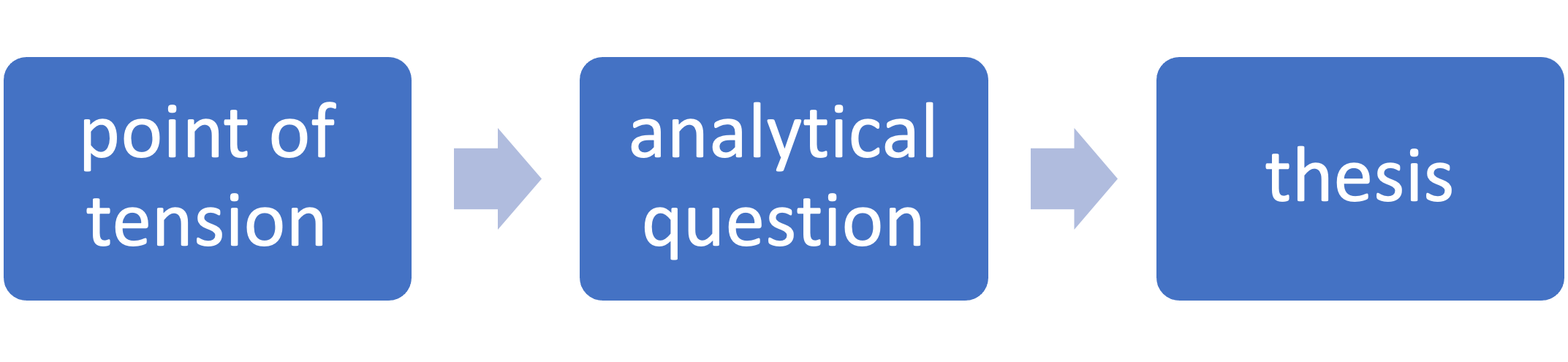
Let's revisit a video from our last lesson to see this path in action. Before, we focused on the observations being made. This time, listen for the questions that arise directly from those observations.
How to Do Literary Analysis (It’s Easy!)
We're returning to this video from English Nerd because it perfectly demonstrates the leap from observation to question.
Please re-watch these two key moments, but this time focus on the questioning part of the analysis: From the observation "the clocks were striking thirteen," the presenter immediately asks: "what is that reason... is this a militaristic Society or what?" From the observation of the name "Victory Mansions" contrasting with the "vile wind," he notes that things are not matching up, which implicitly asks: "Why is there a contrast between the name of this place and its description?" Finally, listen to his summary of the entire process at the end: "observe and then think, 'well, why might that be?'"
This simple prompt—"Why might that be?"—is the engine that drives all literary analysis.
Case Studies in Question Formulation
Let's look at some more detailed examples. A single passage can generate questions about its subject matter, its structure, and its specific word choices. The following resource demonstrates this by analyzing a Robert Frost poem.
A Short Guide to Close Reading for Literary Analysis
We're returning to this guide to see a systematic approach to generating questions. The author breaks down the text into its components and asks questions about each one.
Read the sections on Subject, Form, and Word Choice. For each section, read the "Observations" first, and then pay close attention to the "Questions" that follow. See how each question is a direct result of a specific observation.
Now, let's examine two prose passages where analytical questions have been formulated for you. This will provide a clear model for what you should aim to produce.
Resources - 3 Steps to Successful Close Reading | The Writing Place
This guide from Northwestern University's Writing Place offers two excellent practice passages with questions and sample answers. They are perfect models of our target skill.
Please read the two sections at the end of the document: Practice Passage #1 (Dickens) and Practice Passage #2 (Fitzgerald). For each passage, first read the text, then read the questions carefully. Note how each question points to a very specific detail (e.g., juxtaposition of words, sentence structure, the use of "you").
As you saw in the examples, powerful analytical questions often emerge from noticing:
- Patterns and Repetition: Why does the author keep using the word "gray"?
- Contrasts and Contradictions: Why is a desolate place called "Victory Mansions"?
- Peculiar Details: Why does the clock strike thirteen?
- Structural Choices: Why is this sentence so long and complex, while the next one is short and simple?
Your Turn: From Observation to Question
Now it's time for you to practice this skill. Read the following opening passage from Mary Shelley's Frankenstein.
I am by birth a Genevese, and my family is one of the most distinguished of that republic. My ancestors had been for many years counsellors and syndics, and my father had filled several public situations with honour and reputation. He was respected by all who knew him for his integrity and indefatigable attention to public business. He passed his younger days perpetually occupied by the affairs of his country; a variety of circumstances had prevented his marrying early, nor was it until the decline of life that he became a husband and the father of a family.
Your task:
- First, make two specific observations about the passage. Think about word choice, sentence structure, or the information being presented.
- For each observation, formulate one open-ended analytical question that begins with "How" or "Why."
Take a few minutes to complete this. Once you're done, you can compare your work with my examples below.
My Examples:
-
Observation 1: The narrator spends a lot of time describing his father and ancestors, emphasizing words like "distinguished," "honour," "reputation," and "integrity."
-
Analytical Question 1: Why does the narrator begin his story by focusing so heavily on his family's public reputation and his father's character, rather than on himself?
-
Observation 2: The language is very formal and almost sounds like a legal or official document ("by birth a Genevese," "filled several public situations," "indefatigable attention").
-
Analytical Question 2: How does the formal, almost impersonal tone of the opening paragraph shape our initial impression of the narrator and his relationship to his own story?
Your questions might be different, and that's perfectly fine. The key is that they should be grounded in specific details from the text and should open up avenues for interpretation.
Conclusion
In this lesson, we bridged the gap between observing textual details and beginning an analysis. You've learned that formulating analytical questions is the active process of turning your observations into a focused line of inquiry.
Key takeaways from today are:
- Analytical questions move beyond facts to explore the "hows" and "whys" of an author's choices.
- The best questions arise from "points of tension" in the text—patterns, contradictions, or details that catch your attention.
- The simple prompt "Why might that be?" is a powerful tool to transform an observation into a question.
You now have the two core skills for the first phase of literary analysis: you can observe evidence, and you can formulate questions about it. In our next lesson, "Annotate a literary text systematically to track observations and questions," we will focus on the practical method for capturing these thoughts. We'll explore how to mark up a text effectively so that your valuable observations and questions don't get lost, setting you up for the deeper work of building an interpretation.