Hello! Welcome to your final lesson in this introductory course on the Indian Economy.
Over the past few weeks, we've journeyed from the fundamental economic problem of scarcity, through different ways of organizing an economy, to measuring national income with tools like GDP. Most recently, we explored the dramatic 1991 reforms that began reshaping India's mixed economy.
In this concluding lesson, we will zoom out to appreciate the big picture. We'll summarize two defining characteristics of the Indian economy that make it unique on the world stage. This directly addresses your final learning outcome: to summarize two unique features of the Indian economy, such as its demographic dividend and its status as a large mixed economy.
Understanding these features will provide you with a powerful framework for interpreting current events and future trends related to India.
1. Feature One: A Large and Evolving Mixed Economy
In our previous lessons, we established that India has a mixed economy, a system that combines elements of both capitalism (private sector) and socialism (public sector).
While many countries have mixed economies, India's situation is unique due to its sheer scale and complexity. It is the world's 5th largest economy, yet it simultaneously grapples with developmental challenges typical of a lower-middle-income country. This creates a unique dynamic where a vibrant, globally-integrated private sector coexists with a massive state sector responsible for welfare and infrastructure for hundreds of millions of people.
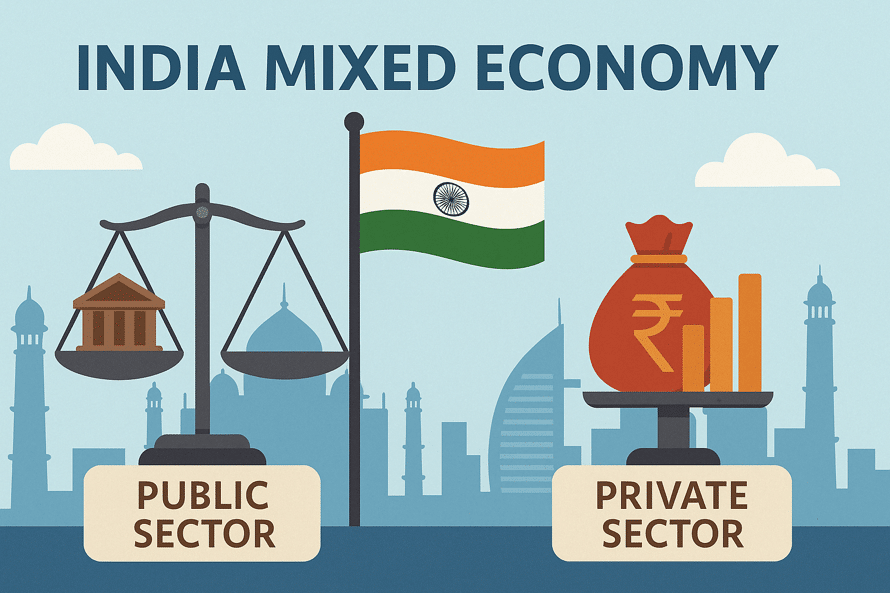
To refresh and solidify this concept, let's look at a quick reading.
Features of Indian Economy: Nature, Characteristics, Salient Points
The following article, 'Features of Indian Economy', provides a concise summary of India's mixed economy structure. It reinforces what we discussed in our last lesson about the dual role of private enterprise and government intervention.
Please read the section titled 'Mixed Economy Structure of India'. Focus on how it describes the goal of balancing profit-making with social fairness.
As the article notes, the goal is to balance the efficiency and wealth creation of the private sector with the state's objectives of social welfare and equitable growth. The 1991 reforms, which we studied previously, marked a pivotal shift in this balance—moving from a state-dominated mix to a more market-oriented one. However, the state remains a huge player, not just as a regulator but also as a direct provider of services, subsidies, and employment. Managing this enormous and complex system is one of the central challenges and defining features of the Indian economy.
2. Feature Two: The Demographic Dividend
The second unique feature is demographic. India is currently in a special period known as the demographic dividend.
What does this mean? In simple terms, it's a window of opportunity that opens when a country has a larger proportion of people in the working-age group (roughly 15-64 years) compared to the non-working, dependent population (children and the elderly).
Think of it like this: a household with more earning members than dependents has a greater potential to save, invest, and improve its standard of living. On a national scale, this translates to the potential for accelerated economic growth.
To get a clear and concise explanation of this powerful concept, please watch the following video.
India's Demographic Dividend and its Impact on the Economy | Microeconomics | Ecoholics
This short video from Ecoholics breaks down the concept of 'demographic dividend' very effectively. It explains what it is, gives the specific timeline for India, and outlines the critical conditions needed to actually benefit from it.
Please watch from the beginning (00:32) to 02:49. Pay close attention to the definition, the projected timeline for India (2005-2055), and the three things a country needs to do to materialize the dividend.
As the video highlights, this dividend is a potential, not a guarantee. The large working-age population is only a benefit if it is educated, healthy, and gainfully employed. If not, it can transform from a "demographic dividend" into a "demographic disaster," leading to widespread unemployment and social unrest.
The following graph powerfully illustrates why this is such a unique feature for India right now.

This graph shows that India has a unique, extended period to harness the energy of its youthful population while other major economies are facing the challenges of an aging workforce. Successfully capitalizing on this window by investing in human capital—through education, healthcare, and skill development—is arguably the single most important task for India's policymakers today. Your own field of Information Technology is a prime example of an industry that can thrive by harnessing this skilled youth workforce.
Conclusion and Course Wrap-up
In this final lesson, we've identified two of the most important features that define the contemporary Indian economy:
Key Takeaways:
- A Large Mixed Economy: India's economic system is a unique, large-scale blend of private enterprise and state intervention, which has been evolving since the 1991 reforms.
- The Demographic Dividend: India has a rare and time-sensitive opportunity for accelerated growth, driven by a large and youthful working-age population. Realizing this potential depends entirely on investing in education, skills, and job creation.
Congratulations on completing this introductory course! You started with the basic question of what economics is and have progressed through understanding how economies are structured, measured, and managed. You now possess the fundamental concepts—like scarcity, sectors of an economy, GDP, and the different economic systems—that form the bedrock of all economic analysis.
This foundation will enable you to better understand economic discussions in the news, analyze government policies, and continue your journey into more advanced topics in economics whenever you choose. Well done