Hello! Welcome to your seventh lesson on the Indian Economy.
In our last lesson, we focused on the difference between production within a country (GDP) and the income of a country's citizens (GNP). We learned that GDP is about where the economic activity happens, while GNP is about who benefits from it.
All these figures—GDP, GNP—are measured in currency, like rupees or dollars. But what happens if the value of the rupee itself changes from one year to the next? If prices go up, a rise in GDP might just be a reflection of higher prices, not more production.
Today, we'll tackle this exact problem. Your learning outcome is to distinguish between Real GDP and Nominal GDP using an analogy to explain the effect of inflation on purchasing power. This is one of the most fundamental concepts for accurately understanding economic growth.
1. The Problem with "Current Prices": Nominal GDP
Imagine a simple economy that only produces one thing: laptops.
-
In 2023: It produces 100 laptops, and each laptop costs ₹50,000.
- The GDP is: 100 laptops × ₹50,000/laptop = ₹50,00,000
-
In 2024: Due to rising costs (inflation), the price of the same laptop is now ₹55,000. The economy still produces 100 laptops.
- The GDP is: 100 laptops × ₹55,000/laptop = ₹55,00,000
If you just looked at the final numbers, you'd think the economy grew by 10% (from ₹50 lakh to ₹55 lakh). But did it? The country didn't produce a single extra laptop. The entire "growth" is just an illusion created by price increases.
This calculation, using the prices of the year in question, is called Nominal GDP. It measures the value of output at current market prices. It's useful, but it mixes up two things: changes in production and changes in prices.
2. Measuring Actual Growth: Real GDP
To get a true picture of whether an economy is producing more, we need to remove the effect of changing prices. We do this by measuring everything in the prices of a single, fixed year, known as the base year.
Let's use 2023 as our base year in the laptop example. The price we'll use for all calculations is the 2023 price: ₹50,000.
- Real GDP in 2023: 100 laptops × ₹50,000 (base year price) = ₹50,00,000
- Real GDP in 2024: 100 laptops × ₹50,000 (base year price) = ₹50,00,000
Now, the numbers tell the correct story: the Real GDP didn't grow at all, because the actual output of laptops didn't change.
This measurement is called Real GDP. It measures the value of output using constant prices from a base year, giving us a clear view of the change in the actual quantity of goods and services produced.
The following video provides a very clear explanation of this difference using a bakery analogy.
GDP Fully Explained: Per Capita, PPP, Nominal
This video from Explains 101 breaks down the concepts of Nominal and Real GDP in a very simple way. Notice how nominal GDP increases with price, while real GDP stays fixed if production doesn't change.
Please watch from 06:17 to 08:32. This covers the definitions and the core difference using a simple example.
3. The Indian Context and the GDP Deflator
In India, the current base year for calculating Real GDP is 2011-12. This means that when you see figures for India's Real GDP for any year (say, 2023), it's calculated using the prices that prevailed in 2011-12.
Let's watch a short clip that explains this in the context of the UPSC syllabus. It also introduces the idea of the GDP Deflator, which is simply a measure of the price level, calculated as the ratio of Nominal GDP to Real GDP.
What is GDP Deflator? | How Does It Measure Inflation? | Economy | UPSC | Drishti IAS English
This video from Drishti IAS, a well-known source for UPSC preparation, will ground these concepts in the Indian context and provide another helpful example.
Watch the segment from 02:22 to 06:51. Pay attention to the mention of India's base year and the car production example, which reinforces the difference between nominal and real calculations.
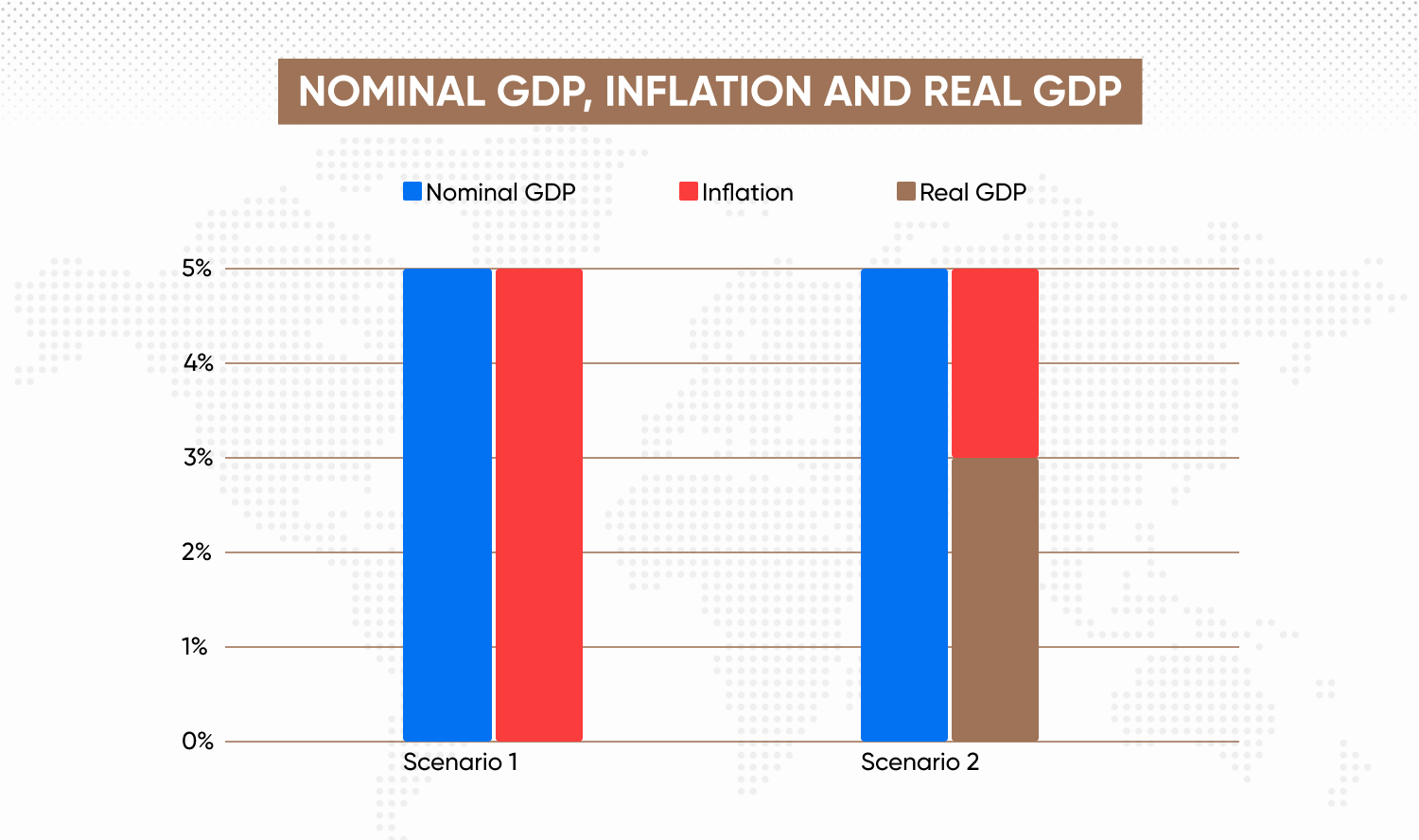
As the video explained, the relationship can be summarized as:
- Nominal GDP changes if prices change OR production changes.
- Real GDP changes only if production changes.
Therefore, Real GDP is the true indicator of economic growth.
4. An Analogy: Your Salary and Purchasing Power
To fully grasp the importance of this distinction, let's use a more personal analogy: your salary. This directly relates to the concept of purchasing power—what your money can actually buy.
Imagine you get a job with a starting salary of ₹1,00,000 per month. After a year of hard work, you get a 5% raise.
- Your nominal salary is now ₹1,05,000 per month. It's higher, which feels great.
But what if, during that same year, the prices of everything you buy—rent, food, transport—went up by 8%? This 8% is the inflation rate.
Even though your nominal salary increased, the cost of living increased even more. Your new, higher salary can actually buy less than your old salary could. Your real income, or your purchasing power, has decreased.
- Nominal Growth: +5% (your raise)
- Inflation: +8% (price increases)
- Real Growth: Approximately 5% - 8% = -3%
Your income in real terms has fallen. The following article provides a great example of a worker negotiating a salary, which perfectly illustrates this point about purchasing power.
Real vs. Nominal Value: Definitions, Differences, and Examples
This article from Investopedia discusses real value. We'll focus on a specific example that serves as a perfect analogy for understanding Real vs. Nominal GDP.
Please read just the section titled 'What Is an Example of a Real Value?'. It's a short, clear paragraph about a worker negotiating a raise based on inflation.
This is exactly why economists focus on Real GDP. A country with a 10% Nominal GDP growth but 12% inflation is, in real terms, getting poorer. Its capacity to produce goods and services has shrunk, just like your salary's purchasing power in the example above.
5. Bringing It All Together: The Formula
Now that you have the conceptual understanding, let's look at how it's formally calculated. The Khan Academy article below clearly lays out the formula that connects Nominal GDP, Real GDP, and the price index (the GDP Deflator).
Adjusting nominal values to real values (article) | Khan Academy
This Khan Academy article, 'Adjusting nominal values to real values', provides a clear, step-by-step guide to the calculations and shows a powerful graph comparing US Nominal and Real GDP over time.
Please read from the beginning ('Key points') down to the end of the section with the graph showing 'US nominal and real GDP since 1960'. Focus on the definitions, the explanation of the base year, the formula for Real GDP, and how the graph visually separates the two lines.
The key formula from the article is:
Here, the "Price Index" is the GDP deflator. This formula is how economists "deflate" the nominal figure to strip out the effects of inflation and arrive at the real figure. The graph in the article, showing the nominal GDP line rising much more steeply than the real GDP line, is a powerful visualization of inflation's long-term effect.
Conclusion
Today, we've untangled one of the most common points of confusion in economics. By distinguishing between nominal and real values, we can get a much more accurate reading of an economy's health.
Key Takeaways:
- Nominal GDP is calculated using current market prices. It can be misleading because it includes changes in both production and prices.
- Real GDP is calculated using constant prices from a base year. It isolates the change in actual production, making it the true measure of economic growth.
- Inflation is the key difference. Real GDP is essentially Nominal GDP with the effects of inflation removed.
- Purchasing Power Analogy: A rise in your nominal salary is only a real gain if it's greater than the rate of inflation. Similarly, a rise in Nominal GDP is only real growth if it outpaces inflation.
In our next lesson, we will pivot from measuring the economy to understanding how it is managed. We'll begin exploring the role of the state in a mixed economy like India's and discuss the context that led to the landmark 1991 economic reforms.