Hello! Welcome back to our module on Formalwear & Evening Gowns.
In our last lesson, we identified the key formalwear necklines and analyzed how their shapes—the dramatic plunge of a V-neck or the gentle curve of a sweetheart—create distinct cleavage effects. You now have the vocabulary to describe the visual goal of a gown's design. Today, we delve into the engineering required to achieve that goal.
Your learning outcome is to integrate a gown's built-in structure (boning, corsetry) with external support solutions to achieve dramatic cleavage. We will explore the internal architecture that gives a gown its shape and then master the toolkit of external supports that can be used to enhance, supplement, or even create that shape from scratch. Given your background in bra and top design, you'll find the principles of load distribution and structural support here quite familiar, just applied on a larger scale.
1. The Gown's Internal Architecture
High-end formalwear is often a marvel of structural engineering. The most effective gowns don't just hang on the body; they actively shape it. This is accomplished through a combination of boning, corsetry, and precisely chosen fabrics.
Let's begin by examining these built-in features. The following article, though focused on prom dresses, provides an excellent technical breakdown of the support structures found in quality formalwear.
Best Prom Dresses For Big Bust Girls | Flattering Fits - Jovani
This article from Jovani, titled 'Best Prom Dresses For Big Bust Girls', introduces the concept of 'engineering' in dress design. It provides a superb overview of the internal components that create support and shape.
Please read the following sections: Start with the introduction under the heading 'What A Big Bust Really Needs In A Prom Dress' to understand the concept of built-in engineering. Read the subsections 'Sweetheart prom dresses' and 'Lace up or corset backs' to see how specific features contribute to support. Finally, pay close attention to the table under the heading 'What to Look for in a Big-Bust Prom Dress.' This table provides a technical summary of high-quality internal support features. \nFocus on the names and functions of the components: boning, internal corsetry, sewn-in cups, and neckline wires.
As the Jovani article highlights, a gown's support system is a combination of several key elements:
- Boning and Internal Corsetry: This is the skeleton of the bodice. High-quality gowns use flexible but strong spiral steel boning, not flimsy plastic stays. This boning provides vertical tension, smoothing the torso and preventing the bodice from collapsing or bunching. When integrated into a lace-up corset back, it allows for a highly customized fit, cinching the waist and providing significant bust support by transferring the garment's weight to the waist and hips.
- Sewn-In Cups and Neckline Wire: These components give the bust area its intended shape. Unlike simple removable pads, sewn-in cups are an integral part of the bodice structure. They are often complemented by a hidden support wire along the edge of the neckline (especially in sweetheart styles) to ensure the top edge doesn't roll or sag, maintaining a clean, sharp line against the skin.
- Structured Fabrics: As we'll explore more in the next lesson, the fabric itself is a structural component. Thick materials like Mikado, taffeta, or heavy satin have enough body to hold their own shape, contributing to the overall support and creating a smooth silhouette.
Understanding these built-in features is the first step. You must first assess what support the gown already provides before you can decide what to add.
2. External Support Solutions: The Stylist's Toolkit
Even a well-structured gown might need help to achieve dramatic cleavage. In other cases, a gown might be intentionally designed with minimal structure (like a silk slip dress) and require a full external support system. Let's review the primary tools at your disposal.
A. Structured Underpinnings
For gowns with low backs but some frontal structure, or for adding a corseted shape under a less-structured dress, combining separate underpinnings is a classic technique.
The following resource from a corsetry expert provides a brilliant solution for supporting a fuller bust in a low-back dress by integrating two separate pieces.
Corset and Strapless Bra: low-back solution for fuller busts!
This article from Lucy's Corsetry, 'Corset and Strapless Bra: low-back solution for fuller busts!', details a professional method for combining a longline bra with an underbust corset.
Please read the two sections following the picture of Jessica Rabbit. The first section begins 'Find yourself a well-fitting strapless, longline bra.' The second begins 'One thing to look out for, however...' \nFocus on how the longline bra provides bust support and how the underbust corset is used to anchor the bra and cinch the waist.
This method is a perfect example of integration:
- A strapless longline bra provides bust lift and shaping. Its extended, boned bodice offers more support than a standard strapless bra.
- An underbust corset or waspie is worn over the longline bra, locking it in place and creating a defined hourglass waist. The entire construction is hidden beneath the gown.
This technique creates a powerful internal foundation that the outer gown can then drape over.
B. "Invisible" Adhesive Solutions
For gowns with plunging necklines, completely open backs, or daring cut-outs, traditional underpinnings are not an option. This is where adhesive solutions become essential.
Boob Tape
This is arguably the most versatile tool. It's essentially a strong, skin-safe adhesive tape that allows you to manually lift, shape, and position the breasts.

To see these techniques in action, let's watch a practical demonstration.
This video from Honeylove, 'How To Apply Boob Tape', provides clear, step-by-step instructions for achieving different effects.
Watch the sections demonstrating taping for a plunging neckline (02:00 - 02:45) and for a backless style (02:45 - 03:23). Pay attention to the principle of starting below the breast and lifting upwards to create support and cleavage.
The key principle with tape is creating lift and support by adhering one end of the tape below the breast and pulling upwards and/or inwards before anchoring the other end.
Adhesive Bras & Inserts
These are pre-shaped solutions that stick directly to the skin or inside the garment.
- Adhesive Bras: These are backless, strapless cups that stick onto the breasts, often with a central clasp to pull them together and create cleavage. They are best for smaller to medium busts, as they offer limited lift for heavier tissue.
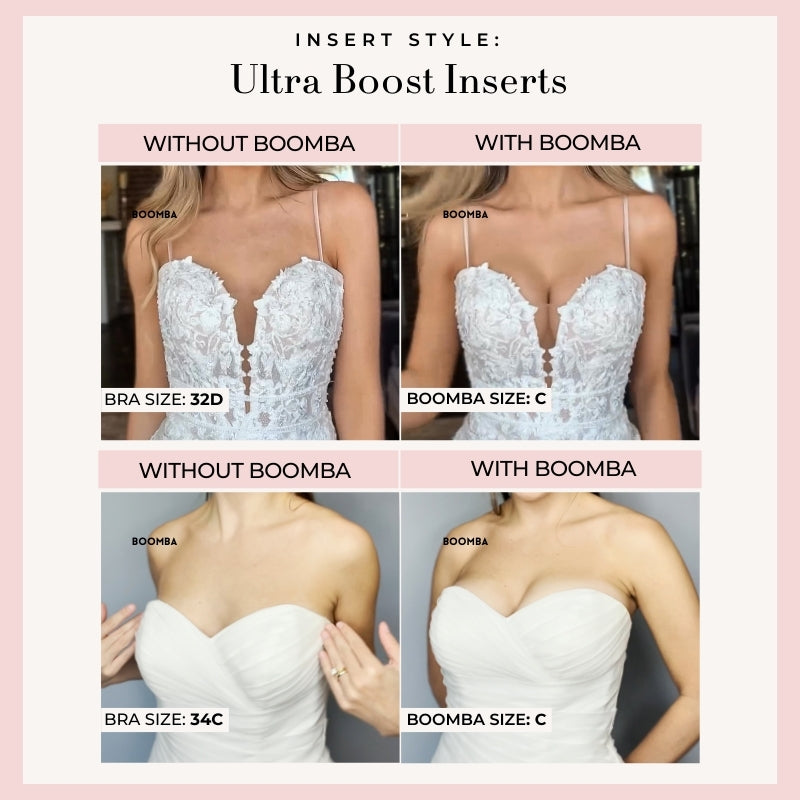
- Adhesive Inserts: These are silicone or foam pads that stick to the inside of the gown's cups. They are not meant to provide primary lift but are exceptional for adding volume and creating a "push-up" effect within an already structured bodice.
3. The Art of Integration: A Scenario-Based Approach
Now, let's bring it all together. The art is in choosing the right combination of tools for the specific gown.
Scenario 1: The Highly Structured Sweetheart Gown
- Gown: Bodice with steel boning, sewn-in cups, and a corset back.
- Integration Strategy: The gown provides the primary support. Your goal is to maximize the cleavage within that structure.
- Solution: Use adhesive inserts (like the Boomba inserts shown in the image) inside the gown's built-in cups. This adds volume and pushes the bust upwards, creating dramatic upper-bust cleavage that the sweetheart neckline is designed to frame. You are enhancing the gown's existing structure.
Scenario 2: The Unstructured Plunging V-Neck Gown
- Gown: A silk or crepe gown with a deep V-neck and no internal boning or cups.
- Integration Strategy: The gown provides the frame, but you must create the entire support system externally and invisibly.
- Solution: This is a job for boob tape. Using the "plunging neckline" technique from the video, you will apply tape vertically from under the breast towards the shoulder on both sides. This lifts and separates the breasts slightly, creating a valley of cleavage that follows the line of the V-neck.
Scenario 3: The Low-Back Gown with a Structured Front
- Gown: A dress with boning and cups in the front bodice, but a back that dips below the traditional bra line.
- Integration Strategy: The gown's front is supportive, but the low back eliminates the anchoring effect of a traditional bra band. You need to recreate that anchor.
- Solution: This is where the Lucy's Corsetry method excels. Wear a strapless longline bra for bust support, and layer an underbust cincher over it. The gown's structured front will lay smoothly over this foundation, and you'll have the defined waist and lifted bust of a full corset while still accommodating the low back.
Conclusion
Today, we've dissected the engineering behind a show-stopping formal look. You've learned to analyze a gown's internal support system and select the right external tools to achieve your desired cleavage effect.
Key Takeaways:
- A gown's built-in structure (boning, corsetry, cups) is the foundation of its fit and shape.
- External solutions like longline bras, corsets, adhesive tapes, and inserts are powerful tools to enhance or create support.
- Successful integration involves a strategic choice: either enhance the gown's existing structure (e.g., adding inserts to cups) or build a new, invisible foundation where the gown offers none (e.g., using tape for a plunging neckline).
Next Lesson Preview:
We have now mastered the shape of the neckline and the structure of the support system. In our next lesson, we will focus on the final piece of the puzzle: the fabric. We will learn to select gown fabrics (e.g., satin, velvet, crepe) based on how they drape across the bust and frame cleavage. You'll see how a fabric's weight, texture, and sheen can dramatically alter the perception of shape and volume.