Hello! Welcome to the final module of your course, Exam Preparation and Scenario Analysis.
In our previous lesson, we concluded the module on governance and auditing by exploring how services like CloudTrail, AWS Config, and KMS help you build compliant data solutions. This provided a perfect foundation for what's to come. Building compliant systems is just one aspect of building good systems.
This lesson kicks off our final module by introducing the mental model that will guide you through the most complex exam questions: the AWS Well-Architected Framework. We will be addressing the learning outcome: Describe the six pillars of the AWS Well-Architected Framework as they apply to data engineering.
Understanding this framework is critical for the certification exam. You will be tested not just on what services do, but on your ability to evaluate trade-offs and choose the optimal service or architecture for a given scenario. The Well-Architected Framework provides the structure for making these critical design decisions.
1. What is the AWS Well-Architected Framework?
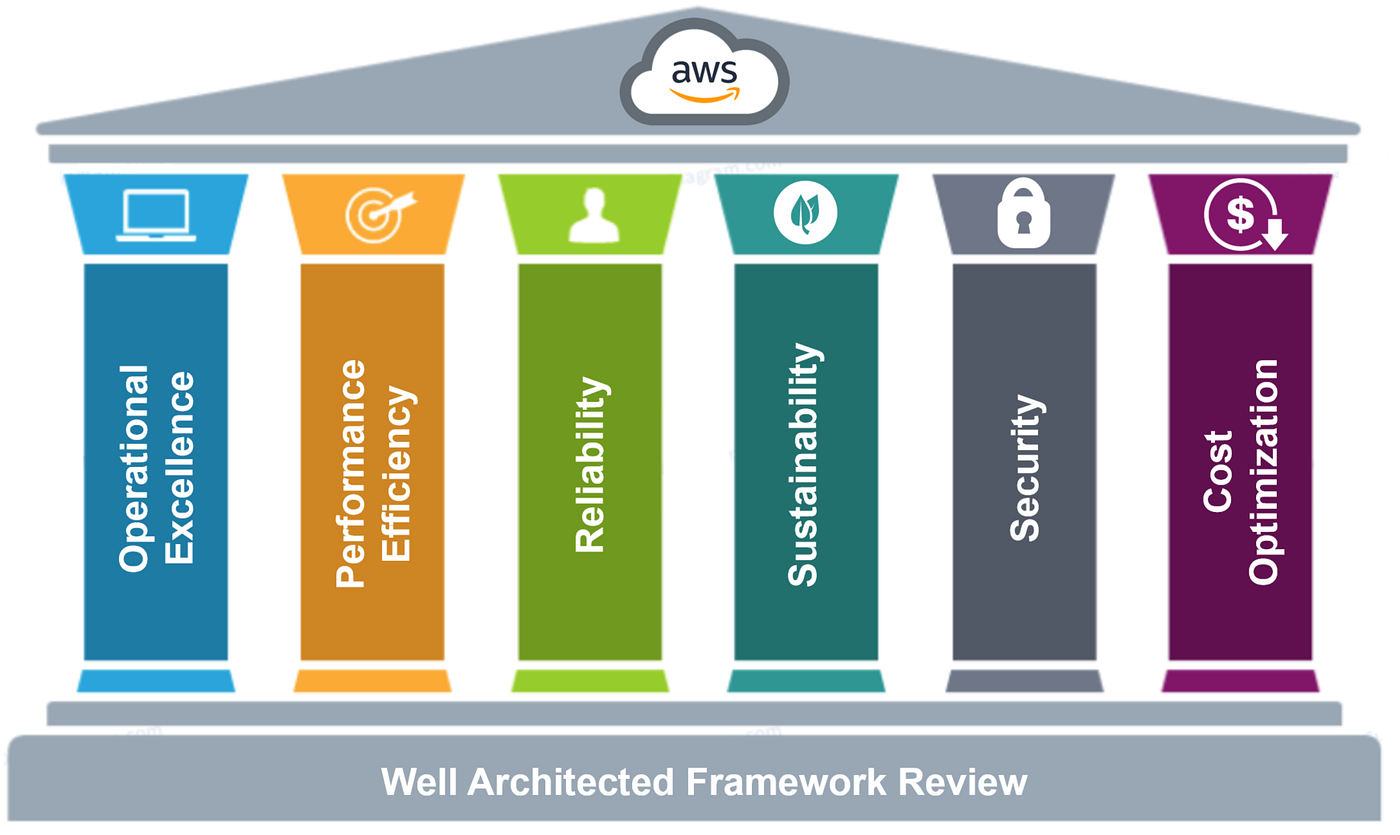
The AWS Well-Architected Framework is a set of best practices and guiding principles for designing and operating reliable, secure, efficient, cost-effective, and sustainable systems in the cloud. It was developed by AWS Solutions Architects based on their experience reviewing thousands of customer architectures.
Think of it as a checklist and a philosophy. It helps you compare your architecture against AWS best practices and identify areas for improvement. The framework is built upon six pillars.
To get a concise overview of the framework and its pillars, let's start with a short video.
AWS Well Architected Framework CLF C02 Exam Topic
This video from IAAS Academy provides a clear introduction to the AWS Well-Architected Framework and its six pillars. It's a great starting point before we dive into the data engineering specifics.
Please watch from the beginning until 01:31. This section will introduce the framework's purpose and name the six pillars we will be exploring.
As the video explains, the framework allows you to build systems that are not just functional but are truly "well-architected" across multiple dimensions. Now, let's explore each of these pillars through the lens of a data engineer.
2. The Six Pillars for Data Engineering
While the pillars are universal, their application has specific nuances in the world of data pipelines, data lakes, and analytics. For each pillar, we'll look at the core principles and then apply them to data engineering scenarios you're familiar with.
AWS Master Class Chapter 14: AWS Well-Architected ...
To get a solid, formal definition of each pillar, we will use a chapter from the 'AWS Master Class' book. It provides a clear and structured explanation of the core concepts.
Please read the section titled 'Core pillars of the Well-Architected framework'. This will give you a high-level summary of all six pillars before we analyze each one in a data context.
Now that you have a general understanding, let's bring it into our world. Much of the following context is guided by the principles in the AWS Well-Architected Analytics Lens, a special whitepaper that applies the framework directly to analytics workloads.
I. Operational Excellence
This pillar is about running and monitoring systems to deliver business value and to continually improve supporting processes. For data engineers, this means building manageable, automatable, and observable data pipelines.
Data Engineering Applications:
- Operations as Code: Define your entire data pipeline—from Kinesis streams to Glue jobs to Redshift clusters—using Infrastructure as Code tools like AWS CloudFormation or CDK. This ensures deployments are repeatable, consistent, and version-controlled.
- Observability: Don't just hope your ETL job worked. Implement detailed monitoring. Use CloudWatch metrics to track the health of a Glue job (e.g.,
glue.driver.aggregate.usedExecutorMemory) or theIteratorAgeof a Kinesis stream consumer to detect processing delays. Centralize logs from EMR and Glue jobs into CloudWatch Logs for easier debugging. - Automated Response: Design pipelines that can handle common failures. Use AWS Step Functions to orchestrate a Glue job, with built-in
Retrylogic for transient errors and aCatchblock to trigger a notification or a cleanup Lambda function if the job fails permanently.
II. Security
This pillar focuses on protecting information, systems, and assets. For data engineers, this is paramount, as you are the custodian of the organization's most valuable data.
Data Engineering Applications:
- Identity and Access Management (IAM): Apply the principle of least privilege everywhere. An ETL job's IAM role should only have permission to read from its specific source S3 prefix and write to its destination prefix, and nothing more.
- Data Protection:
- At Rest: Enable server-side encryption (SSE-KMS) for all S3 buckets in your data lake. Encrypt your Redshift clusters and EMR volumes.
- In Transit: All AWS API calls are encrypted via TLS. Ensure your applications also use TLS when connecting to databases or other endpoints.
- Centralized Governance: Use AWS Lake Formation to manage permissions for your Glue Data Catalog. This allows you to grant
SELECTaccess on specific tables or even columns to different users and roles, centralizing data access control for services like Athena and Redshift Spectrum. - Auditing: Enable CloudTrail data events on your S3 data lake buckets to log every
GetObject,PutObject, andDeleteObjectrequest. This provides a critical audit trail for who is accessing the data.
III. Reliability
This pillar is about ensuring a workload performs its intended function correctly and consistently. It's about recovering from failures and managing change automatically.
Data Engineering Applications:
- Failure Management:
- ETL Jobs: Use AWS Glue job bookmarks to track processed data. If a job fails and is restarted, it can pick up where it left off, preventing duplicate processing.
- Data Warehouses: Deploy your Amazon Redshift cluster across multiple Availability Zones (Multi-AZ) or use Amazon RDS Multi-AZ deployments for databases that support your pipelines. This ensures automatic failover in case of an AZ-level disruption.
- Horizontal Scalability: Don't build a pipeline that relies on a single, massive server. Use services that scale horizontally. For example, increase the number of shards in a Kinesis Data Stream to handle higher throughput, or add more nodes to an EMR or Redshift cluster.
- Preserve Raw Data: A key reliability pattern in data engineering is to always keep an immutable copy of your raw, ingested data. If a bug in your transformation logic corrupts the processed data, you can always rerun the pipeline from the raw source without data loss.
IV. Performance Efficiency
This pillar focuses on using IT and computing resources efficiently. For data engineers, this means designing pipelines and storage to be as fast and resource-efficient as possible.
Data Engineering Applications:
- Select the Right Tool for the Job:
- Storage: Choose appropriate file formats. Storing data in a columnar format like Apache Parquet or ORC drastically improves query performance for analytical tools like Athena because they only need to read the columns required by the query.
- Compute: Right-size your compute. Use memory-optimized instances for Spark jobs with large shuffles, or compute-optimized instances for CPU-intensive transformations.
- Optimize Data Access: Partition your data in Amazon S3. For example, organizing data by date (
/year=2023/month=11/day=15/) allows query engines like Athena and Redshift Spectrum to prune partitions and only scan the data relevant to the query's filter, leading to massive performance gains and cost savings. - Continuous Monitoring: Monitor the performance of your queries. Use Athena's query execution details or Redshift's
EXPLAINplans to identify bottlenecks, such as a full table scan that could be optimized with a better sort key.
V. Cost Optimization
This pillar is about avoiding or eliminating unneeded cost or suboptimal resources. Given the massive scale of data workloads, small inefficiencies can lead to huge costs.
Data Engineering Applications:
- Match Supply and Demand: Use serverless services like AWS Glue, Amazon Athena, and AWS Lambda where possible. You pay only for the compute time you use, eliminating costs from idle clusters. For batch processing, use transient Amazon EMR clusters that terminate automatically after the job is complete.
- Cost-Effective Resources:
- Storage: Use S3 Lifecycle Policies to automatically transition older, less-frequently accessed data from S3 Standard to S3 Standard-IA or S3 Glacier Deep Archive, drastically reducing storage costs.
- Compute: Leverage EC2 Spot Instances for fault-tolerant workloads, such as EMR task nodes, to save up to 90% on compute costs.
- Expenditure Awareness: Use cost allocation tags to tag all resources associated with a specific data pipeline (e.g., Glue jobs, S3 buckets, Lambda functions). This allows you to use AWS Cost Explorer to see exactly how much each pipeline or project is costing the business.
VI. Sustainability
This is the newest pillar, focusing on minimizing the environmental impacts of running cloud workloads. It's about energy reduction and maximizing the efficiency of the resources you use.
Data Engineering Applications:
- Maximize Utilization: The serverless approach mentioned for cost optimization is also a key sustainability pattern. By eliminating idle compute resources, you reduce overall energy consumption.
- Adopt Efficient Hardware: Where you do use provisioned resources (like EMR or Redshift), choose instance types based on modern, energy-efficient processors like AWS Graviton. These processors offer better performance per watt.
- Reduce Data Movement: Plan your architecture to process data as close to where it is stored as possible. Cross-region data transfers not only cost money but also consume more energy. Using services like Redshift Spectrum or Athena to query data directly in S3 avoids moving data into a separate cluster, saving both time and energy.
Test your understanding!
You are designing a new ETL pipeline using AWS Glue to process 1TB of daily data stored in S3. The data is queried by analysts using Amazon Athena. How would you apply the principles of Performance Efficiency and Cost Optimization to this design?
Show answer
-
Performance Efficiency:
- File Format: Convert the source data to a columnar format like Apache Parquet. This allows Athena to read only the specific columns needed for a query, drastically improving speed.
- Partitioning: Partition the data in S3, likely by date (e.g.,
s3://bucket/data/year=YYYY/month=MM/day=DD/). This allows Athena to prune partitions and scan only the relevant data, improving performance. - Compression: Use a splittable compression algorithm like Snappy with Parquet. This reduces storage size and I/O, speeding up reads.
-
Cost Optimization:
- Serverless: Using AWS Glue and Amazon Athena (both serverless) is inherently cost-effective as you only pay for the resources used during job execution and query runtime, with no idle compute costs.
- Data Scanned: The performance efficiency improvements (Parquet format, partitioning, compression) directly reduce the amount of data Athena scans for each query, which is how it's billed. This lowers query costs significantly.
- Storage Tiering: Implement an S3 Lifecycle Policy to move older, less-frequently queried data to S3 Standard-IA or S3 Glacier to reduce storage costs. Athena can still query data in S3 Standard-IA, and S3 Glacier Select can be used for occasional queries on archived data.
Conclusion
In this lesson, we introduced the AWS Well-Architected Framework and its six pillars, applying each one to the specific context of data engineering. This framework is not just an abstract concept; it is the primary tool you will use to deconstruct complex exam questions and justify your architectural choices.
Key Takeaways:
- The AWS Well-Architected Framework is a structured guide for building high-quality cloud systems.
- Operational Excellence is about automating and monitoring your data pipelines.
- Security involves protecting your data with IAM, encryption, and robust auditing.
- Reliability focuses on building fault-tolerant pipelines that can recover from failure.
- Performance Efficiency means choosing the right file formats, partitions, and compute resources to make your jobs run faster.
- Cost Optimization is about eliminating waste by using serverless services, tiered storage, and right-sizing your resources.
- Sustainability involves minimizing environmental impact by reducing idle resources and data movement.
Next Up:
Now that you have the framework, the rest of this module will be dedicated to applying it to realistic scenarios. In our next lesson, we will tackle the learning outcome: Select the appropriate ingestion service (e.g., Kinesis, MSK, DMS) based on data velocity, volume, and variety. We will use the six pillars as our guide to evaluate the trade-offs between these powerful services.