Introduction
Welcome to the final lesson of our foundational module on logical reasoning. Over the past few weeks, we have assembled a powerful toolkit for analyzing arguments. You have learned to deconstruct an argument into its premises and conclusion, distinguish between deductive and inductive reasoning, test for validity and soundness, identify informal fallacies, and evaluate the strength of analogies. Now, we will learn about the ethical and practical mindset required to wield these tools effectively: the principle of charity.
This principle is not just about being polite; it is a core discipline for effective thinking. It governs how you should interpret an argument before you critique it. Applying this principle ensures your analysis is aimed at discovering the truth, not merely at winning a debate. In this lesson, we will define the principle of charity, understand its justifications, and learn a systematic process for applying it to real-world arguments you'll encounter in philosophy, politics, and economics.
What is the Principle of Charity?
At its heart, the principle of charity is a rule of interpretation. When faced with an argument that could be interpreted in multiple ways, you should choose the interpretation that makes the argument as strong, rational, and plausible as possible. This is the direct opposite of the "straw man" fallacy, where you caricature an opponent's argument to make it easier to attack. Instead of building a "straw man," the goal is to build a "steel man"—the strongest possible version of the argument.
The Principle of Charity: Assume the Best Interpretation ...
This article from Effectiviology provides a clear and concise introduction to the principle of charity.
Read the introduction, which ends just before the "Examples" section. Focus on the core definition: you should not attribute irrationality when a plausible, rational alternative interpretation exists.
The philosopher John Corvino offers a succinct video explanation that contrasts this principle with the "straw man" fallacy.
This short video, "The Principle of Charity," makes a compelling case for why this principle is central to the pursuit of truth.
Watch the first minute and a half of the video, up to the end of the discussion on steel-manning. Pay attention to the distinction between finding flaws and getting at the truth.
As the video highlights, the goal isn't to ignore flaws. The goal is to ensure the flaws you find are genuine weaknesses in the best version of the argument, not just defects in a poor interpretation.
The Justifications for Charity
Why go to the trouble of strengthening an argument you disagree with? The justification is not primarily about being kind to your interlocutor; it is about being rigorous in your own thinking. There are two main lines of reasoning for this, one moral and one epistemic (related to knowledge).
In this video, also titled "The Principle of Charity," the speaker offers a clear breakdown of the two main reasons to be charitable in argumentation.
Watch the segment from "Why be charitable?". The speaker outlines a moral justification based on fairness and, more importantly, an epistemic justification related to truth-seeking.
Let's expand on that crucial epistemic justification. Your background in engineering provides a powerful analogy here. When stress-testing a system, you don't just run simple, successful test cases. You design the most challenging tests you can imagine—edge cases, high loads, unexpected inputs—because that is the only way to find true weaknesses and build a more robust system.
The principle of charity applies the same logic to ideas. If you only engage with weak or misrepresented versions of opposing views, you are performing a low-quality test. Your own beliefs will never be seriously challenged, and you will learn nothing. By engaging with the "steel man" version of an argument, you are stress-testing your own views against the strongest possible opposition. This process achieves two things:
- If your view is mistaken, you have the best possible chance of discovering it and correcting it.
- If your view is correct, you will develop a much deeper understanding of why it is correct and how to defend it against its strongest objections.
How to Apply the Principle of Charity: Argument Reconstruction
Applying the principle of charity is a practical skill. It's the core of a process called argument reconstruction, where you take messy, real-world arguments and clarify them into their strongest logical form. This often involves making an author's unstated assumptions explicit. Since you are familiar with algorithmic thinking, you can think of this as a structured procedure for interpreting arguments.
The lecture notes from the University of Massachusetts provide a detailed, step-by-step guide to this process.
Lecture Notes Unit 1 | Practical Reasoning
These notes systematically walk through the process of reconstructing an argument charitably. This is the practical "how-to" of applying the principle.
In the "H. Argument Reconstruction" section, start by reading the definition of the principle of charity in subsection 1. Then, proceed through the following subsections: "Implicit Parts of An Argument": Understand that real arguments often leave premises or conclusions unstated. "Validity and Connecting Premises": Learn how charity demands we add "connecting premises" to make an argument logically valid or strong. "Connecting Conditionals and Covering Generalizations": Differentiate between adding a specific "if-then" statement and a more plausible "covering generalization." "Finding the Right Generalizations": This is the most crucial part. Read carefully how to choose between hard ("all") and soft ("most") generalizations, and between wide and narrow scopes, to create the most plausible version of the argument.
This process gives you a clear methodology:
- Identify the explicit premises and conclusion.
- Check for logical gaps. Is the argument valid or strong as stated?
- If there is a gap, identify the implicit "connecting premise" needed to bridge it.
- Formulate the most plausible connecting premise. This usually involves choosing a "covering generalization" with the right strength (hard vs. soft) and scope (wide vs. narrow) to make the original argument cogent, without attributing an obviously false or foolish belief to the author.
For example, if someone argues, "This car is a Ford, so it was probably made in America," a charitable reconstruction wouldn't add the obviously false premise, "ALL Fords are made in America." It would add the more plausible, inductively strong premise, "MOST Fords sold in this region are made in America."
Engaging with the "Steel Man"
Once you've reconstructed an argument into its strongest form, you are ready to engage with it. This is where you move from interpretation to critique. The goal is to climb to the top of what's known as the "Hierarchy of Disagreement."

Applying the principle of charity is the work you do to ensure your response operates at the top two levels: "Refutation" and "Refuting the Central Point." You are engaging with the actual substance of the best version of the argument.
The flowchart below offers another way to visualize this process in the context of problem-solving with others. It shows a path where understanding and charity lead to constructive outcomes.
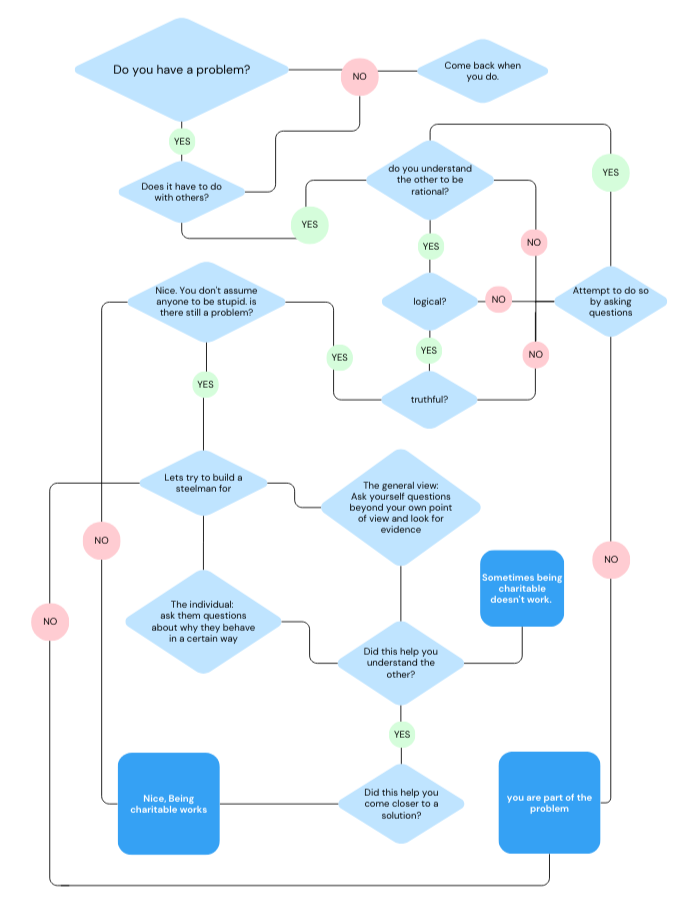
Philosopher Daniel Dennett provides a famous four-step protocol for composing a successful critical commentary, which is the ultimate expression of the principle of charity in action:
- Attempt to re-express your target’s position so clearly, vividly, and fairly that your target says, “Thanks, I wish I’d thought of putting it that way.”
- List any points of agreement.
- Mention anything you have learned from your target.
- Only then are you permitted to say so much as a word of rebuttal or criticism.
This rigorous process forces you to truly understand a position before you object to it, embodying the spirit of truth-seeking.
A Necessary Caveat
The principle of charity is a powerful tool, but it requires common sense. It is not an obligation to invent a good argument for someone who is clearly making a bad one, especially if they are arguing in bad faith (e.g., being intentionally deceptive or manipulative). The goal is to find the best version of their intended argument, not to substitute it with a completely different one of your own creation. If, after your best charitable effort, the argument remains deeply flawed, then you can confidently conclude that the flaws are real and not just a product of your interpretation.
Conclusion
This lesson concludes our first module by adding a crucial layer of intellectual discipline to your analytical toolkit. You now understand not only how to analyze an argument's mechanics but also the guiding principle for how to approach any argument you encounter.
Here are the key takeaways:
- The Principle of Charity requires you to interpret an argument in its most rational and plausible form before you evaluate it.
- Its primary justification is epistemic: by engaging with the strongest version of opposing views ("steel-manning"), you rigorously test your own beliefs and get closer to the truth.
- Applying the principle is a systematic process of argument reconstruction, where you identify and add the most plausible implicit premises to make the argument logically sound or inductively strong.
- Charitable engagement allows you to operate at the highest levels of the Hierarchy of Disagreement, focusing on substance rather than superficial attacks.
You now have a solid foundation in the mechanics and ethos of logical reasoning. In our next module, "Ethics and Moral Philosophy," we will begin to apply these tools to some of life's most profound questions. We will examine competing theories about what makes an action right or wrong—such as utilitarianism and Kantian ethics. The principle of charity will be essential as we strive to understand and fairly evaluate these powerful, and often conflicting, frameworks for moral thought.