Introduction
In our journey through logical reasoning, we started with the world of deductive arguments, where conclusions follow with certainty if the structure is valid and the premises are true. We then explored the ways reasoning can go wrong through informal fallacies. This lesson marks a significant shift in perspective. We will now turn to inductive reasoning, the engine of scientific discovery, everyday learning, and most of the arguments you will encounter in philosophy, politics, and economics.
Unlike deduction, induction deals not in certainty, but in probability. The goal is not to prove a conclusion, but to provide strong reasons to believe it is likely true. Today, we will learn how to distinguish between strong and weak inductive arguments. We'll start with the general principles for evaluating any inductive argument and then focus deeply on one of its most powerful and creative forms: analogical reasoning.
To begin, let's visualize the fundamental split in argumentation we've been discussing.
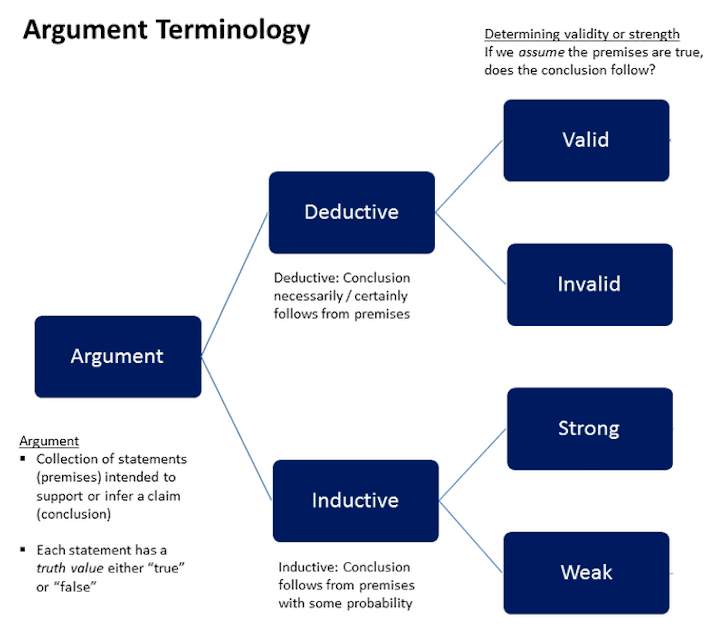
This distinction between validity and strength is the conceptual key to this lesson.
The Principles of Inductive Strength
An inductive argument is one where the premises are intended to support the conclusion, making it more probable. But how do we measure that probability or "strength"? The process is more nuanced than the binary valid/invalid test for deduction.
Episode 1.3: Deductive and Inductive Arguments
This video from the Center for Innovation in Legal Education offers a clear, concise introduction to inductive arguments and a simple framework for evaluating them.
First, watch the definition of an inductive argument. Then, pay close attention to the three key questions for evaluating their strength.
The video gives us a great starting point with three intuitive questions:
- Are the premises true or acceptable?
- Are the premises relevant to the conclusion?
- Are the premises sufficient (or compelling enough) to justify the conclusion?
While these questions provide excellent guidance, we can build a more rigorous framework. Given your background in computer science, you'll appreciate a systematic approach. Logicians break down the evaluation of an argument's strength into two main conditions.
This chapter from A Guide to Good Reasoning introduces a more formal structure for evaluating inductive logic. It will equip you with two powerful analytical tools.
First, read the section "Inductive Arguments Aim for Probability" to solidify the distinction from deduction. Then, read the section "Inductive Arguments Must Fit with the Total Available Evidence". Focus on the definitions of the Correct Form Condition and the Total Evidence Condition. The glossary at the end of the chapter also provides concise definitions for these terms.
Let's unpack those two conditions, as they are fundamental to everything that follows:
- The Correct Form Condition: Just like deductive arguments have valid forms (e.g., modus ponens), inductive arguments have recognizable patterns. Examples include reasoning from a sample to a population (generalization), reasoning from a population to a specific case (what the text calls a frequency argument), or reasoning from one case to another (analogy). The argument must follow one of these established patterns.
- The Total Evidence Condition: This is the crucial difference from deduction. An inductive argument isn't evaluated in a vacuum. Its strength depends on how well its conclusion fits with all the relevant information you have, not just the information presented in the premises. An argument can seem strong based on its premises alone, but be dramatically weakened by a single piece of outside knowledge.
Think of it like testing a function in a program. The premises are the specific inputs you're testing it with. The function might pass those tests. But the "total evidence condition" is like considering all possible edge cases, system states, and user behaviors that aren't in your test suite. A truly robust argument, like a robust program, must hold up against this wider context.
Evaluating Arguments from Analogy
With this general framework in place, let's dive into analogical reasoning. This is where we conclude that because two things are similar in some respects, they are likely to be similar in another. This form of reasoning is at the heart of legal precedent, medical diagnosis, and many scientific breakthroughs.
The strength of an analogy, however, depends entirely on the quality of the comparison. The core principle, which should resonate with your experience in designing abstract systems, is structure over surface. A strong analogy isn't about superficial resemblances; it's about a shared underlying relational structure.
Analogical Reasoning- The Closest Thing To Pure Intelligence
This video, "Analogical Reasoning- The Closest Thing To Pure Intelligence," explores the cognitive science behind analogy and provides a powerful framework for understanding what makes one work.
Watch the first three minutes, which cover the definition of analogical reasoning, the distinction between surface and structural similarity, and the all-important systematicity principle.
The "systematicity principle" is key: deep, interconnected relational systems produce strong analogies. Isolated surface matches produce weak ones. How do we systematically check for this? The following resource provides an excellent, step-by-step method.
5.2 Evaluation of Analogical Arguments – An Introduction to Logic
This chapter from An Introduction to Logic provides six clear criteria for evaluating the strength of an analogical argument. It uses a consistent example to make the criteria easy to understand and apply.
Read the entire chapter. Start with the baseline argument about Alice's philosophy courses. Then, carefully read the explanation for each of the six criteria, making sure you understand how each "tweak" to the baseline argument makes it stronger or weaker.
Let's summarize those six critical criteria. A strong analogical argument generally has:
- More Analogues: More supporting examples (e.g., Alice passing 12 courses is stronger than her passing 4).
- More Variety in the Analogues: The examples are diverse (e.g., Alice succeeding in logic, ethics, and ancient philosophy is stronger than her succeeding in four very similar courses). This shows the shared property holds across different conditions.
- More Similarities: The things being compared share more properties (e.g., the new course is also in Philosophy of Religion, just like the others).
- Fewer Differences: There are few known dissimilarities between the items being compared.
- Relevance of Similarities and Differences: This is the most important criterion and directly relates to the "structure over surface" principle. The shared properties must be relevant to the conclusion. A shared professor is relevant to predicting a grade; a shared classroom building is not.
- A Modest Conclusion: The argument is stronger if it aims for a more probable, less ambitious conclusion (e.g., predicting Alice will pass is a stronger argument than predicting she will get an A).
The Power of "Far" Analogies
Now that you have the tools to dissect and evaluate analogies, let's look at what makes this form of reasoning so powerful. The most creative and insightful analogies are often "far analogies"—those that bridge conceptually distant domains. They are harder to construct but yield greater intellectual rewards.
Your experience in computer science involves this kind of abstract mapping. For instance, representing a social network as a graph, or a logistical problem as a set of linear equations, are forms of far analogy. You're mapping the relational structure of one domain onto a formal structure in another to gain new insights.
Analogical Reasoning- The Closest Thing To Pure Intelligence
Let's return to the video on analogical reasoning to see this principle in action.
First, watch the section on "Semantic Distance" to understand the difference between near and far analogies. Then, watch the brilliant extended example that follows, which constructs a far analogy between fictional characters and Greek gods. Notice how the speaker dismisses attribute matching (surface similarity) and focuses entirely on mapping the relational structure.
The Hannibal/Hades and Sherlock/Athena example is a masterclass. It's not about Hannibal looking like Hades; it's about the relationship between Hannibal and Sherlock (intellect used to take life vs. preserve it) being structurally identical to the relationship between Hades and Athena in their respective domains. This is the essence of a powerful, systematic, and strong analogy.
Conclusion
In this lesson, we ventured into the domain of inductive reasoning, where arguments provide probable, rather than certain, support for their conclusions. We established that the strength of these arguments is not a simple yes/no question but exists on a spectrum from weak to strong.
Here are the essential takeaways:
- Inductive vs. Deductive: Inductive arguments aim for probability and are judged by their strength, while deductive arguments aim for certainty and are judged by their validity.
- Evaluating Induction: A strong inductive argument must have a correct logical form and, crucially, satisfy the total evidence condition—its conclusion must be consistent with all available knowledge.
- Analogical Reasoning: This is a type of inductive reasoning that relies on comparison. Its strength comes from mapping the underlying relational structure between two domains, not just their surface features.
- Criteria for Strong Analogies: Strong analogies are supported by a good number and variety of relevant similarities, have few relevant differences, and typically lead to modest, rather than overly ambitious, conclusions.
You now have a complete introductory toolkit for analyzing arguments. You can identify their structure, assess deductive validity and soundness, spot informal fallacies, and now, evaluate the strength of inductive and analogical claims.
In our final lesson for this module, we will discuss a crucial mindset for applying these tools effectively: the principle of charity. This principle guides us to interpret an argument in its strongest possible form before we critique it, ensuring our analysis is fair, rigorous, and aimed at finding the truth.