Greetings. In our last session, we focused on Logical Reasoning, tackling syllogisms and pattern-based problems. We will now build on that analytical foundation by moving into Mathematical Reasoning. This is a pivotal lesson, as the concepts we cover today—percentages, ratios, and averages—are not only tested in standalone questions but are also the fundamental tools required to solve the entire Data Interpretation (DI) section.
Your goal is to maximize your score in this competitive exam, and fluency with these mathematical concepts is non-negotiable for achieving that. This lesson is designed for both accuracy and speed. We will first establish the core formulas and then dive into time-saving shortcuts and their application to exam-style problems.
1. The Core Formulas: Your Mathematical Toolkit
Success in this section begins with a solid understanding of a few key formulas. While you may have encountered these before, our focus here is on their specific application within the context of the NET exam.
The article "Data Interpretation Questions for UGC NET" provides an excellent, concise summary of these essential formulas.
Data Interpretation Questions for UGC NET
This resource neatly organizes the core formulas for percentages, ratios, and averages, which are the building blocks for this lesson.
Please read the first two subsections, Percentage and Ratio Formulas and Average and Growth Rate Formulas. As you read, focus on understanding the structure of these formulas, particularly: Percentage Change: Notice the denominator is always the original value (Old). This is a common point of error. Weighted Average: Pay attention to how frequency or "weight" changes the calculation compared to a simple average. Reverse Percentage: Understand the logic of finding the total value from a given part and its percentage share.
To supplement this reading, let's watch a clear explanation of how these formulas are applied in comparison-style questions, which are very frequent in the exam.
Data Interpretation Basics | Percentage, Average, Ratio | UGC NET 2022 Paper 1
This video by Global Online provides worked-out examples that bring the formulas to life. We will focus on the percentage section.
Watch the segment from 8:01 to 30:37. The instructor clearly explains the logic of "what to compare / with whom to compare" and walks through examples of: Simple Percentage: A is what % of B? Percentage Increase/Decrease: A is what % more/less than B? Pay close attention to the distinction between these two types of questions, as the base of the calculation (the denominator) changes.
2. Developing Speed: Shortcuts and Mental Math
In a timed exam like the UGC NET, knowing the formula is only half the battle. Calculation speed is what separates a good score from a great one. We will now focus on techniques to solve problems faster.
Fraction-to-Percentage Conversion
Many calculations can be simplified by converting percentages into their common fraction equivalents. Memorizing these is a high-yield investment of your time.
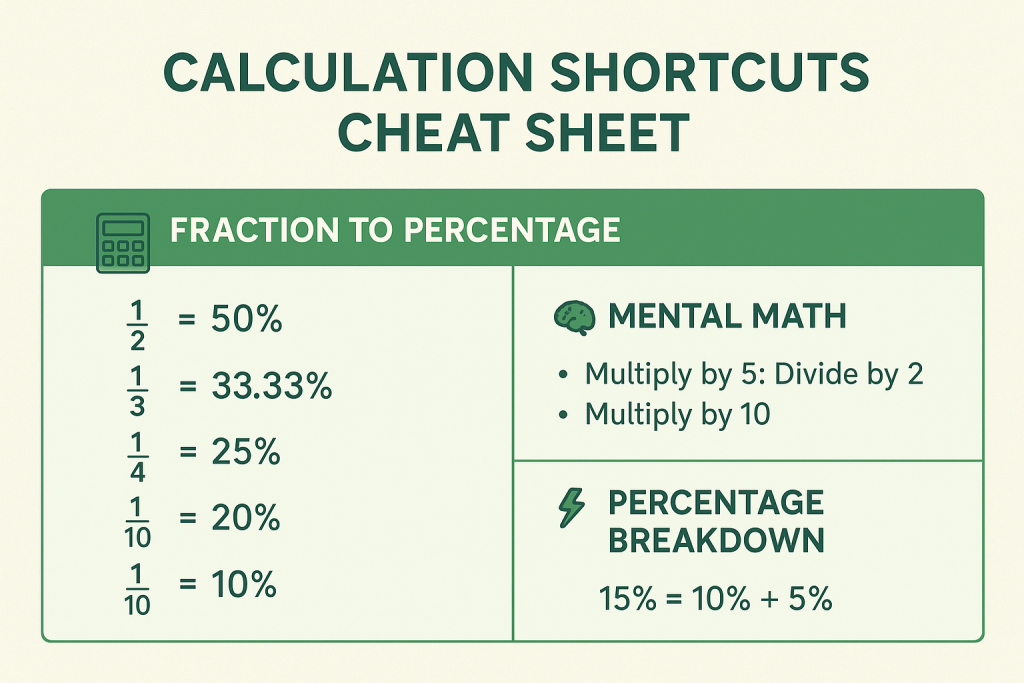
For a deeper dive into these time-saving strategies, let's return to our previous article.
Data Interpretation Questions for UGC NET
This section focuses on practical techniques to reduce calculation time, which is critical for your crash course approach.
Read the subsections Approximation Techniques and Fraction to Percentage Conversion Tricks. Focus on the "10% rule" for approximation and the "Decomposition technique" for mental calculation.
Quick Calculation Tricks
Let's watch a very short video that demonstrates a powerful shortcut for calculating percentages when numbers end in zero—a common scenario in DI questions.
Solving Percentage Problems in Few Seconds
This video offers a simple but effective trick for quick percentage calculations.
Watch from the beginning to 1:38 to see how to calculate percentages like "40% of 70" by simply cancelling the zeros and multiplying the digits (4 x 7 = 28). Then, watch from 2:38 to 3:07 to understand that 25% of a number is the same as dividing it by 4.
3. Application and Practice
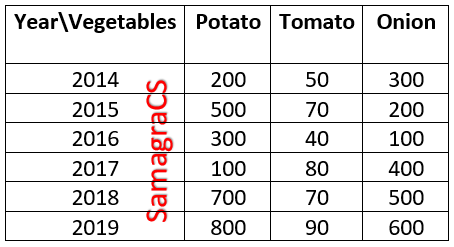
Now, let's apply these concepts and shortcuts to exam-style problems. We'll use the following dataset for our practice.
Problem 1: Percentage Change
Question: What was the approximate percentage increase in the production of Potato from 2017 to 2019?
Solution Walkthrough:
- Identify the values:
- Potato production in 2017 (Old value) = 100
- Potato production in 2019 (New value) = 800
- Apply the formula: Percentage Change =
- Calculate: The production increased by 700%.
Problem 2: Average
Question: What was the average production of Onion across all six years?
Your Turn:
- Sum the Onion production values for all years (2014-2019).
- Divide the total sum by the number of years (which is 6).
- Calculate the final average.
Click to see the solution
1. **Sum of Onion production:** 300 + 200 + 100 + 400 + 500 + 600 = 2100 2. **Number of years:** 6 3. **Average:** $ \frac{2100}{6} = 350 $ The average production of Onion was 350 units.Problem 3: Ratio
Question: What is the ratio of the total production of Tomato to the total production of Potato over the entire period (2014-2019)?
Your Turn:
- Calculate the total production of Tomato for all years.
- Calculate the total production of Potato for all years.
- Express these two totals as a ratio (Total Tomato : Total Potato) and simplify it to its lowest terms.
Click to see the solution
1. **Total Tomato production:** 50 + 70 + 40 + 80 + 70 + 90 = 400 2. **Total Potato production:** 200 + 500 + 300 + 100 + 700 + 800 = 2600 3. **Ratio:** 400 : 2600 4. **Simplify:** Divide both sides by 100 to get 4 : 26. Then divide both sides by 2 to get the simplest form, **2 : 13**.Conclusion
In this lesson, we have systematically covered the three pillars of mathematical reasoning for Paper 1: percentages, averages, and ratios. You now have the core formulas and, just as importantly, a set of time-saving techniques to apply them efficiently under exam pressure.
Key Takeaways:
- Master the Formulas: The formulas for percentage change, simple average, and ratio are your essential tools. Know them cold.
- Distinguish Question Types: Be precise. "What % of" is different from "what % more than." The base of your calculation changes.
- Speed is a Skill: Use approximation, fraction-to-percentage conversion (1/4 = 25%, 1/5 = 20%, etc.), and mental math shortcuts to save valuable seconds on each question.
- Practice is Foundational: These skills are built through repetition. You can find an extensive library of past papers for practice on sites like Human Peritus (LINK), which we've added to your resources.
The skills you've honed today are the direct prerequisites for our next topic. In the upcoming lesson, we will tackle the full Data Interpretation (DI) section. You will learn how to apply your knowledge of percentages, averages, and ratios to interpret tables, bar charts, pie charts, and line graphs to answer the 5-question sets that are a guaranteed feature of the NET exam.