Welcome to the first lesson in our module on transforming the delivery process. As you embark on designing a large-scale transformation, one of the most critical decisions revolves around how work gets done. Moving from legacy methods to a modern, Agile approach at an enterprise scale is a complex undertaking that requires a structured delivery framework.
This lesson will equip you with the knowledge to navigate this crucial choice. We will address two fundamental questions:
- Which enterprise Agile framework is right for your organization's context?
- How do you assess your organization's current delivery maturity to establish a baseline for transformation?
We will compare several dominant enterprise Agile frameworks, focusing on their core philosophies, organizational impact, and ideal use cases. Then, we will explore a model for assessing delivery maturity that looks beyond team-level practices to evaluate the entire system's adaptability.
Comparing Enterprise Agile Frameworks
When a small team adopts Agile, it's relatively straightforward. However, scaling these practices across dozens or hundreds of teams in a large B2B software company introduces challenges of coordination, dependency management, and strategic alignment. Enterprise Agile frameworks were created to solve this problem, but they do so in very different ways.
To get a quick overview of the most common frameworks, please start by watching this short video.
Scaled Agile Framework Explained – Lean, SAFe, Scrum of Scrums, LeSS, DA, Crystal + PMP Questions
The video "Scaled Agile Framework Explained" by PM Aspirant provides a concise introduction to several key frameworks.
Please watch the introduction to understand the scope of scaling challenges, and then skip to the quick summary at the end, which recaps the core focus of Lean, SAFe, Scrum of Scrums, LeSS, Disciplined Agile, and Crystal.
As you saw, these frameworks offer a spectrum of solutions. Now, let's delve deeper into the most prominent ones you'll encounter: SAFe, LeSS, Disciplined Agile, and Scrum@Scale. The following chart provides a helpful visual map of how they compare in terms of management style and intended team size.
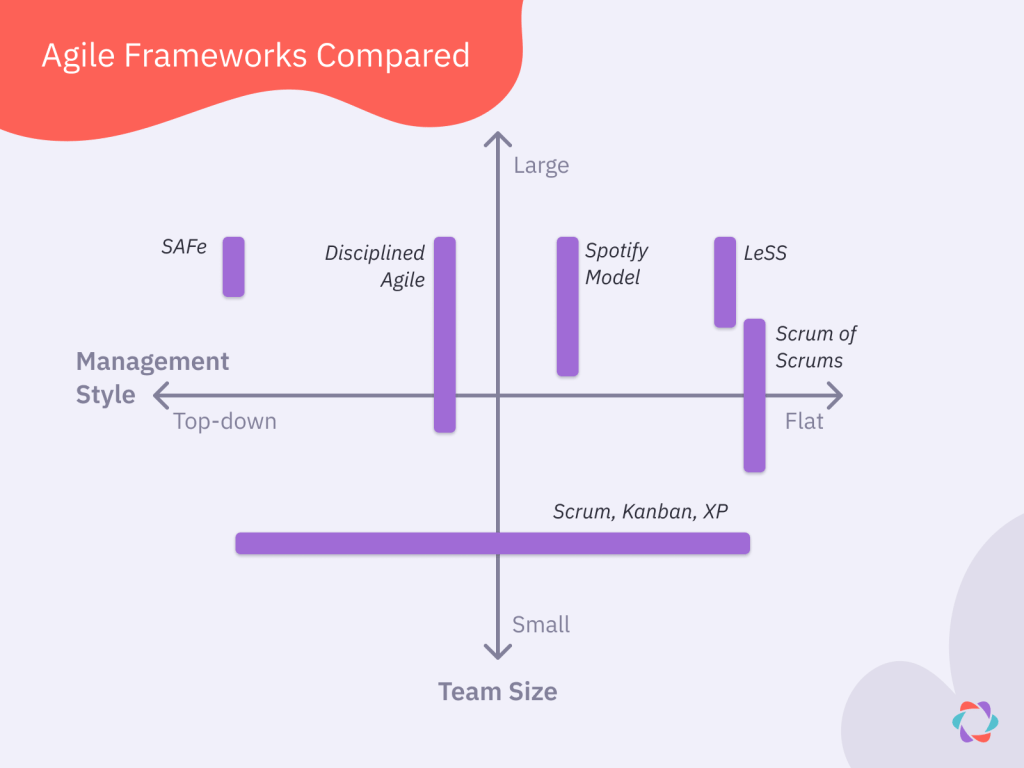
To understand the practical differences, we will use the article "Agile Frameworks for Large Enterprises: Comparison" from Upskillist. It provides an excellent breakdown of each framework's structure, complexity, and organizational fit.
Agile Frameworks for Large Enterprises: Comparison - Upskillist
This article offers detailed explanations and direct comparisons of the major enterprise Agile frameworks. It will help you understand the strategic trade-offs involved in selecting one.
Please read the following sections: Start with the section on SAFe (Scaled Agile Framework). Read this section to understand its highly structured, multi-level approach, the concept of the Agile Release Train (ART), and its suitability for large, regulated enterprises. Next, read the section on LeSS (Large-Scale Scrum). Pay attention to how it aims to simplify scaling by sticking to core Scrum principles, using a single Product Owner, and promoting a flatter organizational structure. Then, review the section on Disciplined Agile (DA). Focus on how it functions as a flexible toolkit, allowing organizations to "choose their way of working" by tailoring practices to their specific context. Continue to the section on Scrum@Scale. Note its lightweight, networked approach, which builds on existing Scrum proficiency and is designed for organic, flexible scaling. Finally, read the Framework Comparison: Pros and Cons section. The entire section, including the summary table, crystallizes the key strengths, limitations, and trade-offs between these frameworks.
From this reading, a clear pattern emerges. The choice of a framework is a strategic decision that reflects and shapes organizational culture and structure.
-
SAFe is prescriptive and hierarchical. It provides a comprehensive, top-down structure that can feel familiar and reassuring to traditional organizations, especially in regulated industries like finance (which aligns with your BFSI background). It scales to thousands of people but is often criticized for being "Agile in name only" due to its complexity and process overhead. Its core unit is the Agile Release Train (ART), a team-of-teams that plans work together in Program Increment (PI) Planning events.
-
LeSS is the philosophical opposite. It's a minimalist framework that scales by descaling the organization—removing layers of management and processes. It insists on one Product Backlog and one Product Owner for up to eight teams, forcing a radical focus on the product and organizational simplification. It is a powerful choice for product-centric companies but requires significant commitment to organizational change.
-
Disciplined Agile (DA), now owned by the Project Management Institute (PMI), isn't a single framework but a decision-making toolkit. It guides you in "choosing your way of working" by drawing from Scrum, Kanban, Lean, and more. This pragmatism is valuable in complex enterprises with diverse teams and projects, but it requires higher Agile maturity and skilled coaching to be effective.
-
Scrum@Scale is another lightweight option that extends the basic Scrum framework. It creates a network of "Scrums of Scrums" that can scale organically. Its appeal lies in its simplicity and the fact that it builds directly on what Scrum teams already know.
As a transformation leader, your role isn't just to pick a framework but to understand the deep organizational implications of that choice. Are you guiding a company that needs the structured guardrails of SAFe, or one that is ready for the deep, systemic changes required by LeSS?
Assessing Current Delivery Process Maturity
Before you can choose a path forward, you must know where you stand. Simply adopting a scaling framework without understanding your organization's current maturity is a common cause of transformation failure. Prematurely scaling can amplify existing dysfunctions, creating the illusion of progress while embedding inefficiency deeper into the operating model.
An effective maturity assessment goes beyond checking if teams are doing daily stand-ups. It evaluates the entire system's ability to deliver value and adapt.
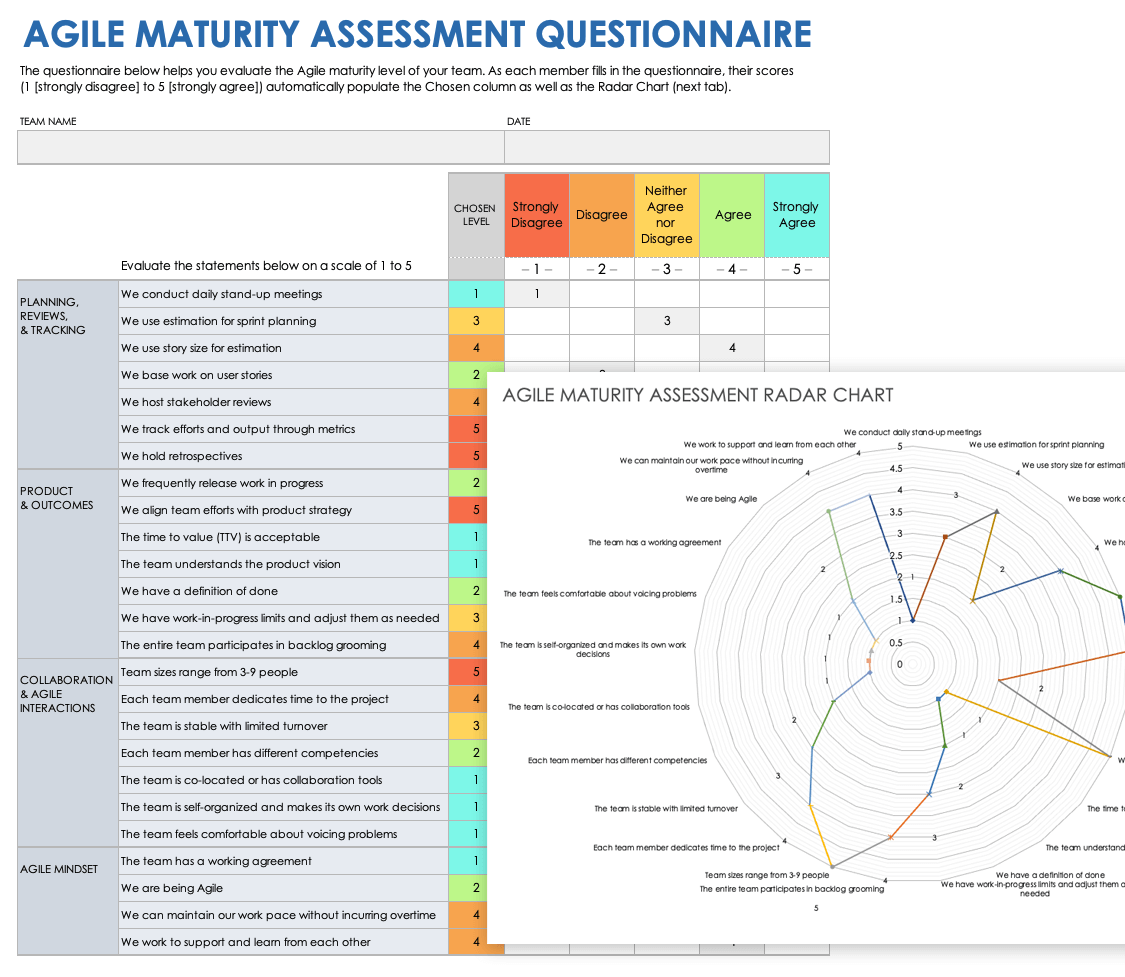
The questionnaire above is a good example of a team-level diagnostic tool. It can reveal important insights about individual teams. However, for an enterprise-wide transformation, you need a more strategic lens. True enterprise agility is constrained by systemic factors like funding models, governance, and decision-making speed, not just team practices.
The following resource presents a powerful model for assessing maturity at the enterprise level.
Agile Transformation Maturity Model: 5 Stages For Enterprises
This article from NextAgile.ai introduces a five-stage maturity model focused on enterprise-level adaptability and decision effectiveness, providing a strategic diagnostic tool for transformation leaders.
Please read the following sections: Begin with the introduction and the section "What Is the Agile Transformation Maturity Model?" to understand how this model differs from generic, team-focused assessments. Note the emphasis on "decision effectiveness at scale." Next, carefully study the core of the article: "The 5 Stages of the Agile Transformation Maturity Model". For each of the five stages (Initiated, Experimenting, Defined, Scaled, Business Agility), focus on the Enterprise Signals and the associated Risks. These are the key diagnostic indicators you would look for as a consultant. Pay special attention to Stage 3, the "Critical Plateau Stage," where many transformations stall.
This five-stage model gives you a powerful vocabulary and framework to diagnose an organization's true state.
- Stage 1 (Initiated): Characterized by traditional, project-based structures and waterfall delivery. Agile is non-existent or misunderstood.
- Stage 2 (Experimenting): Pockets of Agile (often Scrum) emerge. There are early wins, but practices are inconsistent and disconnected from business strategy. The risk is "local optimization" without enterprise-wide impact.
- Stage 3 (Defined): This is the critical plateau. The organization tries to standardize Agile practices. Delivery teams get faster, but because decision-making, funding, and governance remain centralized and slow, value delivery does not accelerate. This is the moment a scaling framework like SAFe is often introduced, sometimes prematurely.
- Stage 4 (Scaled): The organization has implemented a scaling framework. Multiple teams are coordinated, but there's a new risk: process-heavy scaling that loses sight of business outcomes.
- Stage 5 (Business Agility): The organization operates as an adaptive system. Strategy, funding, and operations are aligned and can pivot quickly in response to market changes.
As an Organizational Design Consultant, this model provides a robust diagnostic tool. By identifying an organization's current stage—paying close attention to the systemic blockers characteristic of that stage—you can design a transformation strategy that addresses the root causes of inertia, rather than just treating the symptoms.
Conclusion
In this lesson, we explored the critical first steps in a delivery process transformation. You now have a comparative understanding of the major enterprise Agile frameworks and the strategic trade-offs they entail.
Here are the key takeaways:
- Enterprise Agile frameworks solve the problem of scaling, but they represent a spectrum of philosophies, from the prescriptive, hierarchical approach of SAFe to the minimalist, product-focused model of LeSS.
- The choice of framework is a significant organizational design decision that must align with the company's culture, maturity, and strategic goals.
- Assessing delivery maturity is a crucial prerequisite to transformation. This assessment must go beyond team-level practices to diagnose systemic constraints in governance, funding, and decision-making.
- The five-stage maturity model provides a strategic framework to identify an organization's current state and the specific challenges that must be overcome to advance to the next level of agility.
In our next lesson, we will move from the "what" and "why" to the "who." We will discuss how to structure your teams for success in a modern delivery model by exploring team topologies and roles suitable for a microservices-based delivery model. This will build directly on the framework choices and maturity assessments we have covered today.