Welcome back. In our last lesson, we focused on assembling the "engine" of your transformation—the guiding coalition—and the strategies needed to sustain its momentum. Now that we have the leadership team in place, it's time to give them a clear and compelling destination.
This lesson tackles the heart of strategic leadership in any transformation: defining a powerful vision and translating it into a concrete plan of action. We will explore how to craft a transformation vision that inspires and aligns the organization, and then break that vision down into actionable strategic pillars for product, delivery, and go-to-market (GTM). For anyone in a role focused on organizational design and strategy, mastering this is the bridge between analysis and execution.
From Abstract Goal to Compelling Vision
Every transformation starts with a goal, but a goal isn't a vision. A goal might be "increase market share by 10%," whereas a vision paints a vivid picture of the future that makes such a goal possible. It's the answer to the question, "What will our company, our product, and our customer relationship look like in 3-5 years if we succeed?"
In product management, this is often described as knowing what it looks and feels like to be at the top of the mountain you're climbing. Let's start by grounding our understanding of vision in this context.
From Product Vision to Delivery | Bootcamp - Medium
This article by Alex Tzukerman provides a practical model for product management, starting with the foundational role of vision.
Read the initial section on Vision and Business Objectives. Notice the emphasis on a "highly tangible picture" of the future and its connection to the business's "North Star."
A vision statement on a poster is insufficient. A compelling vision functions as a strategic narrative. It tells a story about the customer's journey from a difficult present to a desirable future—a future your company enables. A powerful framework for this is the "Old Game vs. New Game" narrative.
This idea is central to the first pillar of growth discussed in the following article. As you read, think about how this narrative approach transforms a simple goal into a compelling call to action.
The Three Pillars of Predictable SaaS Growth - Product Marketing Hive
This article from Product Marketing Hive argues for a systematic transformation of go-to-market strategy, starting with narrative design.
Read the introduction to the three pillars and the detailed section on Pillar 1. Focus on the "Old Game vs. New Game" framework and the idea of narrative as an "operating philosophy" for cross-functional alignment, not just a marketing exercise.
The "New Game" narrative is compelling because it shifts the focus from your product's features to the customer's transformation. It answers the "why" behind the change, which is essential for mobilizing the organization.
But where does this story come from? As product expert Marty Cagan explains, great strategy—and therefore a great vision—is the output of deep, immersive work. It is not born in a single brainstorming session. It emerges from a synthesis of insights.
Moving to the Product Operating Model, w/ Marty Cagan
In this talk, Marty Cagan of the Silicon Valley Product Group discusses the core components of the "Product Operating Model" used by top tech companies.
First, watch the segment where he describes the three dimensions of a product company, paying close attention to the third one: how you decide which problems to solve. Then, skip ahead to the section where he details product strategy, and note the four sources of insight he identifies: customers, data, technology, and the industry.
Cagan's point is critical: your vision must be grounded in reality. It is the articulation of the most important problems to solve, derived from a deep understanding of your market, your data, and what is now possible with technology like AI.
Translating Vision into Strategic Pillars
A vision provides the destination, but it doesn't specify the route. Strategic pillars do. They are the 3-5 fundamental areas of focus that must be addressed to make the vision a reality. They break down the grand vision into manageable, but still strategic, workstreams.
The image below shows a classic framework where pillars form the foundation that supports the organization's mission and ultimately its vision.
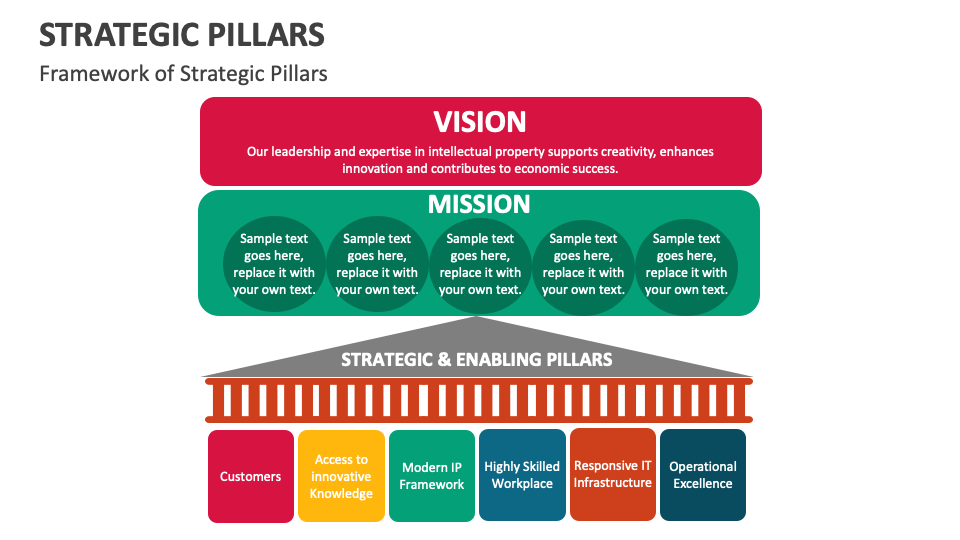
For a B2B software transformation, your pillars must connect directly to the core functions of the business. The learning outcome specifies three essential ones: Product, Delivery, and Go-to-Market (GTM).
1. The Product Pillar
This pillar answers the question: What will we build?
It defines the future state of the product that will enable the "New Game" for your customers. In the context of a major transformation, this pillar would outline the shift from a monolithic architecture to microservices, the integration of AI-driven features, or the creation of a new, modular product suite. This pillar is the direct manifestation of the product strategy Cagan described.
2. The Delivery Pillar
This pillar answers the question: How will we build it?
A transformational product vision cannot be built using legacy processes. This pillar addresses the necessary evolution of your engineering practices, team structures, and development culture. It's about creating a modern "delivery engine" capable of shipping high-quality software rapidly and reliably. This often involves adopting DevOps, continuous integration/continuous delivery (CI/CD), and new team topologies.
The diagram below illustrates the activities within a modern DevOps lifecycle, representing the operational core of a strong Delivery pillar.

3. The Go-to-Market (GTM) Pillar
This pillar answers the question: How will we successfully bring our new product to market and deliver value to customers?
A transformed product requires a transformed GTM strategy. You cannot sell a modular, AI-powered platform the same way you sold a monolithic, on-premise system. This pillar encompasses changes to:
- Positioning & Messaging: Articulating the "New Game" narrative.
- Pricing & Packaging: Shifting from perpetual licenses to consumption-based or tiered subscriptions.
- Sales Motion: Moving from long, feature-focused sales cycles to value-based conversations and land-and-expand models.
- Customer Success: Proactively guiding customers through adoption rather than reactively providing support.
This short video provides an excellent, practical overview of the core components that make up a GTM strategy.
Go To Market Plan - 6 Steps to Creating a Go-to-Market Plan
This video by TK Kader breaks down the creation of a go-to-market plan into six actionable steps.
Watch the entire video (6 steps) to see how the strategic elements fit together. Pay attention to how defining the market, understanding macro trends, positioning, competitive analysis, and messaging all precede the final step of execution. This sequence is fundamental to building your GTM pillar.
An Integrated System, Not a Set of Silos
Crucially, these pillars are not independent workstreams. They are an interconnected system where progress in one area enables and depends on progress in the others.
- The Product vision (e.g., an AI-driven recommendation engine) dictates the skills and tools needed by the Delivery team.
- The speed and agility of the Delivery team allow the GTM team to test pricing and messaging rapidly.
- Feedback gathered by the GTM team from early customers directly informs the priorities of the Product roadmap.
The article on SaaS growth explains this synergy well.
The Three Pillars of Predictable SaaS Growth - Product Marketing Hive
Let's return to the Product Marketing Hive article to understand how these pillars must work together.
Read the section Bringing It All Together. Although the pillars discussed here are different, the underlying principle of synergy and integration is universal and directly applicable to our Product, Delivery, and GTM pillars.
Failing to manage these pillars as an integrated system is a common cause of transformation failure. You might build a brilliant AI-driven product, but if your sales team isn't trained to sell value and your delivery team can't ship updates reliably, the vision will never be realized.
Conclusion
In this lesson, we established the strategic direction for our transformation. We moved from the abstract concept of a goal to a tangible, compelling vision framed as a narrative of customer transformation. We then translated that high-level vision into three concrete, interconnected strategic pillars—Product, Delivery, and Go-to-Market—that provide a roadmap for execution.
Key Takeaways:
- A compelling transformation vision is a tangible picture of a future state, framed as a narrative that moves the customer from an "Old Game" to a "New Game."
- This vision must be grounded in deep insights from customers, data, technology, and the broader industry.
- Strategic pillars (e.g., Product, Delivery, GTM) are the critical focus areas that break the vision down into an actionable strategic plan.
- These pillars must be managed as an integrated system, as they are deeply interdependent.
You now have a destination (the vision) and a map (the strategic pillars). The next step is to secure the resources and formal buy-in to begin the journey. In our next lesson, we will focus on structuring the transformation business case and creating a transformation charter to align leadership and justify the investment.