Welcome to your third lesson. In our previous session, we established the importance of structuring C programs into multiple source (.c) and header (.h) files. You learned that this modular approach is crucial for managing complexity and that the preprocessor's #include directive works by literally copy-pasting the contents of a header file into a source file.
This lesson directly addresses a critical problem that arises from that copy-paste mechanism. We will explore what happens when a header file is included multiple times within a single compilation unit, leading to errors. By the end of this lesson, you will be able to use header guards, the standard C idiom for preventing these multiple inclusion errors, ensuring your multi-file projects are robust and error-free.
The Diamond Dependency Problem
In any non-trivial program, especially a game, you'll have complex relationships between your modules. Imagine a scenario with three headers: player.h, world.h, and stream.h. Let's say both the player and the world need functionality for streaming data (e.g., for saving/loading), so both player.h and world.h include stream.h. Now, your main game file, main.c, needs to manage both the player and the world, so it includes player.h and world.h.
This creates a "diamond" dependency structure, as illustrated below.

Because #include is a simple copy-paste operation, when main.c is compiled, the preprocessor first includes player.h, which in turn pastes the entire contents of stream.h. Then, it includes world.h, which also pastes the entire contents of stream.h. The result is that the compiler sees the definitions inside stream.h (like struct definitions or typedefs) twice in the same file, which violates C's One Definition Rule (ODR) and results in a compilation error.
Visualizing the Error
To see this problem in action, let's watch a short video. The example is in C++, but the preprocessor behavior and the error it causes are identical in C. The key is to understand why the compiler complains.
Software Development with C++: Header Guards
The video "Software Development with C++: Header Guards" by Nick clearly demonstrates the redefinition error and then uses a powerful technique to show exactly what the preprocessor is doing.
First, watch the segment from the beginning, which sets up a classic diamond dependency and shows the resulting "redefinition of struct" error. Next, watch the crucial explanation from pre-processing. The speaker uses the compiler flag -E to show the preprocessed output, visually confirming that the header's content has been copied twice. This is a key insight into the build process.
The -E flag is a valuable tool for debugging preprocessor issues, as it stops the compilation process after the preprocessor runs and prints the resulting expanded source code to the terminal. It transforms the abstract concept of "copy-pasting" into something you can see and verify.
The Solution: Conditional Compilation with Header Guards
The solution is to tell the preprocessor: "Only include the contents of this header if you haven't included it already during the compilation of this specific source file." We achieve this using a standard preprocessor idiom called a header guard.
A header guard is composed of three preprocessor directives:
#ifndef MACRO_NAME(if not defined)#define MACRO_NAME#endif
The logic works like this:
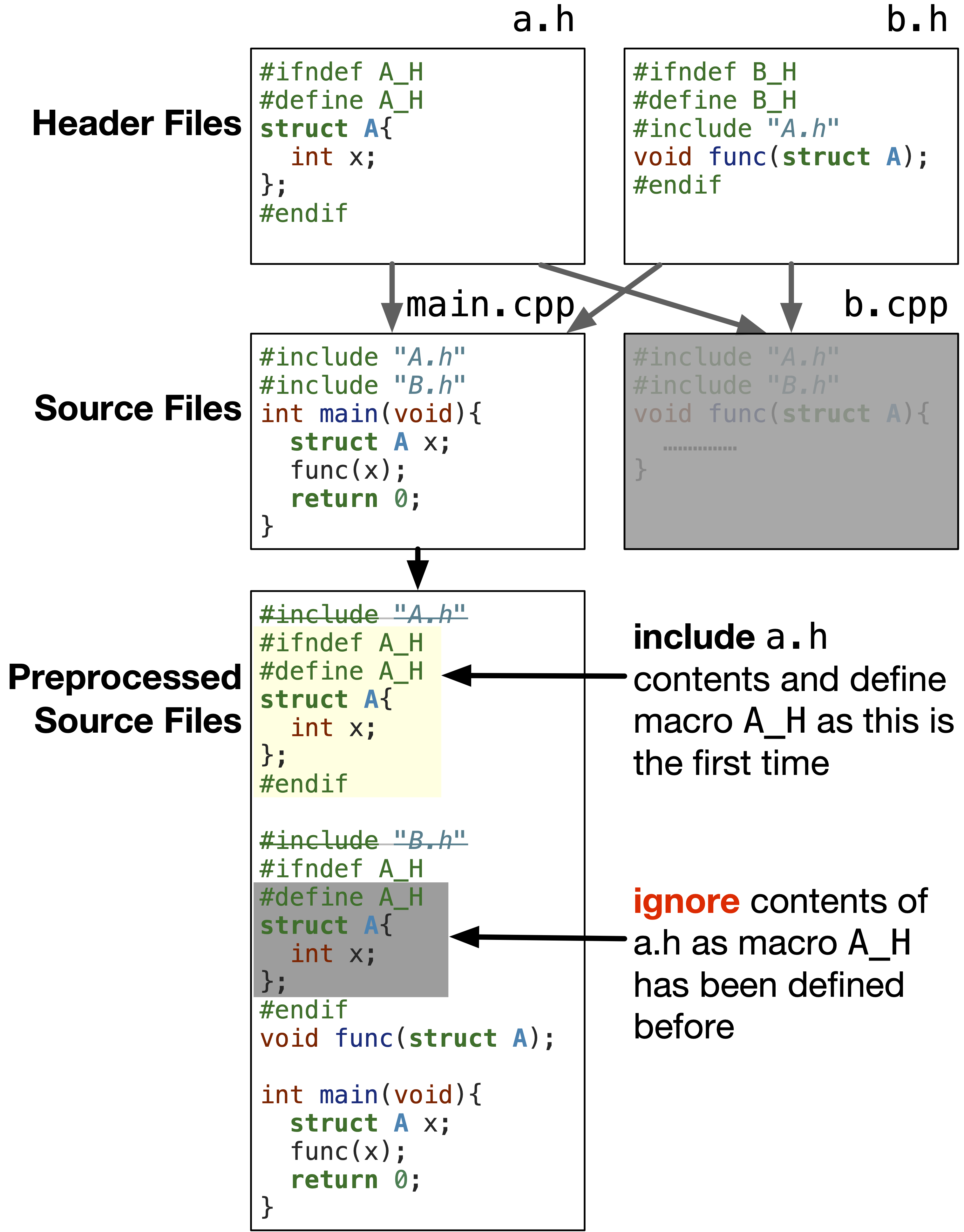
- The first time the preprocessor encounters the header file (e.g.,
stream.h), it checks#ifndef STREAM_H. Since this is the first time, the macroSTREAM_Hhas not been defined, so the condition is true. - It then immediately executes
#define STREAM_H, defining the macro. - It proceeds to include all the content within the header, down to the
#endif. - Later, when the preprocessor encounters the same header file again within the same compilation unit, it checks
#ifndef STREAM_Ha second time. This time, the condition is false becauseSTREAM_His now defined. - The preprocessor then skips all the content between
#ifndefand#endif, completely avoiding the second inclusion.
The following video provides a practical demonstration of adding these guards to solve the problem.
Include Guards | C Programming Tutorial
The video "Include Guards | C Programming Tutorial" by Portfolio Courses walks through a C-specific example, clearly showing the error and how to fix it with traditional include guards.
Please watch from the beginning of the video. This will cover the "double inclusion problem" and demonstrate how to implement the #ifndef/#define/#endif solution. Pay attention to the convention used for naming the macro.
Naming Conventions are Critical
The macro used for the guard must be unique across your entire project. If two different header files accidentally use the same guard macro, the second header to be included will be silently skipped, leading to "undefined reference" errors that can be very difficult to debug.
The standard convention is to name the macro after the header file itself, in all uppercase, with underscores replacing periods or other special characters. For a file named my_game/player.h, a robust guard macro would be MY_GAME_PLAYER_H.
The diagram below shows how the preprocessor logic changes once header guards are in place, preventing the redefinition.
An Alternative: #pragma once
You will often encounter another, simpler-looking directive used for the same purpose: #pragma once.
Placing #pragma once at the top of a header file tells the compiler to ensure the file is only included once. It achieves the same goal as the #ifndef/#define/#endif trio but with less boilerplate code and no risk of macro name collisions.
Include Guards | C Programming Tutorial
The same video from Portfolio Courses also introduces this alternative.
Watch the final segment on pragma once. The video explains its benefits in terms of simplicity.
So, Header Guards or #pragma once?
If #pragma once is simpler and safer, why doesn't everyone use it? The answer lies in standardization and portability. The #ifndef technique is part of the C standard, meaning every compliant C compiler in existence must support it. #pragma once, on the other hand, is a non-standard but widely supported extension.
For your goal of C mastery and building a robust game engine from the ground up, understanding the trade-offs is important.
To guard or not to guard: Header guards x pragma once
This article provides a superb, concise analysis of the two approaches and offers a well-reasoned conclusion for serious software development.
Please read the article from the Header guards section to the end. Focus on the author's arguments in the sections Why can’t I just use #pragma once? and their final recommendation.
As the article concludes, traditional header guards are "trustworthy." While #pragma once is convenient and will work in most cases with modern compilers (like GCC, Clang, and MSVC), it has known edge-case failures with certain file system setups (like symbolic links). For maximum portability and to guarantee correctness, the standard #ifndef guard is the professional's choice. We will use it as the standard in this course.
Practical Application
Let's apply this to the project from our last lesson.
- Open the
add.hfile you created. - Add a header guard to it. The file should now look like this:
#ifndef ADD_H
#define ADD_H

int add(int a, int b); // Function declaration


#endif // ADD_H
Note: Adding a comment with the macro name to the #endif is a common and helpful practice for readability, especially in long files.
After adding the guard, re-compile your calculator program using the same commands as before to confirm everything still works. While this simple project doesn't suffer from the double inclusion problem, it is an essential best practice to add a header guard to every header file you write, without exception. Most modern IDEs and code editors can be configured to do this automatically when you create a new header file.
Conclusion
You have now mastered a crucial mechanism for building clean, scalable, and robust C programs. By preventing multiple inclusion errors, header guards eliminate a whole class of frustrating bugs that can arise in complex projects.
Key Takeaways:
- Including the same header multiple times in one source file (often indirectly) causes redefinition errors due to the preprocessor's copy-paste nature.
- The standard solution is the
#ifndef/#define/#endifheader guard, which uses conditional compilation to ensure a header's content is processed only once per compilation unit. - The macro name for a guard must be unique to avoid conflicts; a common convention is
FILENAME_H. #pragma onceis a simpler, non-standard alternative, but for maximum portability and guaranteed correctness, traditional header guards are the preferred method.
In our next lesson, we will shift our focus from project structure to the data itself. We will begin our deep dive into the C type system by exploring integer types, their sizes in memory, and the critical concept of overflow.