Welcome to your fifth lesson. In our previous session, we established that C's integer types have fixed, finite sizes on any given machine, and you learned to verify these sizes using the sizeof operator. This naturally led to a critical question: what happens when we try to store a number that's too big for its data type?
Today, we will answer that question by exploring integer overflow and underflow. This lesson is crucial, as you've noted that the C type system is an area you want to reinforce. We will move beyond simply knowing the types and into understanding their behavior at the limits. You will learn to predict what happens when an integer overflows, see how the behavior differs for signed and unsigned types, and learn practical techniques to handle and prevent these potentially dangerous bugs. This knowledge is fundamental for writing robust and secure low-level code, a key part of your goal to master C for game development.
Let's start with a helpful visual overview of the concepts we'll be covering.
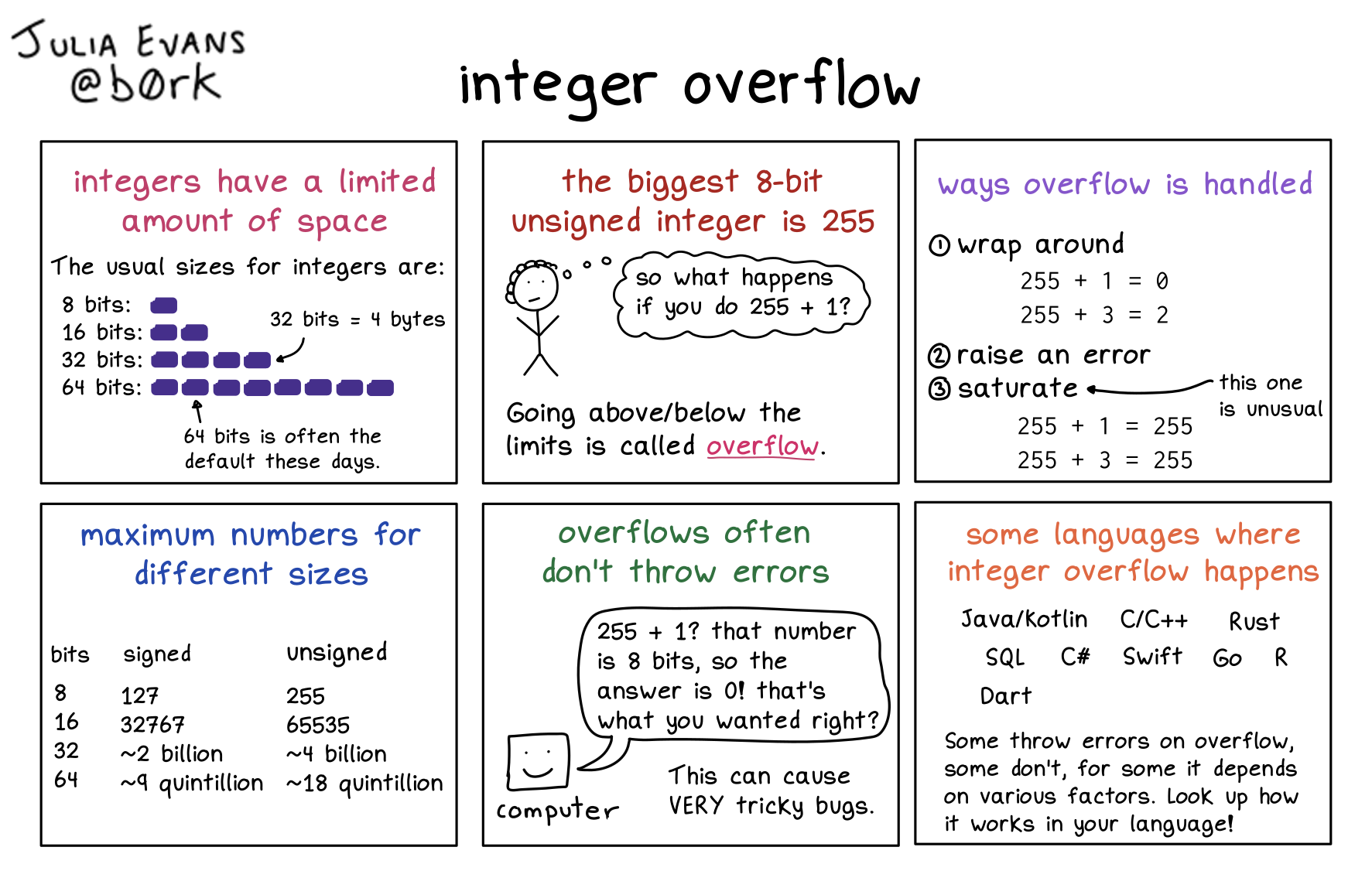
This comic by Julia Evans provides a fantastic summary of integer overflow: numbers have limits, and exceeding them can lead to unexpected behavior that varies between programming languages.
Unsigned Integers: The Predictable Wraparound
Unsigned integers in C have a behavior that is easy to predict because it is well-defined by the standard. They act like an odometer in a car: after reaching its maximum value, it "wraps around" back to zero. The same happens in reverse for underflow; subtracting 1 from 0 causes it to wrap around to the maximum possible value.
This behavior occurs because of the underlying binary arithmetic. For example, an 8-bit unsigned integer can hold values from 0 to 255. In binary, 255 is 11111111. If you add 1, you get 100000000. But since the type can only store 8 bits, the leading 1 is discarded, leaving 00000000, which is 0.
Video games, especially older ones, provide some classic examples of this. The following video illustrates this wraparound behavior with bugs and mechanics from Pac-Man and Final Fantasy.
Signed and Unsigned Binary Numbers
The video "Signed and Unsigned Binary Numbers" from the Mental Outlaw channel gives excellent, game-related examples of both overflow and underflow.
Watch the segment from Pac-Man to Final Fantasy. Pay attention to: How the level counter in Pac-Man overflows from 255 to 0, causing the infamous "split-screen" level. How subtracting a small amount of money from a very low total in Final Fantasy causes an underflow, wrapping the value around to the maximum possible amount.
You can easily replicate this yourself with a short C program:
#include <stdio.h>

int main(void) {
    unsigned char u_char_val = 255;
    printf("Initial unsigned char: %u\n", u_char_val);

    u_char_val = u_char_val + 1;
    printf("After adding 1 (overflow): %u\n", u_char_val);

    u_char_val = u_char_val - 1;
    printf("After subtracting 1 (underflow): %u\n", u_char_val);

    return 0;
}
When you run this, you will see the overflow wrap to 0 and the subsequent underflow wrap back to 255. This predictable behavior is something you can, in rare cases, even use intentionally, but more often it's something you need to guard against.
A famous, non-malicious bug caused by unsigned integer underflow is the "Nuclear Gandhi" bug in the game Civilization. This next reading explains how a simple subtraction caused a peaceful leader to become the most aggressive character in the game.
Overflow and Underflow in C - Scaler Topics
This article from Scaler Topics clearly defines underflow and provides the classic "Nuclear Gandhi" example.
Please read the sections What is Integer Underflow? and the first paragraph of the Gandhi example. This demonstrates how a seemingly innocuous design choice (using an unsigned integer for an "aggressiveness" score) can lead to hilarious and unexpected game behavior due to underflow.
Signed Integers: The Danger of Undefined Behavior
While unsigned overflow is predictable, signed integer overflow in C is Undefined Behavior (UB). This is one ofthe most critical concepts to understand for safe C programming.
"Undefined Behavior" means the C standard places no requirements on what must happen. When signed overflow occurs:
- The program might crash.
- The value might wrap around (e.g., from
INT_MAXtoINT_MIN), which is common on systems using two's complement representation, but you cannot rely on this. - The compiler, assuming that signed overflow will never happen, might perform optimizations that lead to completely nonsensical results or security holes.
Because the behavior is not guaranteed, you must treat any potential for signed integer overflow as a critical bug and prevent it from ever happening.
The following article from ESET provides a great visual for how both signed and unsigned integers wrap around, but remember, only the unsigned case is guaranteed by the C standard.
Integer overflow: How does it occur and how can it be prevented?
This article provides context on integer types and a clear visual model for thinking about overflow.
First, quickly review the table under "Integer types" as a refresher on the ranges we discussed last lesson. Then, carefully study the section "What is an integer overflow?", paying close attention to the circular number line diagram for a signed char. This visual helps explain why 127 + 1 might become -128, but again, do not depend on this behavior.
Techniques for Handling and Preventing Overflow
Since signed overflow is UB and unsigned overflow is often undesirable, robust code must prevent it. There are several strategies to achieve this.
1. Pre-computation Checks
The most direct method is to check if an operation would cause an overflow before you perform it. For example, to check if a + b will overflow a signed integer:
#include <limits.h> // For INT_MAX

// a and b are positive integers
if (a > INT_MAX - b) {
    // Adding a and b would cause an overflow.
    // Handle the error here.
} else {
    int sum = a + b;
    // Proceed normally.
}
This logic checks if b is larger than the remaining "space" available in the integer after a has been accounted for. Similar checks exist for subtraction and multiplication.
2. Algorithmic Redesign
Sometimes, you can rewrite a formula to avoid the large intermediate values that cause overflow. This is often more elegant and efficient than manual checks. A classic example is finding the middle index in an array for a binary search.
The naive approach is middle = (left + right) / 2;. If left and right are both very large, their sum can overflow INT_MAX. The robust solution is mathematically equivalent but avoids the large sum: middle = left + (right - left) / 2;.
The following video provides an excellent, practical demonstration of this exact problem and its solution.
Find Middle Index Without Integer Overflow | C Programming Tutorial
The tutorial "Find Middle Index Without Integer Overflow" by Portfolio Courses is a perfect case study in preventing overflow through smart algorithm design.
Please watch the entire video from start to finish. The creator does a superb job of: Showing that both the naive and robust formulas work for small numbers. Demonstrating how the naive (l + r) / 2 fails spectacularly by overflowing when l and r are large. Explaining why the robust l + (r - l) / 2 works by keeping all intermediate calculations within the integer's limits.
3. Saturation Arithmetic
Another approach, though less common in general C but prevalent in graphics and signal processing, is saturation. Instead of wrapping around, the value "clamps" or "saturates" at the maximum (or minimum) value. For example, with saturation, INT_MAX + 1 would simply remain INT_MAX. C does not do this by default, but you can implement it with explicit checks.
Why This All Matters: A Gateway to Security Flaws
Integer overflow isn't just a mathematical curiosity; it is a frequent source of serious security vulnerabilities. One of the most dangerous consequences is that an integer overflow can be used to trigger a buffer overflow.
Imagine a program that accepts a length from a user, allocates a buffer of that size, and copies data into it. A check like if (user_length > MAX_LENGTH) seems safe. But what if a malicious user provides a negative length? If the length variable is signed, the check might pass. However, when that negative number is then used in a function that expects an unsigned size (like malloc or memcpy), it can be implicitly converted, wrapping around to a massive positive number. This can cause the program to attempt a memory operation far beyond the intended buffer's bounds, leading to crashes or, worse, arbitrary code execution.
This exact scenario is detailed in the ESET article, providing a tangible example of how a simple integer bug becomes a critical security flaw.
Integer overflow: How does it occur and how can it be prevented?
This section connects the dots between integer overflow and the more widely known buffer overflow vulnerability.
Read the section How an integer overflow leads to a buffer overflow. The code example demonstrates precisely how a negative buffer_length bypasses a size check and, through an implicit cast, leads strncpy to attempt writing gigabytes of data where it shouldn't.
Conclusion
In this lesson, you've moved from knowing what integers are to understanding how they behave under stress. This is a vital step in your journey toward writing professional, low-level C code. The distinction between the predictable wraparound of unsigned types and the treacherous Undefined Behavior of signed types is paramount.
Key Takeaways:
- Unsigned integer overflow/underflow is well-defined: The value wraps around, like a clock or an odometer.
- Signed integer overflow is Undefined Behavior: You must never allow it to happen, as the results are unpredictable and can be exploited by attackers.
- Prevention is the best strategy: You can handle potential overflows by using pre-computation checks to validate operations or by redesigning algorithms to avoid large intermediate values.
- Integer overflow is a security risk: It can be the root cause of more severe vulnerabilities like buffer overflows, making it critical to manage in any application.
We saw in the last example that an implicit, automatic type conversion was the final trigger for the security bug. The C compiler often performs these conversions behind the scenes, and they can be a source of very subtle errors. In our next lesson, we will shine a spotlight on these implicit type conversions and integer promotions to understand the rules the compiler follows and how to avoid the pitfalls they can create.