Welcome to your sixth lesson. In our last session, we investigated the consequences of pushing integers beyond their limits, revealing the critical difference between the predictable wraparound of unsigned types and the dangerous Undefined Behavior of signed overflow. We ended by seeing how a simple, implicit type conversion was the final link in a chain that created a serious security bug.
This lesson directly addresses that cliffhanger. We will now demystify the automatic, "behind-the-scenes" rules that the C compiler follows when it encounters expressions with mixed data types. This topic, known as implicit type conversions and integer promotions, is one of the most subtle and error-prone areas of the C language. Mastering these rules is essential for writing robust, bug-free code and is a significant step toward your goal of C mastery for low-level programming.
What are Implicit Conversions?
In C, you can write expressions that mix different data types, like adding an int to a double. The CPU can't directly perform arithmetic on two different types of data. To resolve this, the compiler automatically generates code to convert one or more of the operands to a common type before the operation occurs. This is called an implicit conversion.
Let's see a simple example.
Type Casting | C Programming Tutorial
The video "Type Casting" by Portfolio Courses, while focused on explicit casting, provides an excellent demonstration of implicit conversion.
First, watch from the explanation of promotion. The key takeaway here is that when you divide a double by an int, C doesn't complain. Instead, it implicitly "promotes" the int to a double before performing floating-point division. Then, watch the segment on implicit demotion. This shows the reverse: when a double result is assigned to an int variable, the fractional part is truncated. This is also an implicit conversion, but one that can lose data.
These conversions follow a strict set of rules. For integers, these rules are broadly split into two phases: Integer Promotions and the Usual Arithmetic Conversions.
Phase 1: Integer Promotions
The first rule is simple but fundamental. Before any other conversion rules are considered, any operand whose type is "smaller" than int is automatically promoted to int (or unsigned int).
Specifically, values of type char, short int, _Bool (and their unsigned variants) are promoted to int if int can represent all possible values of the original type. If it can't (a rare case, e.g., if short and int are the same size), it's promoted to unsigned int.
This promotion happens even in simple expressions, often with surprising results.
Choosing the Right Integer Types in C and C++ - Dan Saks - code::dive 2018
In his talk "Choosing the Right Integer Types in C and C++," Dan Saks gives a precise explanation of this process.
Watch the section from "promotions and conversions". He clarifies the subtle difference: "promotions" drag small types up to int first, and "conversions" happen after that. His example is perfect: what do you think the type of bool_variable + char_variable is? It's not char, but int, because both operands are promoted to int before the addition even happens.
This "promote to int" rule is a major reason for many subtle bugs, as we'll see next.
Phase 2: The Usual Arithmetic Conversions
After any initial integer promotions are done, the compiler looks at the two operands of a binary operator (like +, *, or <). If they are still of different types, it applies the "usual arithmetic conversions" to bring them to a common type.
These rules are based on a hierarchy or "rank" of integer types:long double > double > float > long long > long > int
The general principle is to convert the "lower-rank" operand to the type of the "higher-rank" operand. For example, in an int + long operation, the int is converted to a long, and the result is a long.
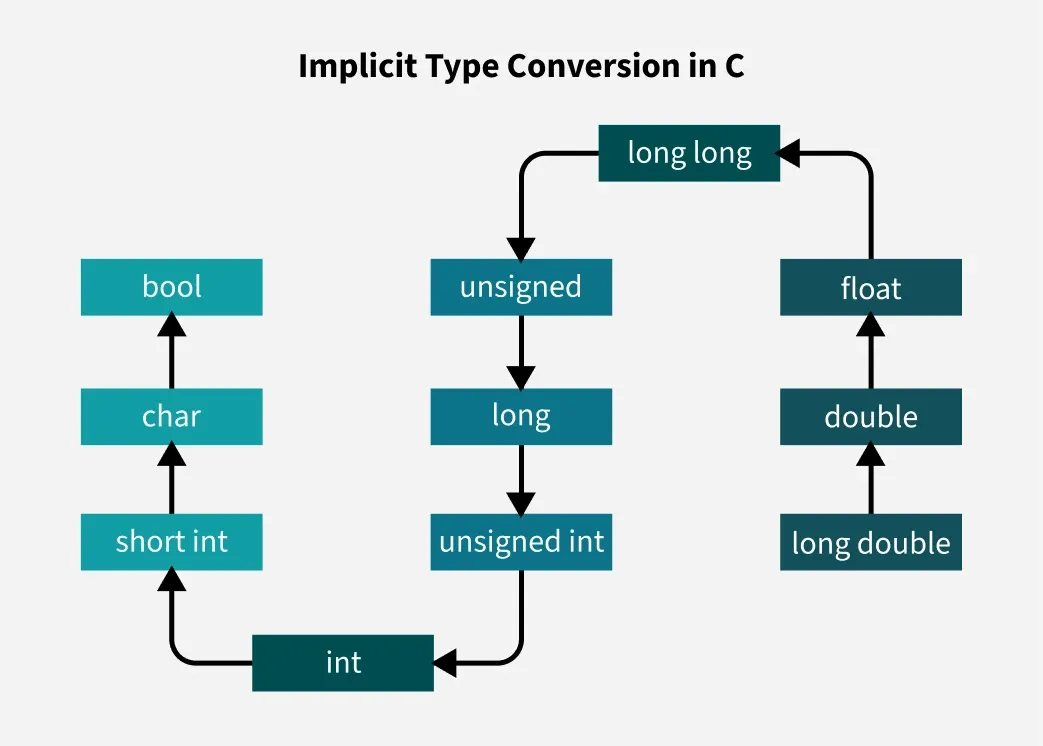
This sounds straightforward, but a dangerous exception arises when mixing signed and unsigned integers. The full set of rules can be complex, but they are captured wonderfully in the diagram below.

Let's focus on the most perilous rule embedded in that chart:
If both operands have the same rank (e.g., int and unsigned int), the signed operand is converted to unsigned before the operation.
This single rule is the source of countless bugs. When a negative signed number is converted to unsigned, it doesn't stay negative. Due to the rules of two's complement arithmetic and modular wraparound, it becomes a very large positive number.
Choosing the Right Integer Types in C and C++ - Dan Saks - code::dive 2018
Dan Saks provides the canonical example of this signed/unsigned trap.
Watch the segment from the signed/unsigned mixing example. He shows that the expression -1 < 1U (where 1U is an unsigned int) evaluates to false. This is because the signed -1 is promoted to unsigned int, becoming UINT_MAX, which is certainly not less than 1.
A Deeper Dive: Where Promotions and Conversions Collide
Now let's look at an example that combines both integer promotion and the usual arithmetic conversions. It reveals just how unintuitive the results can be. The following article presents a classic "gotcha".
Should I use Signed or Unsigned Ints In C? (Part 2)
This article by Robert Elder contains a fantastic code snippet that illustrates the complex interplay between promotion and conversion rules.
Read the section "Mixing Signed and Unsigned". Pay very close attention to the two if statements and the comments explaining them. In the first case, signed_short < unsigned_short, both operands are promoted to int. The comparison becomes (int)-1 < (int)0, which is true. In the second case, signed_int < unsigned_int, no promotion is needed. The usual arithmetic conversion rules apply directly. The signed_int is converted to unsigned int, and the comparison becomes (unsigned)UINT_MAX < (unsigned)0, which is false. This is the same logical comparison with different sized types yielding opposite results!
Avoiding the Pitfalls
The complexity of these rules has led experts to a simple, powerful piece of advice, echoed by both Dan Saks in his talk and Bjarne Stroustrup (the creator of C++) in the article you just read:
Avoid mixing signed and unsigned integers in the same expression whenever possible.
If you must work with both, try to convert them explicitly and consciously to a common, known type rather than relying on the compiler's implicit rules.
To solidify your understanding, this final reading provides a formal summary of the rules and debunks common myths. It's a great reference to bookmark.
Summary of C/C++ integer rules
This page by Nayuki is a dense, technical, but highly accurate summary of C's integer behaviors.
First, read the section on Promotions/conversions. This textually describes the same rules shown in the flowchart earlier, providing a formal definition. Then, review the list under "Misconceptions". This section is particularly valuable because it directly addresses common incorrect assumptions that programmers make, such as "arithmetic on all-unsigned types will produce an unsigned result" (false, due to promotion to signed int).
Conclusion
Today we've pulled back the curtain on the C compiler's "magic," revealing the strict and sometimes surprising rules of implicit type conversions. This is a topic that separates novice programmers from experienced ones. Understanding these rules isn't just about academic correctness; it's about preventing real-world bugs that can be incredibly difficult to trace.
Key Takeaways:
- When operands of different types are in an expression, the compiler implicitly converts them to a common type.
- Integer Promotion: Types smaller than
int(likecharandshort) are almost always promoted tointbefore any other calculation. - Usual Arithmetic Conversions: After promotion, operands are converted to the type of the higher-ranking operand.
- The Golden Rule of Pitfalls: The most dangerous rule is that when mixing signed and unsigned integers of the same rank (e.g.,
intandunsigned int), the signed value is converted to unsigned. This can make negative numbers become large positive numbers, reversing the outcome of comparisons. - Best Practice: To stay safe, avoid mixing signed and unsigned types in expressions.
You have now completed a deep dive into C's integer type system, from their sizes and limits to their behavior with overflow and implicit conversions. In the next lesson, we will put this foundational knowledge to use in a practical warm-up exercise: building a number-based game.