Hello. The first four books of the Odyssey keep Odysseus largely out of sight while his household struggles without him. Book 5 finally brings him into view—not commanding a ship or outwitting an enemy, but sitting on a shore and longing for home. This begins the part of the course concerned with Odysseus himself: what he wants, how he survives, and how he tells his story.
In this lesson, you will read his conversation with Calypso, who offers him an immortal life with her. The exchange gives us an unusually direct statement of what homecoming means to him, while making that choice more complicated than a simple rejection of pleasure.
The island before the offer
Calypso’s island can sustain Odysseus, but he cannot leave it on his own. Before reading their conversation about immortality, attend to the poem’s first picture of his life there and to his reaction when Calypso says he may depart.
Homer (c.750 BC) - The Odyssey: Book V
Read Book 5 in the translation at Poetry in Translation to establish what Odysseus wants before Calypso makes her final offer.
In “BkV:148-191 Calypso promises to free Odysseus,” begin with the shore scene. Continue through the promise and oath, ending at Calypso’s claim that she means him no harm. Notice both the help she offers and why Odysseus insists on an oath before trusting it.
The shore scene establishes that Odysseus’s longing is not an answer invented to escape an awkward conversation. He has been grieving for home already. The narrator says that he sleeps with Calypso at night “as she wished though he did not”; by day he looks out over the sea. Her island is a place of shelter, but its shelter does not make it a home he has chosen.
Even her announcement that he can leave does not immediately put him at ease. A raft seems perilously small for the crossing, and he demands a solemn oath that she is not plotting his harm. His suspicion does not prove that Calypso is lying—she swears she intends to help—but it shows how little control he has had over his circumstances. His desire to return is his own; the opportunity to act on it depends on a goddess releasing him.
That distinction matters when we call his departure a choice. The poem does not present two equally free alternatives awaiting his calm consideration. Odysseus wants to leave, Calypso wants him to stay, and Zeus’s command has compelled her to let him go. Within those unequal conditions, Calypso still makes a powerful case for remaining.
“Make your home with me”
The decisive exchange takes place over a meal. Read slowly enough to notice the order of each speaker’s claims, rather than reducing the scene to “immortality versus Penelope.”
Homer (c.750 BC) - The Odyssey: Book V
Return to the same translation for the central conversation and its immediate aftermath. This is the passage on which the lesson’s interpretation rests.
In “BkV:192-261 Odysseus builds his raft,” read the cave scene, from their arrival at the cave through its final sentence. On a second pass, follow the contrast between their food, Calypso’s promise of immortality and warning of suffering, and Odysseus’s reply beginning “Great goddess.”
The meal quietly marks a boundary between them. Odysseus receives food “that mortals consume”; Calypso receives ambrosia and nectar. They sit together, but they do not have the same kind of life. Calypso then offers to erase that difference: if he stays and “make[s] your home with me,” he will be immortal. She adds that he is fated to suffer before reaching his present home. Remaining promises safety from that journey as well as perpetual life.
Her phrase “make your home with me” is important. Calypso does not ask Odysseus to choose between having a home and having none. She offers him another home, centered on herself. She also frames the decision as a comparison between herself and Penelope, arguing that a mortal woman cannot rival a goddess in appearance.
Odysseus does not dispute that comparison. He acknowledges Calypso’s greater beauty and everlasting youth, then turns with “Even so” to what the comparison cannot settle. He longs “to reach home, and see the hour of my return.” His answer does not claim that Penelope is secretly more beautiful, or that immortal life has no appeal. Rather, the advantages Calypso names are not what determines where he belongs. Penelope is part of the mortal life to which he wishes to return, not a contestant in a beauty comparison.
His closing words give the decision its weight. He anticipates that a god might strike him on the sea, yet says he will endure it. This is not a wish to suffer or die. It is a willingness to risk further suffering rather than remain safe and separated from the life he calls his own. “Home” here is more than a pleasant location: it is the possibility of resuming his relationships and his place in a human household, however uncertain his arrival may prove.
What his answer reveals—and leaves open
One reading of the exchange emphasizes how carefully Odysseus speaks. A mortal trying to leave a powerful goddess has reason to be tactful, especially after needing an oath from her. The following short commentary develops that point and offers an interpretation of the scene’s ending.
5.192-227 | Dickinson College Commentaries
Read the Dickinson College Commentaries note for an interpretation of Odysseus’s reply as a negotiation across the boundary between mortal and divine. Treat its account of the final night as an interpretation to weigh against Homer’s wording.
Under “notes,” locate the short introductory note, then open “read full essay.” Read the opening discussion, stopping at the end of its account of their conversation and night together. Focus on why the commentator calls Odysseus’s speech tactful, and compare the commentator’s confidence about the final night with the earlier shore scene.
The commentary draws attention to Odysseus’s verbal skill. He concedes what matters to Calypso—her divine superiority in youth and looks—without conceding the decision itself. He does not give her a long argument about why she cannot replace his wife. His tact makes sense in a relationship where he has had little power to determine whether he stays.
The ending asks for equal care. After Odysseus states his wish to leave, the narrator describes the two together in the cave. That moment may sound warmer than the earlier account of nights spent there against his wishes. The commentary reads it as a tender change. Yet the earlier statement remains part of the episode; the final sentence alone cannot settle everything about their relationship. Nor does their lovemaking cancel Odysseus’s expressed desire for home. The poem allows a complicated final encounter without making his decision unclear.
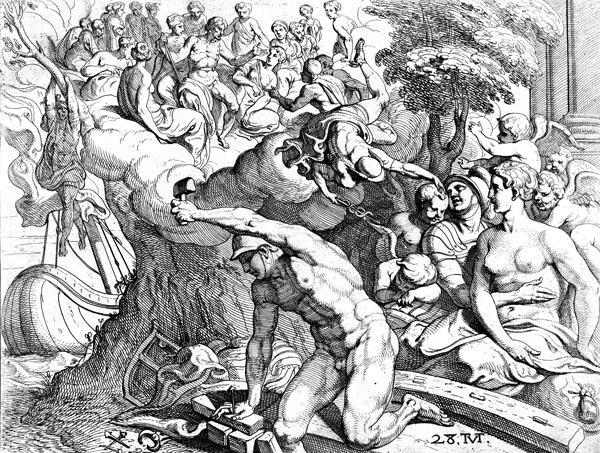
The image below depicts the work that follows the conversation. It is a later artist’s imagining, not evidence for the details of Homer’s scene. Its useful contrast is visual: Odysseus’s longing, voiced in a private exchange, must become the physical labor of leaving.
The meaning of this choice
Odysseus declines a promise most mortals could never receive: life without an end beside an ever-young goddess. The poem makes that offer substantial by showing its comforts and by letting Calypso warn him of the pain ahead. It also shows why the offer cannot answer his longing. An immortal future on her island would keep him apart from the mortal relationships and household to which he wants to return.
His reply combines desire with resolve. He cannot guarantee a safe voyage, and he does not pretend that Penelope can match a goddess’s immortality. He chooses to pursue home nevertheless. In the next lesson, the sea crossing will test how far that resolve can carry him—and where his own resourcefulness still depends on divine intervention.