Welcome back. Last time, Penelope’s weaving showed how the suitors have turned her household into a place where delay is costly and refusal is difficult. Telemachus has now left Ithaca to seek news of Odysseus. His visits in Books 3–4 give him something else as well: a chance to see how a household treats people who arrive without an invitation.
This lesson follows his reception at Pylos and Sparta. Rather than treating their feasts as decorative scenes, we will look at who offers food, when a stranger is questioned, and what a host provides when the visit ends. Those details make the disorder at home more legible.
Pylos: a place at the feast
Telemachus sails from Ithaca to Pylos with Athena, who is disguised as Mentor. From there, Nestor’s son Peisistratus will accompany him overland toward Sparta. The map shows the first leg of the journey; it does not trace the later road trip.
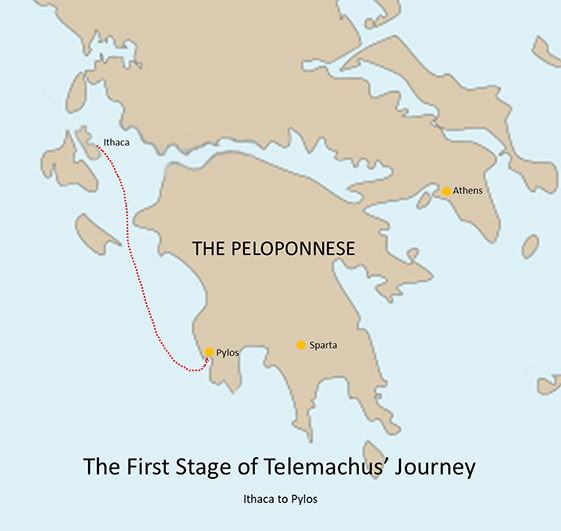
At Pylos, Telemachus is anxious about approaching Nestor, an older king and former companion of Odysseus. Athena urges him to speak for himself. Before he has to do so, Nestor’s family and people make room for the arrivals at a sacrifice and communal meal honoring Poseidon.
Homer (c.750 BC) - The Odyssey: Book III
Read the opening reception in Book III of A. S. Kline’s translation, available at Poetry in Translation. It shows how Telemachus becomes a guest before he becomes an identified visitor asking for news.
In “BkIII:1-50 Telemachus and Athene reach Pylos,” read the arrival from the opening description of dawn through Peisistratus seating and serving the strangers. Continue into “BkIII:51-101 Telemachus declares himself to Nestor”: begin with Peisistratus’ words, “Stranger, pray to the lord Poseidon,” and read through Telemachus’ request. Notice when Nestor asks who the visitors are, and what Telemachus asks him to say.
Peisistratus takes the strangers by the hand, seats them beside his father, and gives them a share of the food and wine. He also invites them into the religious act already under way. They are not kept at the edge of the gathering until they can justify their presence. Their need for welcome comes before their names and purpose.
Only after everyone has eaten does Nestor ask where the visitors came from—even raising the possibility that they might be pirates. Hospitality has not made him incapable of judging strangers. It establishes the order in which he treats and questions them. Telemachus can then identify himself and ask for truthful news of his father, rather than having to earn a meal by telling a persuasive story.
This is one practical shape of xenia, the guest-friendship introduced earlier in the course. A host offers food and a place in the household; a guest accepts its customs and speaks truthfully about their business. At Pylos, that exchange also gives Telemachus room to practice speaking. Athena prompts him, but she does not ask Nestor the question on his behalf.
Welcome that lasts beyond dinner
Nestor’s obligation does not end when the feast ends. When Telemachus prepares to return to his ship for the night, Nestor objects: he has beds and blankets, and he will not have Odysseus’ son sleep on deck. Once Athena departs, Nestor brings Telemachus into his palace. The next day his household bathes and feeds the visitor, then supplies a chariot, provisions, and Peisistratus as a companion for the journey to Sparta.
Homer (c.750 BC) - The Odyssey: Book III
Return to Kline’s Book III to see how Nestor’s welcome extends from a place to sleep to help with the next stage of travel.
In “BkIII:356-403 Athene departs, and Nestor prays to her,” start just before the subsection heading, where Nestor protests at the idea of sleeping aboard ship: read through the lodging arrangements. Then in “BkIII:464-497 Telemachus departs,” begin where Polycaste has bathed and dressed Telemachus; read through his departure. Follow what Nestor’s household does, not just what Nestor says.
The bath, bed, food, and transport may seem lavish. Their significance is not simply that Nestor is rich. He uses what his household has to leave his guest better equipped to travel. Even his offer of Peisistratus’ company matters: Telemachus gains a guide and fellow traveler, not merely a vehicle.
Keep Ithaca in view. The suitors also gather for meals in a wealthy household, but they consume its animals and stores while refusing to leave. They are not travelers who need a night’s shelter; they are men pressing a marriage claim and making Telemachus’ family pay for their prolonged stay. The contrast is not feasting versus restraint. It is generosity directed toward a guest versus consumption imposed on a host.
Sparta: the decision to admit strangers
Menelaus’ palace offers a second reception scene, with a small hesitation that makes its principle especially clear. Menelaus is already hosting a celebration when Telemachus and Peisistratus arrive. His attendant Eteoneus asks whether to bring the two strangers in or send them to someone else. Menelaus rebukes him: he and his companions once depended on other people’s tables during their own journeys.
Homer (c.750 BC) - The Odyssey: Book IV
Read the selected scenes from Kline’s Book IV for both the decision to welcome Telemachus and the limits of what even a splendid home can repair.
At the beginning of Book IV, read the reception, stopping just before “BkIV:59-112 Menelaus speaks of Odysseus.” Watch for Eteoneus’ question, Menelaus’ answer, and the care given to the travelers and their horses. In “BkIV:59-112 Menelaus speaks of Odysseus,” read the conversation from Menelaus’ invitation to eat through his grief for Odysseus. Finally, in “BkIV:290-350 Menelaus hears Telemachus,” start where Helen orders beds made in the portico, and read through Menelaus’ response to Telemachus’ account of the suitors.
Menelaus’ reply to Eteoneus makes hospitality a matter of remembered dependence. He does not need to know that one visitor is Odysseus’ son before admitting them. His household tends their horses, bathes and clothes the travelers, washes their hands, and serves them a meal. Like Nestor, Menelaus waits until they have eaten before asking who they are.
Telemachus is awed by the palace’s gold, silver, and ivory. Yet the scene does not ask us to equate wealth with a happy home. Menelaus says he would give up much of his treasure if the men killed at Troy were alive. He grieves particularly for Odysseus, whose fate remains unknown to those waiting for him. His ordered household can welcome a traveler; it cannot erase war, loss, or absence.
Later, Helen has beds prepared for the visitors. The next morning, Telemachus tells Menelaus why he has come: his own house is being ruined by men who kill his livestock and occupy his home. Menelaus responds with indignation and promises to tell him what he knows. The difference between the two households is now stated inside the story, by the guest who has experienced both.
What the contrast teaches Telemachus
Pylos and Sparta are not identical. At Pylos, Telemachus joins an outdoor communal feast, then receives lodging and help onward from Nestor’s family. At Sparta, he arrives at a palace already filled with wedding guests; Menelaus must first decide whether two more strangers will be admitted. In both places, the answer takes a material form: a seat, a meal, rest, and attention to the traveler’s purpose.
Ithaca’s trouble is more specific than an absence of hospitality. Telemachus welcomed the disguised Athena there in Book 1. His household still knows how to receive a stranger. What it cannot do is make the suitors respect its boundaries. Last lesson, Antinous tried to turn their continued feasting into Penelope’s fault. The receptions in Books 3–4 sharpen our judgment of that defense: hosts at Pylos and Sparta give freely, while the suitors treat another family’s resources as something they may keep taking.
These visits also change Telemachus’ position. He is still seeking news, not returning with Odysseus. But he has asked an elder for the truth, traveled as an honored guest, and described the damage at home to someone who takes it seriously. The hospitable houses offer him a working picture of household authority: it involves protecting and providing for others, not merely possessing wealth or commanding a hall.
The key distinction in Books 3–4 is how a household uses its resources and treats those within its power. Nestor and Menelaus welcome travelers before they know what the travelers can offer, then give them rest and help. The suitors, by contrast, extend their stay at someone else’s expense. Menelaus’ grief keeps the comparison from becoming too neat: a well-run home is precious, but it does not make homecoming simple.
In the next module, the poem turns more directly to Odysseus. His choice between Calypso’s island and Ithaca will make the meaning of “home” harder—and more urgent—to define.