Welcome to the Ithaca portion of the Odyssey. The long voyage has brought Odysseus home, but arrival does not yet give him a place in his household. Disguised as an impoverished stranger, he must discover whom he can trust before he reveals himself.
Book 14 begins that discovery with Eumaeus, the swineherd who tends Odysseus’ pigs. This lesson follows their meeting, their conversation about the absent king, and a cold night in Eumaeus’ hut. Throughout, the audience knows the guest’s identity while Eumaeus does not. That difference lets the poem show what hospitality and loyalty look like when neither can depend on recognition.
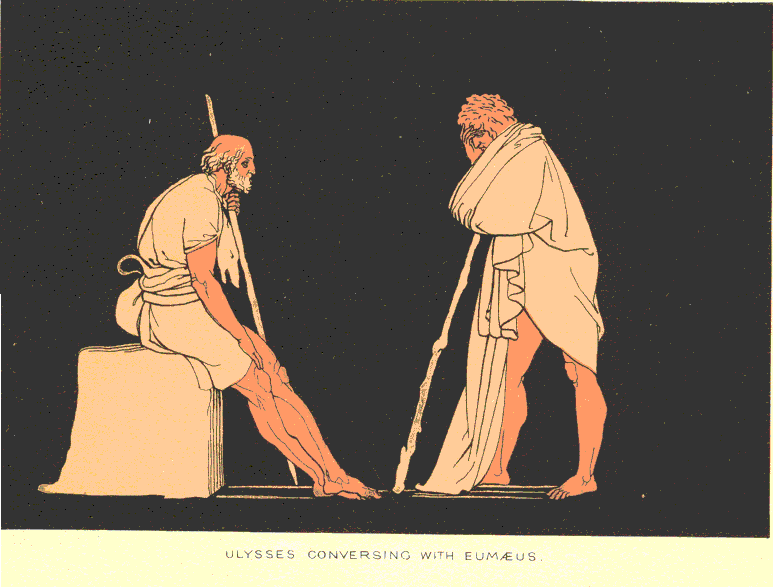
A welcome before a name
First, read the arrival and initial meal. Allow about 10 minutes for these two short sections.
Homer (c.750 BC) - The Odyssey: Book XIV
Read Homer's Book XIV on Poetry in Translation to see Eumaeus' hospitality in the poem's own sequence of actions and speech.
In “BkXIV:1-47 Odysseus finds Eumaeus,” read the arrival, from Odysseus' walk to the hut through Eumaeus' invitation. Notice what Eumaeus does before asking for the visitor's story. Then, in “BkXIV:48-108 Eumaeus’ hospitality,” read the welcome and meal, from the guest's seat through Eumaeus' account of the suitors. Attend to what Eumaeus can offer, what he cannot, and his reason for receiving a stranger.
The welcome begins with danger. Eumaeus’ dogs rush at the unknown man, and Eumaeus drives them off. He invites the stranger in, gives him a place to sit, and feeds him before learning his name or judging his account of himself. The sequence matters: the guest does not earn safety and food by proving who he is.
Eumaeus states the principle behind his conduct: it would be wrong to reject a guest, even one worse off than this visitor, because “every beggar and stranger is from Zeus.” He is not claiming to recognize a god beneath the disguise. Rather, he treats care for vulnerable strangers as an obligation under divine protection. This is xenia, or guest-friendship, practiced at its most demanding point: the stranger has little apparent power to repay his host.
Eumaeus also makes the cost visible. He is a servant with limited goods, living under the authority of the young men who consume the household’s supplies. He offers a humble bed, meat, and wine while describing how the suitors take the best animals. The contrast is not simply between a good man and bad men. It is between someone who shares what little he controls and men who consume another household’s wealth as though their appetite grants them a right to it.
Loyalty without credulity
Hospitality does not require Eumaeus to believe everything his guest says. Read the next exchange in about 6 minutes.
Homer (c.750 BC) - The Odyssey: Book XIV
Continue in the same translation to examine how Eumaeus responds when the stranger claims to know about Odysseus.
In “BkXIV:109-164 Odysseus ‘prophesies’ his own return,” read the exchange, from Odysseus' meal through his oath that the king will return. Focus especially on Eumaeus' explanation of why he distrusts travellers' reports and on what he says about the master he believes he has lost.
Odysseus, still concealed, draws Eumaeus into talking about his master and then promises that Odysseus will return. Eumaeus refuses to accept the news. Travellers, he says, have offered Penelope false stories in hope of receiving clothing or food. His doubt is therefore more than stubborn pessimism: it protects a grieving household from another appealing claim without evidence.
At the same time, Eumaeus speaks of Odysseus with deep affection. He remembers being cared for by him and grieves his absence, even while believing him dead. Loyalty here is not the same as confidence that Odysseus is alive. Eumaeus can remain attached to his master without believing an unknown visitor’s promise.
The scene tests two relationships at once. Odysseus hears how Eumaeus speaks about him when he seems unable to reward or punish him. Eumaeus, unaware that he faces his master, must decide how to treat a guest whose story he doubts. His answer separates judgment from cruelty: he need not believe the stranger to keep feeding him.
There is a harder edge to this loyalty. Eumaeus is not an independent friend awaiting a companion’s return; he is a servant who says a returned Odysseus could have granted him property and a family life of his own. His devotion is expressed within unequal circumstances. Noticing that dependence makes his generosity more concrete, rather than less meaningful.
A cloak requested through a story
Later, the men eat together again, and Odysseus devises a more pointed test. Allow about 11 minutes for the supper and the night that follows.
Homer (c.750 BC) - The Odyssey: Book XIV
Finish these selected scenes from Book XIV to see how hospitality extends beyond the first welcome and how Odysseus tests it through storytelling.
In “BkXIV:409-456 Supper in Eumaeus’ hut,” read the supper, from the herdsmen's return through the end of the meal. Notice Eumaeus' treatment of the guest and his prayer for Odysseus. In “BkXIV:457-506 Odysseus’ tale of Troy,” read the night scene, from the storm through Eumaeus' departure to guard the pigs. Follow the connection between the guest's story about a missing cloak and the bedding Eumaeus provides.
At supper, Eumaeus gives the stranger an honored portion of meat while praying for Odysseus’ safe return. The irony is sharp but gentle: he serves the man he prays for without knowing it. The honor cannot be explained as deference to a king. From Eumaeus’ point of view, the recipient is still a poor guest.
When the weather turns cold, Odysseus does not directly demand a cloak. He tells a story about a night near Troy when a clever Odysseus arranged for a cloakless man to obtain warmth. The tale praises Odysseus’ ingenuity while hinting at the present guest’s need. Cunning enters the scene not as a way to defeat an enemy, but as a way to ask for help without asking outright.
Eumaeus understands. He praises the tale, says a weary guest should have what he needs for the night, and makes him a bed near the fire with a thick covering. He also explains a real limit: the workers have no spare changes of clothes to give away, though Telemachus may be able to provide them later. His response is neither extravagant nor evasive. He offers what he can now.
Finally, Eumaeus goes out to sleep near the pigs so he can guard the herd. Odysseus is pleased by this care for his absent master’s property. The closing action adds another dimension to the test: Eumaeus protects a stranger inside the hut while continuing his responsibilities outside it.
What Book 14 establishes
Eumaeus passes no formal examination, and he does not recognize Odysseus. That is precisely why this meeting matters. He protects and feeds a man who appears unable to benefit him, remains loyal to a master he thinks may be dead, and refuses to confuse loyalty with belief in every hopeful rumour. Odysseus’ disguise allows those qualities to appear before his identity can influence them.
Homecoming is thus more than setting foot on Ithaca. Odysseus must find out whether the relationships that made it home have survived his absence. In the next lesson, recognition between father and son will change the struggle for the household: Telemachus will no longer have to act without knowing that Odysseus has returned.