Welcome back. In the last lesson, Eumaeus welcomed the disguised Odysseus without knowing whom he served. Book 16 brings someone else to the hut: Telemachus. His father’s identity can no longer remain hidden from everyone, but revealing it creates a new problem. What can father and son do together that neither could do alone?
This lesson follows their recognition and the conversation immediately after it. The reunion is deeply emotional, yet the poem does not leave them in an embrace for long. Telemachus becomes a participant in a dangerous plan to reclaim the household—and shows that he can question his father as well as follow him.
Recognition is not instantaneous
Read the recognition scene in the translation from Theoi Classical Texts Library. Allow about 9 minutes.
HOMER, ODYSSEY BOOK 16 - Theoi Classical Texts Library
Read the father–son reunion in Book 16 to see why Odysseus’ declaration alone does not convince Telemachus, and what finally allows them to speak as father and son.
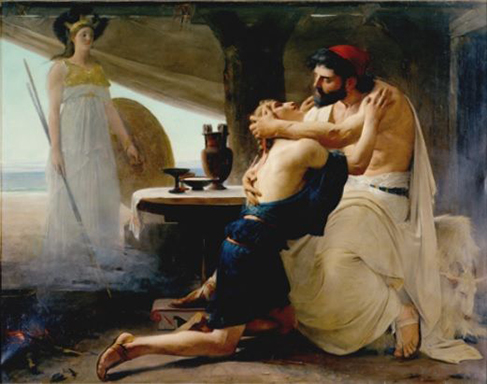
In Book 16, begin at line [154], just after Eumaeus leaves the hut and Athena appears to Odysseus. Read the recognition scene through Telemachus’ question about the ship that brought his father home, immediately before line [225]. Watch the sequence of Athena’s instruction, Odysseus’ changed appearance, Telemachus’ disbelief, and their shared weeping. In this translation, “wooers” means suitors.
Athena appears to Odysseus but not to Telemachus. She tells Odysseus to reveal himself so that they can plan against the suitors, then restores his imposing appearance. Divine intervention makes recognition possible, but it does not make recognition simple. Telemachus has just seen an impoverished older stranger leave the hut and a strikingly changed man return. He concludes that the visitor must be a god. Even after Odysseus says, “I am thy father,” Telemachus fears that a god may be deceiving him.
That doubt is not a failure of affection. Telemachus has never known his father as an adult, and the transformation demands an explanation. Odysseus supplies one: Athena can make him look like a beggar or like a splendidly dressed man. Only then does Telemachus embrace him. Disclosure and recognition are different actions: Odysseus tells the truth, but Telemachus must decide whether to accept it.
The poem lets the two grieve together before they plan together. Odysseus, who has kept his tears back, kisses his son and weeps; Telemachus joins him. Their cries are compared to those of birds whose young have been taken from the nest. The image makes this a reunion marked by loss, not a simple cancellation of twenty years apart. Telemachus then asks how Odysseus reached Ithaca. It is an ordinary, concrete question after an extraordinary revelation: his father is here, but they still need to understand the circumstances of his return.
The embrace becomes a council
The next passage changes the scene’s direction. Allow about 11 minutes to read the rest of their conversation.
HOMER, ODYSSEY BOOK 16 - Theoi Classical Texts Library
Continue in the same Theoi translation to follow what father and son actually decide, and where Telemachus challenges the plan.
In Book 16, read from line [225], where Odysseus explains how he reached Ithaca, through Telemachus’ reply at [308], which closes the supplied passage. Follow their planning. Focus on Telemachus’ count of the suitors, Odysseus’ instructions about secrecy and weapons, and Telemachus’ objection to delaying while they test people on the farms.
Odysseus first asks for information: how many suitors are there, and could the two of them face them without help? Telemachus gives a detailed count—108 suitors, besides attendants and other people in the hall—and refuses to treat courage as a substitute for numbers. He has heard of his father’s strength and good counsel, but he says plainly that two men cannot simply fight so many. This is not the helplessness he felt earlier in the poem. It is useful knowledge of the household’s danger, offered to someone who has only just returned.
Odysseus proposes Athena and Zeus as allies, but divine favor does not make human preparation unnecessary. He tells Telemachus to return to the house while he himself will arrive later as a beggar. Telemachus must bear seeing the stranger mistreated without revealing who he is. When Odysseus gives a signal, Telemachus is to remove the weapons from the hall, leave arms for the two of them, and give the suitors a plausible explanation for the missing equipment. His assigned role demands restraint, deception, and action—not merely a willingness to fight.
Odysseus also insists that their knowledge remain secret, even from Penelope and Eumaeus. Eumaeus’ welcome in Book 14 established his loyalty, but Odysseus still chooses not to tell him. The concealment gives father and son time to observe the household before others can react to the king’s return. It also makes Telemachus his father’s sole informed partner there, with the burden that entails.
Telemachus does not accept every part of the proposal without comment. He is willing to investigate conduct within the house, but he argues that visiting farms to test men would take too long while the suitors continue to consume their property. Odysseus brings a plan for regaining control; Telemachus brings knowledge of what continued delay costs. The exchange shows a working alliance rather than a son simply receiving orders.
What changes—and what does not
A critical reading by Sheila Murnaghan offers a useful complication: perhaps Telemachus did not become capable at the moment he recognized his father. Allow about 7 minutes.
Read Murnaghan’s account of Telemachus’ earlier growth to distinguish what the reunion reveals about him from what it newly enables him to do.
In Chapter 1, find the paragraph beginning “When the poem opens, Telemachus is in a state of unreadiness.” Read the discussion of his journey and reunion, ending in the paragraph that contrasts his newfound maturity with the limits placed on it by Odysseus’ return. Focus on Murnaghan’s claim that Telemachus has grown through his own journey before meeting Odysseus, and on her observation that the father’s return both needs and constrains the son’s independence.
Earlier in the poem, Telemachus confronted the suitors, called an assembly, and travelled to seek news of his father. Those efforts did not free the house, but they gave him experience acting without Odysseus beside him. Murnaghan’s interpretation helps explain why Odysseus can reveal himself to Telemachus before the struggle is over: he needs a son who can help him now.
The recognition therefore changes Telemachus’ position, not his entire character in an instant. He is no longer trying to protect a household in uncertainty about whether its head will return. He knows Odysseus is alive; he shares information with him; and he takes on a concealed part of the plan. At the same time, the returning father assumes command of the effort to reclaim his own house. Telemachus is becoming a capable heir, but his father’s return makes him a partner under Odysseus’ leadership rather than the household’s independent leader.
That tension gives the scene much of its force. The tears acknowledge a relationship long denied to both of them. The argument about tactics shows what that relationship can now do—and that it will involve two minds, not one.
Looking ahead
Book 16 turns recognition into cooperation. Athena enables Odysseus to disclose himself, Telemachus accepts him after understandable doubt, and the two move from shared grief to a secret plan. Telemachus’ growth predates the reunion, but knowing his father has returned gives that growth a new purpose in the struggle for their household.
Their secrecy will shape the next encounters in Ithaca. In the following lesson, Penelope speaks with the still-disguised Odysseus without being told what Telemachus now knows, making her words and possible suspicions especially difficult to interpret.