Welcome to the first lesson of your intensive course on China's Digital Silk Road and Cyber Sovereignty in Africa. Our goal over the next five days is to equip you with a sophisticated theoretical toolkit to construct the framework for your doctoral thesis. We will be moving from foundational concepts to complex theoretical syntheses, always with the aim of "mobilizing" these ideas for your research on China's use of huàyǔ quán (discourse power).
Today, we begin not with high theory, but with the crucial groundwork of empirical reality. Before we can analyze how China's discourse shapes African digital policy, we must first understand the pre-existing needs, ambitions, and anxieties of African states themselves. This lesson is dedicated to identifying the distinct demands that create the political and economic landscape upon which the Digital Silk Road is being built. By the end of our session, you will be able to clearly identify and categorize the primary motivations driving African states' approaches to digital governance, setting the stage for our subsequent analysis of how discourse organizes these very demands.
The Landscape of Demand: Africa's Push for Digital Sovereignty
The term 'digital sovereignty' is gaining significant traction across the African continent. At its core, it reflects a desire by states to assert control over their digital future. In practice, this is often interpreted in a very tangible, material way: control over physical infrastructure (like data centers and fiber optic cables) and the data that flows through it.
To understand the context, let's begin with a short reading from a policy brief by the Centre for International Governance Innovation.
[PDF] Digital Sovereignty in Africa: Moving beyond Local Data Ownership
This reading introduces the prevailing interpretation of 'digital sovereignty' among many African states and institutions, linking it directly to the ownership and location of digital infrastructure.
Please read the section What Is Africa’s Approach to Digital Sovereignty?. As you read, focus on how the concept of sovereignty is being translated into concrete policy ambitions, such as the construction of national data centers.
The drive to build this domestic infrastructure is a direct response to the current state of affairs. While internet connectivity is expanding, the underlying high-level infrastructure that supports it remains unevenly distributed.
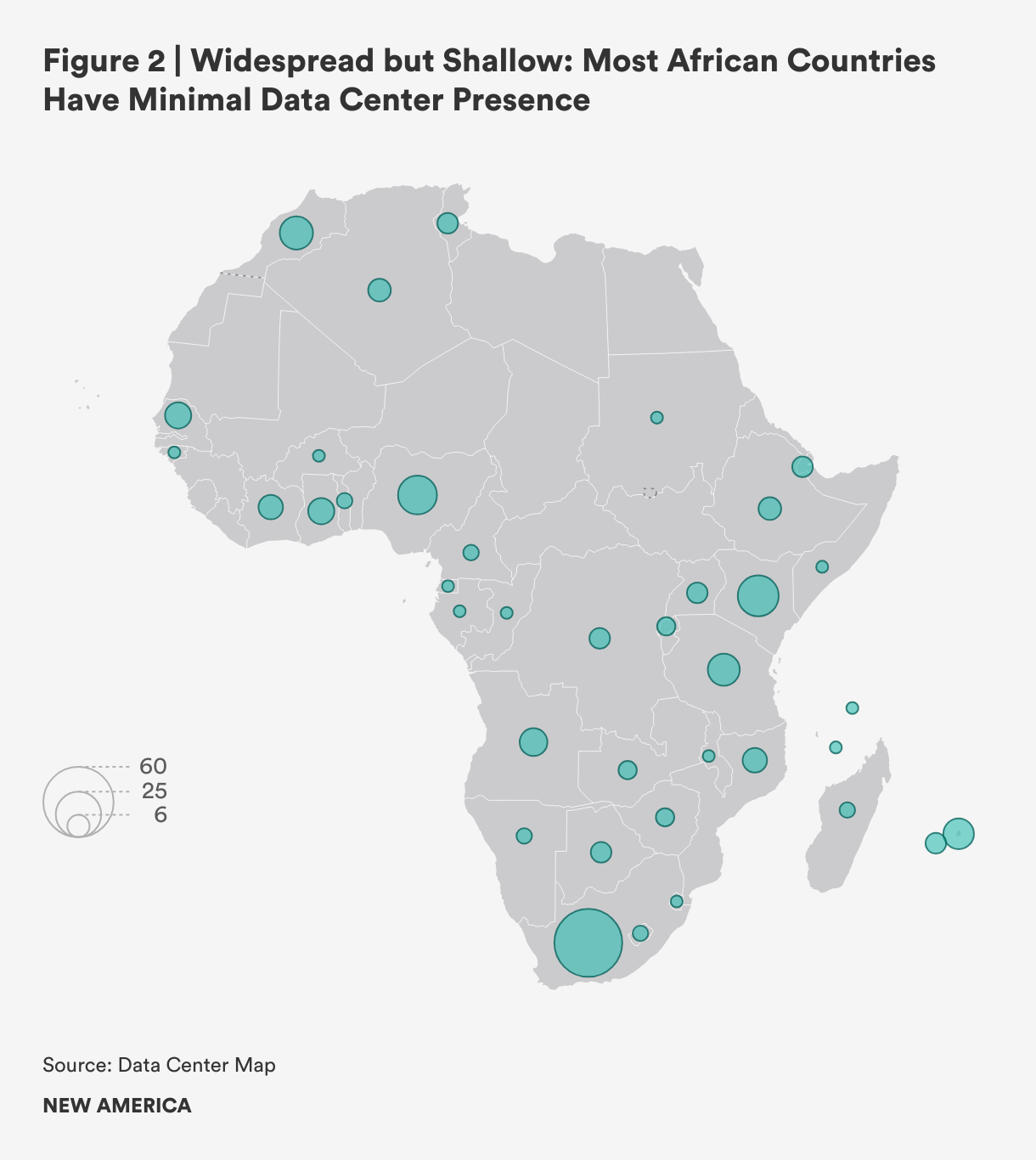
This map highlights the "shallow" presence of data centers in many regions, creating a powerful incentive for governments to seek partners and financing to develop their own infrastructure. But what are the specific goals they hope to achieve with these projects? The general desire for "sovereignty" can be broken down into several distinct, and sometimes overlapping, demands. Let's examine three of the most significant.
1. The Demand for Economic Development
First and foremost, the push for digital infrastructure is an economic imperative. For many African nations, developing a robust digital economy is seen as a pathway to diversify away from resource dependence, create high-skilled jobs, and integrate more fully into the global economy. Digital technologies are catalysts for everything from fintech and e-commerce to agriculture and healthcare.
However, realizing this vision requires immense capital and technical expertise, which has not always been forthcoming from traditional Western partners. This has created a significant opening for China.
[PDF] China's Digital Silk Road and Africa's Technological Future
This excerpt from a report by the Council on Foreign Relations explains the "supply-and-demand logic" underpinning China's growing role in Africa's telecom sector.
Please read the paragraph that begins here. Note the example of Tanzania, which turned to China after other potential financiers, including the World Bank, were not forthcoming.
This demand for economic transformation is not just about building infrastructure, but about capturing the value generated by it. Let's turn to a short video from Al Jazeera that provides a vivid illustration of this dynamic in Lagos, Nigeria.
West Africa's fast-growing digital hub: Lagos data facilities face operational challenges
This video showcases Lagos's emergence as a major digital hub in West Africa, directly linking the growth of data centers to economic activity and opportunity.
Please watch the first minute of the video, from the beginning to the point where they discuss a new online university. Pay attention to how the narrator and interviewees frame the data boom in economic terms.
As you can see, the vision is one of a vibrant, self-sustaining digital ecosystem that drives national growth.
Romanian Translation:
Cererea pentru Dezvoltare Economică (The Demand for Economic Development)
2. The Demand for Regime Stability and National Security
Alongside the economic drivers are powerful political and security motivations. For many governments, control over information flows and digital infrastructure is a critical tool for maintaining state stability and national security. This can range from countering terrorism and organized crime to, more controversially, monitoring political opponents and controlling public dissent.
The Chinese model of internet governance, which combines economic dynamism with strict state control, is particularly appealing to certain regimes. This alignment of interests provides another key driver for the adoption of Chinese technology.
[PDF] China's Digital Silk Road and Africa's Technological Future
This reading delves into the more sensitive aspects of technology transfer, detailing how some African states seek surveillance capabilities to ensure regime stability and how China's model of internet governance appeals to them.
First, read the paragraph describing the use of Chinese technology to spy on political opponents. Next, skip down and read the section that begins, "Like its economic model...", which explicitly details how Nigeria's government looked to China's approach to internet censorship as a template following the #EndSARS protests.
These examples reveal a distinct demand for technologies that enhance the state's capacity for surveillance and control. While often justified under the banner of "national security," the application frequently extends to preserving the political status quo. This is a crucial, if often unspoken, element of the partnership between some African states and Chinese tech firms.
Romanian Translation:
Cererea pentru Stabilitatea Regimului și Securitate Națională (The Demand for Regime Stability and National Security)
3. The Demand for Data Localization and Protection
The third major demand is for data localization—the requirement that data generated within a country's borders be stored and processed there. This demand is a complex hybrid of economic, security, and sovereign aspirations.
- Economically, it's about preventing "data colonialism," where the value from African data is extracted by foreign corporations. Keeping data local is seen as a way to build a domestic data economy.
- From a security perspective, it allows governments to maintain legal jurisdiction over data, preventing foreign intelligence agencies from accessing it without their consent.
- In terms of sovereignty, it's a symbolic and practical assertion of control—a declaration of "digital independence."
Let's return to the policy brief and the video on Nigeria to see this demand in action.
[PDF] Digital Sovereignty in Africa: Moving beyond Local Data Ownership
This section explicitly outlines the various rationales behind data localization policies in Africa, highlighting the goals of mitigating 'data colonization' and reinforcing digital sovereignty.
In the section titled "The Dual Challenge of Data Storage and Data Protection," please read from the beginning of the paragraph here. Focus on the language used to describe the perceived threats and the intended benefits of localization.
The situation in Senegal, which built a national data center with a Chinese loan, offers a powerful example of this logic. The project was explicitly framed by the government as the key to "control its destiny and to definitively resolve the issue of its digital sovereignty."
The Al Jazeera video also clearly captures this sentiment in the Nigerian context.
West Africa's fast-growing digital hub: Lagos data facilities face operational challenges
This part of the video focuses on the push for local data storage as a matter of security, protection, and ultimately, 'digital independence'.
Please watch from where the discussion turns to local cloud storage and then from the section on 'digital independence' to the end. Notice the explicit connection made between local data hosting and the nation's sovereign future.
Romanian Translation:
Cererea pentru Localizarea și Protecția Datelor (The Demand for Data Localization and Protection)
Mobilizing These Concepts for Your Thesis
For your doctoral research, these three categories of demand—economic development, regime stability, and data localization—form the essential empirical foundation. They are the discrete, particularistic interests floating within the African political sphere.
- When you conduct your Critical Discourse Analysis of a policy document, a joint communiqué, or a speech by a political leader, you can use these categories to deconstruct the claims being made. Are they emphasizing economic benefits? Are they invoking threats to national security? Are they championing digital independence?
- These demands are not mutually exclusive. Often, they are strategically bundled together. A project for a surveillance system (fulfilling the demand for regime stability) might be publicly justified using the rhetoric of economic development and cybersecurity.
- Recognizing these distinct underlying demands is the first step toward understanding how a hegemonic discourse works. They are the "elements" that will be "articulated" into a chain of equivalence, a concept from Laclau and Mouffe that we will explore in depth tomorrow.
Conclusion
In this lesson, we have established the crucial context for your research by identifying the concrete demands that African states bring to the table in their digital partnerships with China. We have moved beyond a vague notion of the "Digital Silk Road" to categorize these motivations into three key pillars: the drive for economic development, the desire for regime stability and security, and the push for data localization as an expression of sovereignty. These are the raw materials of political discourse.
In our next lesson, we will pivot to theory. We will introduce Ernesto Laclau and Chantal Mouffe’s concepts of articulation, nodal points, and empty signifiers. You will learn how a powerful discourse, centered on a term like 'Cyber Sovereignty,' can take these disparate and even contradictory demands and weave them into a single, compelling political project that challenges the existing order.