Hello! Welcome to our final lesson in the "Foundations of Mindful Movement" module.
In our last session, you performed a body scan meditation to build your interoceptive awareness—your ability to sense your body's internal state. This skill of "listening" to your body is fundamental to a safe and effective yoga practice.
Today, we will build on that foundation by exploring the tools that help you respond to what your body tells you. Our learning outcome is to identify common yoga props (blocks, blankets, bolsters) and their use for support and alignment. Props are not crutches or signs of weakness; they are intelligent tools that make poses more accessible, safe, and effective for everyone. They will be your allies as you work toward better posture, increased energy, and stress relief.
Why Use Props? The Myth of the "Crutch"
Before we dive into specific props, it's important to understand their purpose. Many beginners feel that using a prop means they aren't "good" at a pose. The opposite is true! Using props is a sign of a mature and intelligent practice. They help you find correct alignment and receive the full benefits of a pose without straining your body.
How To Use Yoga Props: My Expert Guide
To understand the key benefits, please read a short section from the article 'How To Use Yoga Props: My Expert Guide' by Arhanta Yoga. It clearly explains why props are so valuable.
Please read the section titled 'Why Use Yoga Props? Key Benefits Explained'. Focus on the four main points: Greater Accessibility, Improved Alignment and Safety, Support for Longer Holds, and Enhanced Body Awareness.
As the article points out, props enhance your body awareness—a direct extension of the interoceptive skills you developed in the last lesson. By providing support, they allow you to relax into a pose and notice more subtle sensations, rather than just struggling to hold on.
Your Yoga Toolkit: Common Props and Household Alternatives
You don't need to buy a full set of props to get started. Many common household items can work just as well, especially when you're beginning your practice.
This chart gives a great overview of the most common props and simple substitutes you can find at home.

For our lesson today, we'll focus on the three props mentioned in our learning outcome—blocks, blankets, and bolsters—plus the very useful yoga strap.
1. Yoga Blocks
Blocks are arguably the most versatile yoga prop. Their primary function is to "bring the floor closer to you," helping you maintain good alignment in poses where your hands can't comfortably reach the ground.
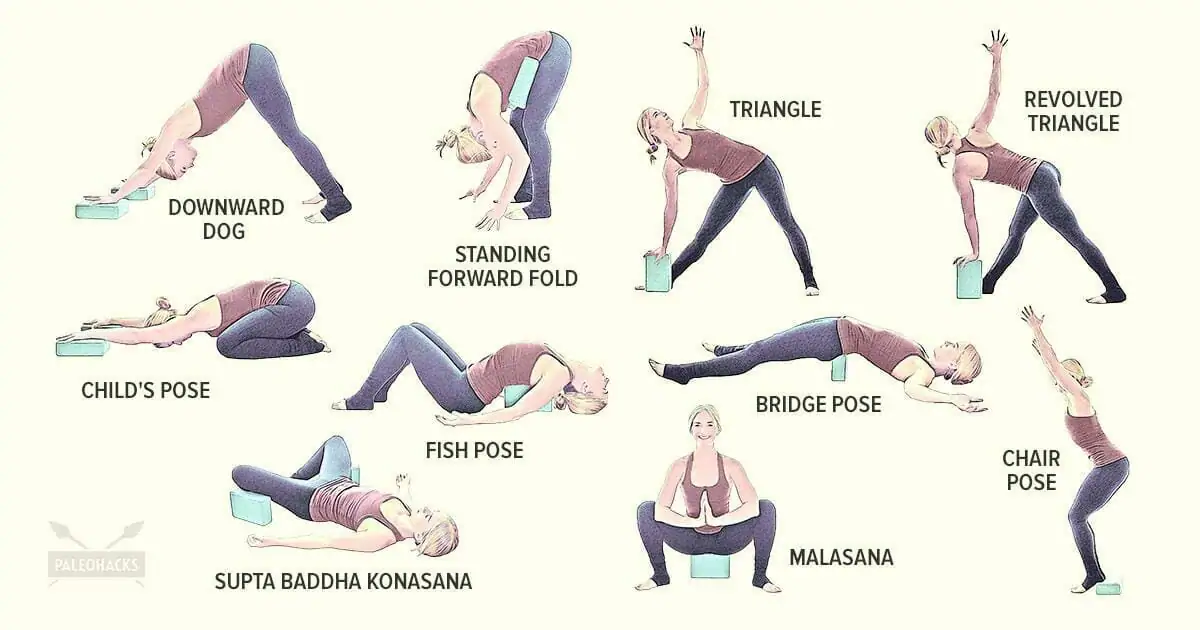
Blocks come in different materials, typically foam or cork. The choice depends on the intended use.
Yoga Block Review - Cork VS Foam Blocks - What's the difference? Which Yoga Block Is Right For You?
To understand the difference, let's watch a short review video, 'Yoga Block Review - Cork VS Foam Blocks' by Farah Ehsan. She gives a very clear explanation of when you might choose one over the other.
Watch from the beginning until 06:12. Pay attention to her summary of the key differences: Cork blocks (01:07 - 03:25): Heavy, sturdy, great for stability in balancing or strengthening poses. Foam blocks (03:25 - 06:12): Lightweight, soft, and more comfortable for restorative poses where the block is placed against your body.
Key Uses for Blocks:
- Support: Placing under your hands in standing poses (like Triangle Pose) or forward folds.
- Alignment: Squeezing a block between your thighs in poses like Bridge Pose to keep your knees from splaying apart.
- Lift: Sitting on a block to elevate your hips, which helps you maintain a straight spine in seated poses (we'll explore this in our next module!).
2. Yoga Blankets
A simple folded blanket is a wonderfully versatile and comforting prop. It provides cushioning, warmth, and gentle support.
5 Cool Ways to Use Yoga Props - How to Use Yoga Blocks, a Yoga Strap, and a Yoga Blanket
Let's watch a practical demonstration from the video '5 Cool Ways to Use Yoga Props' by Christina | Yoga Teacher Mom. She shows two simple but highly effective ways to use a blanket for relaxation.
Watch the segment from 04:04 to 06:17. Notice how a rolled blanket under the knees can release tension in the lower back, and a folded blanket on the pelvis can provide a 'grounding' sensation to calm the nervous system.
Key Uses for Blankets:
- Cushioning: Placing under your knees or wrists for comfort on a hard surface.
- Support: A rolled blanket under the knees in relaxation poses (like Savasana) to ease lower back strain.
- Lift: Sitting on the edge of a folded blanket to tilt your pelvis forward and straighten your spine in seated poses.
3. Yoga Bolsters
Bolsters are large, firm pillows designed to provide substantial support, especially in restorative and gentle yoga styles. They allow your body to be fully supported, helping your muscles relax and release tension. While you may not have a dedicated bolster, you can create a similar effect by stacking two firm pillows or tightly rolling up a couple of thick blankets.
Key Uses for Bolsters:
- Spinal Support: Placing a bolster along your spine in a reclined chest-opening pose.
- Knee Support: Placing a bolster under your knees during Savasana (Corpse Pose) for deep lower back release.
- Forward Folds: Resting your torso on a bolster in a seated forward fold to make the pose more passive and relaxing.
Bonus Prop: The Yoga Strap (and its Posture-Fixing Power!)
While not in our official outcome, the yoga strap (or a substitute like a belt, tie, or scarf) is too useful to ignore, especially given your goal to correct your posture. Its main purpose is to extend your reach, for example, by looping it around your feet in a forward fold if you can't reach your toes.
However, a strap can also be used as a postural guide.
5 Cool Ways to Use Yoga Props - How to Use Yoga Blocks, a Yoga Strap, and a Yoga Blanket
The same video, '5 Cool Ways to Use Yoga Props,' has an excellent demonstration of using a strap to help with rounded shoulders—a common issue for anyone who spends time at a desk, contributing to 'tech neck.'
Watch the final segment from 06:17 to 07:41. See how the strap acts as a gentle physical reminder to draw the shoulders back and keep the chest open. This is a fantastic tool you can even use for a few minutes while sitting at your desk.
Test your understanding!
Based on what you've learned, imagine the following scenarios. What prop (or household alternative) would you choose and why?
- You are sitting on the floor to meditate, but you find your lower back is rounding and it's hard to sit up straight.
- You are doing a low lunge pose, and your hand doesn't comfortably reach the floor, causing you to collapse in your chest.
- You want to do a hamstring stretch by lying on your back and extending one leg up, but you can't reach your foot with your hand.
Show answer
- A folded blanket or a block. Sitting on the edge of a prop elevates your hips above your knees, allowing your pelvis to tilt forward naturally. This makes it much easier to maintain a tall, neutral spine without straining.
- A yoga block (or a stack of thick books). Placing the block under your hand "brings the floor up to you." This allows you to keep your chest open and your spine long, getting the intended stretch in your hips instead of compromising your posture.
- A yoga strap (or a belt/scarf). By looping the strap around the ball of your foot, you can gently hold the ends with your hands. This extends your reach, allowing you to guide your leg into a stretch without straining your neck or shoulders to reach your foot.
Conclusion
Great work today! You have successfully learned to identify the most common yoga props and, more importantly, understand how and why they are used to support your practice.
Key Takeaways:
- Yoga props like blocks, blankets, and bolsters are essential tools for practitioners of all levels.
- They enhance a practice by improving alignment, providing support, ensuring safety, and deepening body awareness.
- You can easily substitute props with household items like books, towels, and belts when you are starting out.
- Props are not just for making poses easier; they are for making them more effective and intelligent.
In our next lesson, we will begin Module 2: "Postural Blueprint and Seated Poses." The very first thing we will do is learn how to demonstrate a neutral spine position. The props you've just learned about, especially blankets and blocks, will be immediately useful in helping you find and support this foundational alignment in your own body. See you then