Hello! Welcome to the fourth lesson in our "Foundations of Mindful Movement" module.
In our last session, you learned the crucial skill of distinguishing between a productive stretching sensation and a harmful pain signal. This practice of listening to your body's "louder" messages is the first step toward building a safe and intelligent yoga practice.
Today, we will deepen that skill by tuning into your body's more subtle signals. Our goal is to execute a basic body scan meditation to develop interoceptive awareness. This is a foundational meditation technique that directly addresses your goals of managing stress and anxiety. It also builds the body-mind connection necessary for correcting posture and improving your overall sense of energy and well-being.
What is a Body Scan and Why Is It So Powerful?
Before we practice, let's understand what a body scan is and how it can help you. In simple terms, it's a meditation where you systematically bring your attention to different parts of your body, noticing whatever sensations are present without judging them or trying to change them.
This process cultivates interoceptive awareness, which is your ability to sense the internal state of your body. Think of it as developing a high-resolution inner map. When you're more aware of subtle tension in your shoulders from sitting at a desk, or the fluttery feeling in your stomach when you're anxious, you are better equipped to respond consciously rather than react automatically.
Body scan meditation: a step-by-step guide...
The article 'Body scan meditation: a step-by-step guide' from Calm.com provides an excellent, easy-to-understand introduction to this practice and its benefits.
Please read the first two main sections: 'What is a body scan meditation?' and 'Benefits of body scan meditation.' Pay attention to how the practice connects your mind to your body, which is always in the present moment.
As the article highlights, this simple act of checking in with yourself can significantly reduce stress and anxiety, improve sleep, and help you better regulate your emotions—all key areas you want to work on.
The Steps of a Body Scan Meditation
The process of a body scan is straightforward. You'll typically lie down, get comfortable, and then mentally "scan" your body, usually starting from your toes and moving all the way up to your head.
This infographic provides a clear visual summary of the process.
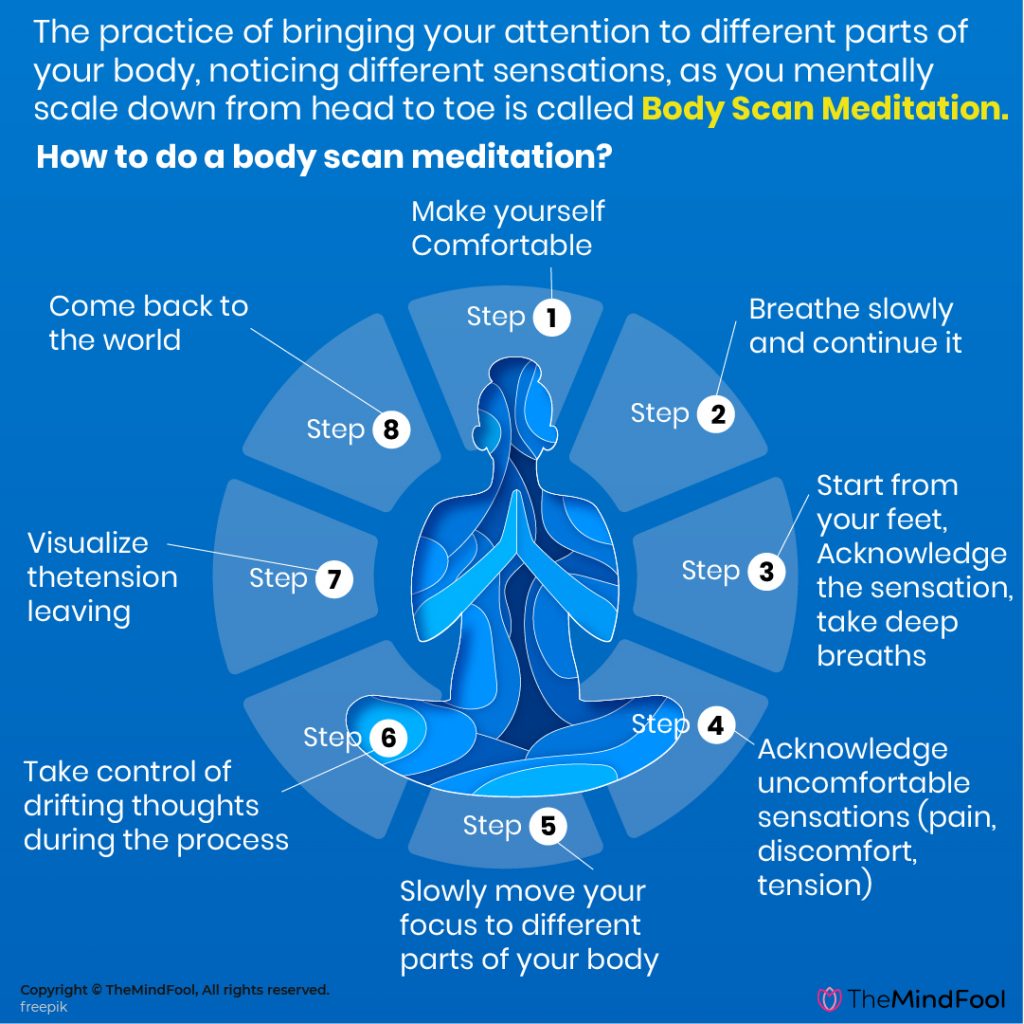
The key is to bring a quality of curious and kind attention to each body part, simply noticing sensations like warmth, coolness, tingling, pressure, or even numbness, without feeling the need to "fix" anything.
Your Guided Practice
Now it's time to experience a body scan for yourself. Reading about it is one thing, but the real learning happens in the practice. We will use a guided meditation to help you stay focused.
Before you begin, find a comfortable place where you can lie down undisturbed for about 20 minutes. As the video suggests, you might want to place a pillow under your head and a cushion or rolled-up blanket under your knees to take any pressure off your lower back.
20min body scan meditation | relaxation | alleviate anxiety & stress
This '20min body scan meditation' from yoginimelbourne is a perfect guided practice for beginners. The instructor's voice is calm and the pacing is very clear and methodical, allowing you to fully settle into the experience.
Please play the video and follow along for the entire 20 minutes. Your only task is to listen to the guidance and allow your awareness to move where it is directed. Don't worry if your mind wanders—that's completely normal. Just gently bring your focus back to the practice whenever you notice it has drifted.
Test your understanding!
After completing the guided meditation, take a moment to reflect. What was one sensation you noticed in a part of your body that you weren't aware of before the practice (e.g., tension in your jaw, warmth in your hands, the feeling of your clothes on your skin)? What does noticing this tell you about where you might be holding stress or how your body is feeling right now?
Show answer
There is no right or wrong answer here. The goal is simply to notice. For example, you might have realized your jaw was slightly clenched, or that one foot felt colder than the other. This new awareness is the first step. By noticing you hold tension in your jaw, for instance, you now have the ability to consciously relax it during stressful moments in your day. This is interoceptive awareness in action.
Tips for Future Practice
As you continue with this practice, keep these points in mind:
- There is no "perfect" meditation. The goal isn't to have a completely blank mind. The practice is about noticing when your mind wanders and gently guiding it back, over and over.
- Be patient and kind. Some days will be easier than others. Approach each session with curiosity, not judgment.
- Don't force relaxation. The aim is awareness, not necessarily immediate relaxation. Ironically, by simply noticing tension without fighting it, you create the conditions for it to release on its own.
- Start short. A 5 or 10-minute scan is still incredibly beneficial. Consistency is more important than duration.
Conclusion
Well done. You have now learned and performed a body scan meditation, a powerful tool for building the mind-body connection.
Key Takeaways:
- Body scan meditation involves systematically focusing on different parts of your body to build interoceptive awareness.
- This practice is not about changing or fixing sensations, but about noticing them with curiosity and non-judgment.
- Regular practice can help reduce stress, calm the nervous system, and give you valuable information about how emotions and thoughts manifest physically in your body.
In our next lesson, we will move into our second module, "Postural Blueprint and Seated Poses." The heightened body awareness you cultivated today is the perfect foundation for what's next: learning to demonstrate a neutral spine position while lying down, sitting, and standing. You'll start putting your interoceptive skills to work to actively improve your posture.