Welcome to the next lesson in our journey through the key concepts of service management. In our last discussion, we established that a service's value is determined by a balance of the outcomes it facilitates versus the costs and risks it imposes. We ended with the idea that the true measure of a service lies in how well it delivers on its promises.
Today, we will explore the two fundamental components that determine a service's value: utility and warranty. These concepts are at the very heart of the ITIL framework, defining what makes a service valuable from a customer's perspective. Your extensive experience in designing and delivering data platforms has required you to balance these two factors constantly, even if you used different terminology. This lesson will provide the formal ITIL definitions for these intuitive ideas.
By the end of this lesson, you will be able to explain how a service's utility (fitness for purpose) and warranty (fitness for use) combine to create value.
Utility: Is the Service Fit for Purpose?
The first component of value is utility. In simple terms, utility is what the service does. It is the functionality offered by a service to meet a particular need or achieve a specific outcome. The core question utility answers is: "Does this service do what I need it to do?"
ITIL defines utility as being 'fit for purpose'. A service has utility if it supports the performance of the consumer or removes one or more constraints they face.
Let's look at the formal definition.
[PDF] ITIL 4 Foundation Study Guide
This study guide provides clear, exam-focused definitions.
Please read the section on Utility and Warranty. Focus first on the definition of Utility: "the functionality offered by a product or service to meet a particular need." Note the key phrases 'what the service does' and 'fit for purpose'.
To apply this to your field, consider a business intelligence service you might provide. Its utility would be defined by its features and functions:
- Does it allow users to create ad-hoc reports?
- Can it connect to the required data sources, like Snowflake and on-premise SQL Server instances?
- Does it support the complex calculations needed by the finance department?
If the service provides the necessary functionality to help the finance department create its quarterly reports, then it has utility for that purpose. If it cannot connect to the necessary data sources, it is not fit for that purpose and lacks utility.
This short video clip will further clarify the concept.
ITIL® 4 Foundation Exam Preparation Training | Key-Concepts and Definitions 3 (eLearning)
This video from Value Insights gives a concise explanation of utility.
Watch the segment from "we have utility", where the speaker defines utility as being 'fit for purpose' and relating primarily to functionality.
Warranty: Is the Service Fit for Use?
Having the right functionality is only half the story. The service must also perform reliably. This is where warranty comes in. Warranty is the assurance that a service will meet its agreed-upon requirements. It addresses how well the service performs.
ITIL defines warranty as being 'fit for use'. While utility is about what the service does, warranty is about aspects such as availability, capacity, continuity, and security.
Let's return to the study guide for the formal definition.
[PDF] ITIL 4 Foundation Study Guide
You have this document open already.
Now, focus on the definition of Warranty: "the assurance that a product or service will meet agreed requirements." Pay close attention to the examples provided: availability, capacity, security, and continuity.
These four aspects of warranty are likely very familiar to you from your work in data engineering and system architecture:
- Availability: Is the service available when it is needed? (e.g., promising 99.9% uptime for a critical database).
- Capacity: Does the service have sufficient performance to meet current and future demand? (e.g., ensuring a data pipeline can process 1 million records per hour without delays).
- Continuity: Can the service survive and recover from a disaster? (e.g., having a failover data center for your Azure Synapse environment).
- Security: Is the service, and its data, protected from unauthorized access? (e.g., implementing robust encryption and access controls).
A service that is frequently unavailable, slow, or insecure is not fit for use, regardless of how much utility it offers.
This next clip from the same video explains warranty.
ITIL® 4 Foundation Exam Preparation Training | Key-Concepts and Definitions 3 (eLearning)
This clip immediately follows the one on utility.
Watch the segment from "warranty means", where the speaker defines warranty as 'fit for use' and lists the key non-functional requirements it covers.
Value Creation: The Synthesis of Utility and Warranty
The most critical concept to grasp is that value is only created when both utility and warranty are present. They are not independent; they are multiplicative. A service must do the right thing (utility) and do it right (warranty).
- A data analytics platform with powerful predictive modeling features (high utility) that is constantly down (low warranty) delivers no value.
- An extremely stable and secure database (high warranty) that doesn't support the data types required by the business (low utility) also delivers no value.
Let's read the official ITIL perspective on this relationship.
Introductory Overview of ITIL 4
This introductory overview from itSMF UK formally states the relationship between utility, warranty, and value.
Find the paragraph that begins "The value of a product or service...". The final sentence is the key takeaway for the ITIL exam: customers cannot derive benefit from something that is fit for purpose but not fit for use, or vice versa.
Given your background, we can visualize this relationship using a logic gate diagram. This is a powerful way to understand how these components combine to produce a single output: value.
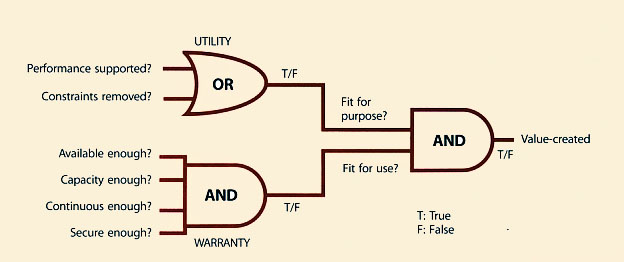
Let's break down this diagram:
- Utility (OR Gate): A service provides utility if it supports performance OR removes constraints. It only needs to do one of these things to be considered 'Fit for purpose'.
- Warranty (AND Gate): A service has warranty only if it is available enough AND has enough capacity AND is continuous enough AND is secure enough. All of these conditions must be met for it to be 'Fit for use'.
- Value Created (AND Gate): Finally, value is only created if the service is both 'Fit for purpose' AND 'Fit for use'.
This logical model makes it clear that a failure in any one of the warranty conditions, or a failure to meet the purpose, will result in the entire expression evaluating to false—meaning no value is created.
The final piece of this puzzle is understanding who defines what is "enough" or "supported." The answer is always the consumer.
ITIL® 4 Foundation Exam Preparation Training | Key-Concepts and Definitions 3 (eLearning)
This final clip ties everything together.
Watch the last segment from "who is defining this". It emphasizes that value is created when the right utility is combined with the right levels of warranty, and that the customer defines what those 'right levels' are.
Conclusion
In this lesson, we have defined the two essential pillars of service value. These concepts provide a clear vocabulary for discussing and evaluating what makes a service successful.
Here are the key takeaways:
- Utility is the service's functionality, answering the question "what does it do?" It makes a service fit for purpose.
- Warranty is the assurance of the service's performance in areas like availability, capacity, continuity, and security. It answers "how well does it do it?" and makes a service fit for use.
- Value is only created when a service has both utility and warranty. A failure in one negates the other.
- The service consumer determines the required levels of utility and warranty that make a service valuable to them.
In our next lesson, we will delve deeper into who these service consumers are. We will identify the specific roles of customers, users, and sponsors. Understanding these different stakeholder roles is critical, as they each have different perspectives on what constitutes acceptable utility and warranty.