Welcome to the next lesson in our exploration of ITIL's key service management concepts. In our previous discussion, we established that a service's value is created through a combination of its utility (what it does) and its warranty (how well it does it). We concluded with the critical point that the service consumer is the ultimate judge of whether the right levels of utility and warranty have been provided.
This naturally leads to the question: who exactly is the service consumer? Today, we will answer that by dissecting this role into its three distinct components as defined by ITIL 4: the customer, the user, and the sponsor. Understanding the unique responsibilities and perspectives of each is fundamental to successful service management. Your experience in leadership roles has certainly involved balancing the demands of different stakeholders; this lesson will provide the formal ITIL framework for classifying them.
By the end of our session, you will be able to identify the specific roles and responsibilities of customers, users, and sponsors within a service relationship.
The Service Consumer: A General Role
Before we look at the specific roles, it's important to understand the umbrella term ITIL uses: the service consumer. This is the generic role an organization takes on when it receives services. It's the counterpart to the service provider.
Let's get the formal definition from a pocket guide to ITIL 4.
This guide offers concise, official definitions that are essential for the foundation exam.
Please read the section titled 2.2.2 Service consumers. Pay close attention to the definition of the generic role, and then read the brief definitions provided for the three specific roles: customer, user, and sponsor. Note the statement that these roles can be used in any combination.
As the reading states, while "service consumer" is the generic term, ITIL 4 finds it more practical to break this down into three more specific roles. This is because each role has a different relationship with the service and different expectations of the value it should deliver.
The following diagram gives a high-level overview of these key stakeholders in the ITIL ecosystem. For this lesson, we will focus on the Customer, User, and Sponsor.
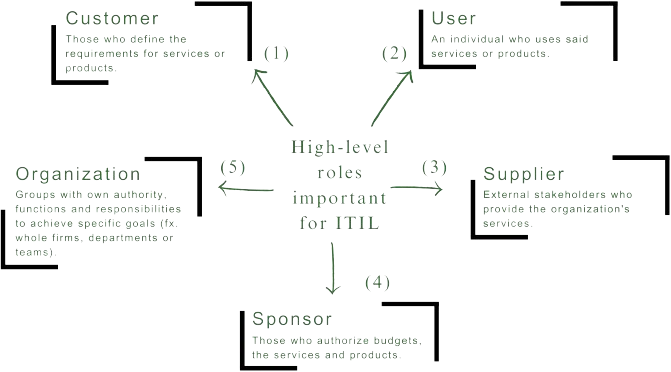
The Three Consumer Roles Explained
A single individual can sometimes embody all three roles, especially in a small organization. However, in the large enterprise environments you're familiar with, these roles are almost always fulfilled by different people or groups. Distinguishing between them is crucial for understanding requirements, managing expectations, and ensuring value is co-created successfully.
Let's dive into the specifics of each role. We will use a resource that clearly breaks down their definitions, responsibilities, and provides examples.
Customer, User, and Sponsor in ITIL 4
This article from TrainingTraining.Training provides a very clear and structured explanation of each role.
First, review the summary table in the Key Roles Breakdown. Then, read the Detailed Explanation with Examples section for all three roles: Customer, User, and Sponsor. Focus on understanding the primary responsibility of each role.
Now, let's consolidate this information and apply it to a context more aligned with your background in data engineering.
1. The Customer
- Definition: The person who defines the requirements for a service and takes responsibility for the outcomes of service consumption.
- Core Responsibility: The Customer is concerned with the "what" and the "why." They are accountable for ensuring the service delivers the intended business value. They are the primary stakeholder defining the service's utility.
- Your World Example: Imagine your team is tasked with building a new sales analytics platform using Power BI on an Azure Synapse backend. The Customer is likely the Head of Sales. This person doesn't build the reports themselves, but they define the requirements: "I need to see weekly sales performance by region," or "The platform must allow my team to identify cross-selling opportunities." They are responsible for the outcome—whether the new platform actually helps the sales team increase revenue.
2. The User
- Definition: A person who uses services.
- Core Responsibility: The User is concerned with the "how." They interact with the service directly to perform their tasks. They are the best source of feedback on the service's usability and the day-to-day aspects of its warranty (e.g., performance, availability).
- Your World Example: In our sales analytics platform scenario, the Users are the sales analysts. They are the ones logging into Power BI every day, running queries, building dashboards, and interacting with the data. If the platform is slow, if a dashboard fails to load, or if a specific feature is hard to use, they are the ones who experience it directly. Their feedback is crucial for continual improvement.
3. The Sponsor
- Definition: A person who authorizes the budget for service consumption.
- Core Responsibility: The Sponsor is the person who provides the financial resources. They are concerned with the financial justification for the service—the costs versus the benefits. They sign off on the funding.
- Your World Example: For the new analytics platform, the Sponsor could be the Chief Technology Officer (CTO) or Chief Financial Officer (CFO). They approve the budget for the Azure consumption costs, the Power BI licenses, and the salaries of the data engineers building the solution. Their main question is, "Is this investment worth it for the business?"
Why the Distinction Is Critical
Understanding these separate roles is not just an academic exercise; it's vital for effective service delivery. Each role perceives value differently:
- The Customer sees value in achieving business outcomes.
- The User sees value in a service that is easy to use, functional, and reliable.
- The Sponsor sees value in a positive return on investment (ROI).
A service provider must engage with all three stakeholders to be successful. You cannot just listen to the Customer's requirements and ignore the User's experience, nor can you build a perfect system that the Sponsor deems too expensive.
This video from Simplilearn touches on the importance of engaging with these different stakeholders to understand their needs and set expectations.
ITIL 4 Foundation Complete Course | ITIL For Beginners |ITIL Certification Training | Simplilearn
This is a clip from a longer ITIL Foundation course by Simplilearn.
Watch the segment from Engaging with stakeholders. The speaker explicitly mentions the need to understand the requirements of different stakeholders, including end-users and customers, and the importance of setting clear expectations with all of them.
This engagement is the foundation of a successful service relationship. By identifying who the customer, user, and sponsor are, a service provider can manage their often-competing expectations and ensure that the service co-creates value for everyone involved.
Conclusion
In this lesson, we have moved from the general concept of a "service consumer" to a more precise understanding of the three key roles involved: the customer, the user, and the sponsor.
Here are your key takeaways:
- A service consumer is the generic term for an organization or individual receiving a service.
- The Customer defines the service requirements and is responsible for the business outcomes. They answer "what" the service should do.
- The User interacts directly with the service to perform tasks. They are focused on functionality and performance.
- The Sponsor authorizes the budget for the service and is concerned with its financial viability and ROI.
In your extensive career, you have implicitly managed the needs of these three groups. ITIL simply provides a clear and consistent vocabulary to formalize this stakeholder management, which is essential for passing the foundation exam and applying the framework effectively.
Now that we have clearly defined the roles on the consumer side, our next lesson will focus on the dynamics between the provider and the consumer. We will describe the core components of a service relationship: service provision, service consumption, and relationship management. This will build directly upon what we've learned today about the key players involved.