In our last lesson, we explored the concept of value, establishing that it is subjective, perceived by the consumer, and co-created through a collaborative service relationship. This understanding sets the stage for our work today, where we will define the core components that service providers use to facilitate this value co-creation.
This lesson addresses the learning outcome: "Define a service, a product, and a service offering." These three terms are foundational to the entire ITIL framework. While they may seem familiar from general IT or business contexts, ITIL 4 gives them very precise definitions that you will need to know for the certification exam and to understand the rest of our course material. We will dissect each definition and then see how they fit together to form a complete picture of service delivery.
What is a Service?
We'll begin with the highest-level concept: the service itself. In ITIL, a service is not just something you do for someone; it's a formal mechanism for enabling value.
[PDF] ITIL® 4 FOUNDATION STUDY NOTES | Thought Rock
The Thought Rock study guide provides a glossary of official ITIL 4 definitions. This is an excellent resource for memorizing the precise terminology required for the exam.
In the "Key Term Definition" table (page 11), find and review the definitions for Service, Product, and Service Offering. For now, focus primarily on the definition of "Service."
The official definition is:
Service: A means of enabling value co-creation by facilitating outcomes that customers want to achieve, without the customer having to manage specific costs and risks.
The last part of this definition is crucial: "without the customer having to manage specific costs and risks." This is what truly separates a service from simply providing a tool. The service provider absorbs the complexity and risk on behalf of the consumer.
To make this tangible, let's watch a short clip that explains this concept with a simple, non-IT example.
ITSM & ITIL Explained Simply | Beginner’s Guide
This video from Knewget provides a straightforward illustration of the "costs and risks" aspect of a service.
Watch the segment from "They Define a service". The presenter uses the example of a taxi service to explain what it means for the consumer to not have to manage specific costs and risks.
As the video explains, when you consume a taxi service, you don't have to worry about the car's maintenance, insurance, fuel, or what to do if it breaks down. The provider manages those costs and risks. You simply consume the service to achieve your desired outcome: getting to your destination.
In your domain, this is analogous to providing a business unit with access to an analytics platform. The business user consumes the service of data analysis without having to manage the costs and risks of the underlying Snowflake clusters, Azure data pipelines, server patching, security configurations, or software licensing. Your data engineering team provides the service, abstracting away that complexity.
From Services to Products
So, how does a provider deliver a service? The foundation of any service is a product. In ITIL, a product is the configuration of resources that the service provider uses to create value.
Services and Products in ITIL 4
This article presents the definitions of services and products in a clear, comparative table format.
Focus on the row for Product. Read the definition, explanation, and example.
The official definition is:
Product: A configuration of an organization’s resources designed to offer value for a consumer.
Think of a product as the "black box" that the provider builds and maintains. The consumer doesn't necessarily see or interact with all of its components. For example, your extensive experience with MS SQL Server is experience with a product. Microsoft configured its resources (code, infrastructure, expertise) to create the SQL Server software. You then use that product to build and provide database services to your stakeholders.
A single product can also be the basis for multiple different services. For instance, a core data platform (the product) could support a financial reporting service for the finance department and a separate logistics analytics service for the supply chain team.
Bridging the Gap: The Service Offering
A consumer doesn't buy a "product" directly; they subscribe to a service offering. This is the formal description of how one or more products are packaged and presented to a specific consumer group to address their needs.
A service offering details the complete package, which can include three types of components:
- Goods: Tangible items supplied to the consumer. Ownership is typically transferred.
- Access to Resources: Granting the consumer rights to use specific resources. Ownership is not transferred.
- Service Actions: Activities performed by the provider to address a consumer's needs.
Let's watch a video that breaks these components down with clear examples.
ITIL 4 KEY Concepts of Service Management | ITIL In Focus | Episode 1
Returning to the official ITIL channel video, this segment explains the relationship between products and service offerings and uses a great real-world example.
Watch the clip from "Behind These services are the products". Pay close attention to how the mobile phone contract example is broken down into goods, access to resources, and service actions.
To summarize the video's example of a business mobile phone plan:
- Goods: The phone handset itself.
- Access to Resources: Access to the mobile network for calls and data.
- Service Actions: User support from the provider's service desk.
This bundle—the phone, the network access, and the support—constitutes the service offering. It is based on the provider's underlying products (their network infrastructure, their billing systems, their CRM, etc.) and is consumed by the customer as a service (a mobile communications service).
Putting It All Together
The relationship between these concepts is hierarchical. Resources are used to create products, which are then packaged into service offerings that are delivered as services through a service relationship.
This diagram shows how these elements build upon one another:
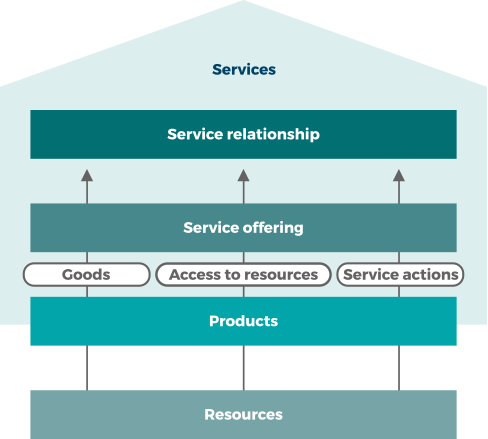
Let's trace this flow from the bottom up:
- Resources: At the base are an organization's resources—people, technology, information, etc.
- Products: These resources are configured into products (e.g., a specific application, a server infrastructure).
- Service Offering: The product(s) are then packaged into a specific service offering for a target group. As we've seen, this offering includes a mix of goods, access to resources, and service actions.
- Service Relationship: The offering is delivered via a service relationship, the collaborative space we discussed in the last lesson.
- Services: The entire structure exists to enable services, the means by which value is co-created with the customer.
Conclusion
In this lesson, we have defined three of the most critical terms in the ITIL 4 vocabulary. Mastering these distinctions is essential for the exam and for applying the framework correctly.
Here are your key takeaways:
- Service: A means of enabling value co-creation by facilitating customer outcomes while the provider manages the associated costs and risks. This is the "why."
- Product: A configuration of an organization’s resources that offers value. This is the provider's internal "how."
- Service Offering: A formal description of one or more services designed for a target consumer group, which can include goods, access to resources, and service actions. This is the "what" that is offered to the customer.
In our next lesson, we will delve deeper into the definition of a service by examining its constituent parts: outputs, outcomes, costs, and risks. Understanding these will further clarify how services successfully facilitate value for customers.