In our previous lesson, we established the formal definition of service management as a set of specialized organizational capabilities for enabling value to customers in the form of services. As you'll have noted, the entire purpose of service management hinges on that single, crucial word: value.
This lesson zooms in on that concept. We will dissect what ITIL 4 means by "value" and, more importantly, explore the modern understanding that value is not simply delivered but is co-created through a dynamic partnership with stakeholders. This is a fundamental shift in perspective and a cornerstone of the ITIL 4 framework, moving away from a simple provider-consumer transaction to a collaborative relationship.
What is Value?
In everyday language, "value" can mean many things—monetary worth, importance, or utility. ITIL 4 provides a specific definition that is essential for the exam and for understanding the rest of the framework.
ITIL 4 Key Concepts of Service Management - A Complete Guide
This article from SPOCLEARN provides a clear and detailed explanation of how ITIL 4 treats the concept of value.
Please read the section titled 1. The Concept of Value. Focus on the formal definition and the subsequent explanation that value is dynamic and subjective. Also, note the distinction between Objective vs. Subjective Value.
The official definition is:
Value is the perceived benefits, usefulness, and importance of something.
The most critical word in this definition is perceived. This means value is not an absolute, objective fact determined by the service provider. It is entirely subjective and exists in the eyes of the stakeholder. For instance, in your role as a data engineer, you might build a data pipeline that is technically elegant, efficient, and robust. You perceive its value in its technical excellence. However, if the business user finds the resulting report slow to load or the data difficult to interpret, they perceive little to no value, regardless of the underlying technical quality.
This subjectivity is why ITIL 4 stresses the importance of perception.
ITIL 4 KEY Concepts of Service Management | ITIL In Focus | Episode 1
The official ITIL channel offers a concise summary of this idea.
Watch this short segment from the video's discussion on value to hear the definition reinforced and the emphasis placed on its subjective nature.
The infographic below visually represents how value is realized. It's a balance: the consumer achieves their desired outcomes while the provider helps them manage the associated costs and risks.
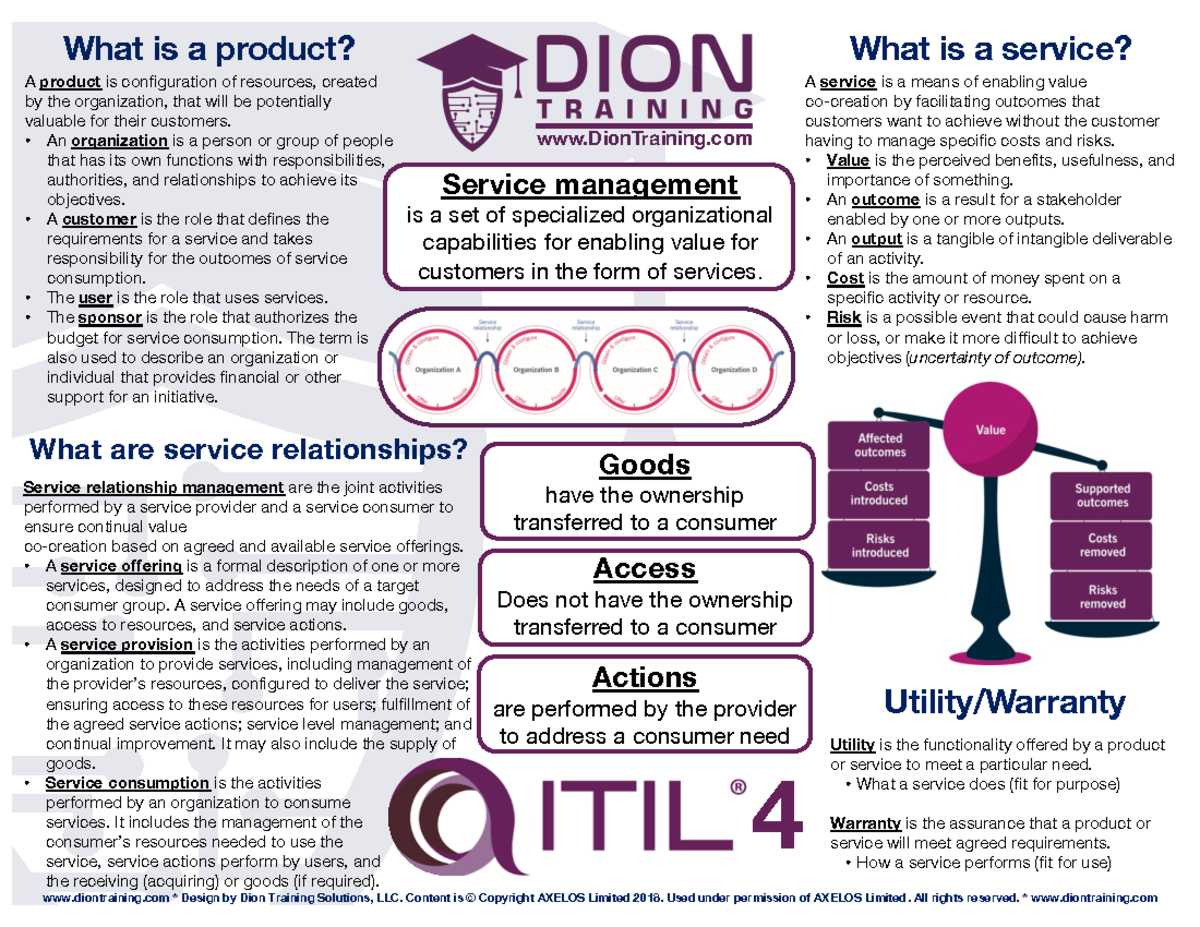
From Value Delivery to Value Co-Creation
Historically, the relationship between a service provider and a consumer was seen as linear and transactional. The provider built a service, delivered it, and the consumer received value—much like a package delivery. ITIL 4 argues this model is outdated and inefficient.
Instead, it promotes the concept of value co-creation. This is the idea that value is generated through active collaboration between providers, consumers, and other stakeholders.

Let's explore what this shift means in practice.
[PDF] ITIL 4 Foundation Study Guide
This study guide explains the transition from the old model to the new one.
In the "Service Management" section, read the paragraphs under the headings How is Value Created? and Providers and Consumers Co-Create Value. This text directly explains the conceptual shift depicted in the image above.
Value co-creation recognizes that consumers are not passive recipients. Their participation is essential. Consider a SaaS analytics platform (like Power BI, with which you are very familiar). The provider creates the platform, but value is only truly realized—and co-created—when:
- The consumer uses the platform to build insightful reports.
- The consumer provides feedback on bugs or suggests new features.
- The provider uses that feedback to improve the platform, which in turn enables the consumer to generate even more value.
This interactive loop is the essence of co-creation.
ITIL 4 KEY Concepts of Service Management | ITIL In Focus | Episode 1
Let's return to the ITIL video for a further explanation of this collaborative process.
Watch the segment from "seeing it as a oneway street", which emphasizes the crucial role consumers play in co-creating value.
How is Value Co-Created? Service Relationships and Stakeholders
Value co-creation doesn't happen in a vacuum. It occurs within the context of a service relationship. This relationship involves the activities performed by the provider (service provision) and the consumer (service consumption) working together.
ITIL 4 Key Concepts of Service Management - A Complete Guide
The SPOCLEARN article elaborates on how these relationships and collaborative actions facilitate value co-creation.
Please read the two subsections titled Service Relationships and Value Co-Creation and Collaborative Value Creation. These sections detail the specific roles and activities that form this partnership.
As the article notes, this collaboration includes joint problem-solving, continuous feedback, and shared innovation. It is an ongoing, dynamic interaction.
Finally, it's vital to recognize that the "consumer" is not the only other party in value co-creation. The term stakeholder encompasses a much broader group, and a service must consider the value perceived by all relevant parties.
In your work, a project stakeholder group might include:
- Customers: The person or group who defines the requirements and pays for the service (e.g., the Head of Finance).
- Users: The people who use the service day-to-day (e.g., the financial analysts using the reports).
- Sponsors: The person who authorizes the budget for the service (e.g., the CFO).
- Other Stakeholders: This can include your own employees (the data engineering team), partners, suppliers, and even regulatory bodies. Each of these groups has its own perception of value.
ITIL 4 KEY Concepts of Service Management | ITIL In Focus | Episode 1
The ITIL video expands on this broader view of stakeholders and relationships.
Please watch these two final clips: The first, from "might also have different definitions of value", discusses the wide range of stakeholders involved. The second, from "takes us onto the next stage", explains how the service relationship is the cooperative space where value is found and co-created.
Conclusion
This lesson introduced one of the most important concepts in ITIL 4. Understanding value and its co-creation is key to adopting a true service-oriented mindset.
Here are your key takeaways for this lesson:
- Value is defined as the perceived benefits, usefulness, and importance of something. Its subjective and perceptual nature is paramount.
- The modern view of service management has shifted from a one-way delivery of value to the co-creation of value.
- Value is co-created through an active, collaborative service relationship between providers and consumers.
- This collaboration involves not just the direct consumer but a broad range of stakeholders, all of whom have their own unique perceptions of value.
In our next lesson, we will continue to build our foundational vocabulary by defining what a service is in the ITIL context, and how it differs from a product and a service offering.