Last lesson, you read the SELECT cardiovascular result in both absolute and relative terms: 6.5% versus 8.0% experienced a first cardiovascular death, nonfatal heart attack, or nonfatal stroke. The important boundary was that a clear result for this combined outcome did not automatically establish a reduction in every event within it.
This lesson adds a second trial, FLOW, which studied kidney outcomes in a different population. Together, the trials show why a benefit needs an attached drug, dose, population, comparison, and outcome. They also show why evidence for semaglutide cannot simply be assigned to every GLP-1 medicine or to dual GIP/GLP-1 agonists.
SELECT: a cardiovascular benefit with a defined scope
SELECT tested once-weekly injected semaglutide, targeting 2.4 mg, against placebo in adults with overweight or obesity and established cardiovascular disease, but without diabetes. This was a secondary-prevention trial: participants already had cardiovascular disease. Its primary finding was a lower rate of the first cardiovascular death, nonfatal heart attack, or nonfatal stroke—6.5% versus 8.0%, with a hazard ratio of 0.80.
This brief NEJM Group video revisits the result and, importantly, distinguishes the primary finding from less certain secondary findings.
Semaglutide and Cardiovascular Outcomes in Obesity | NEJM
“Semaglutide and Cardiovascular Outcomes in Obesity” from NEJM Group is a concise reminder of what SELECT did—and did not—establish.
Watch the primary result for the three-event composite and its group percentages. Continue through the secondary outcomes; focus on why a favorable direction for cardiovascular death or other outcomes is not the same as a formally established separate benefit.
The defensible headline is fewer first major cardiovascular composite events in the SELECT population. Cardiovascular death alone was 2.5% versus 3.0%, but its hazard-ratio confidence interval extended across no difference. Nor was SELECT a dedicated kidney-outcomes trial. It cannot supply the kidney conclusion that FLOW was designed to test.
FLOW: a different population and a kidney-focused outcome
FLOW also randomized participants to semaglutide or placebo, but it asked a different question. Participants had type 2 diabetes and high-risk chronic kidney disease (CKD); the semaglutide maintenance dose was 1.0 mg weekly. Most were receiving a standard type of kidney-protective background treatment called a renin–angiotensin system inhibitor. The two trials therefore differ in more than their dose: their participants’ starting risks and their primary outcomes differ too.
The following short segment introduces FLOW’s combined primary outcome. Listen especially for the inclusion of cardiovascular death within an outcome described as “major kidney disease events.”
Semaglutide in CKD - The Flow Trial NEJM 2024 (Journal Club Idol)
“Semaglutide in CKD – The Flow Trial NEJM 2024,” presented by Tutorials by Kristeen Barker, gives an accessible introduction to FLOW’s outcome and headline result. The trial paper below provides the precise definitions and numbers.
Watch the outcome definition to identify what could count as a first event. Then watch the main finding, noting that the reported 24% reduction is a relative time-to-event result for the combined outcome.
Two measurements make the trial’s kidney terminology easier to read. eGFR is an estimate of how much blood the kidneys filter; a sustained, substantial fall signals worsening function. Urine albumin is a protein whose presence at elevated levels can indicate kidney damage. FLOW enrolled people with specified combinations of reduced eGFR and elevated urine albumin—not everyone who has any degree of CKD.
Read the trial paper’s participant criteria and outcome definition before interpreting its result.
Effects of Semaglutide on Chronic Kidney Disease in Patients ...
The FLOW investigators’ article in the New England Journal of Medicine specifies who entered the trial and what its primary outcome actually counted.
In Methods, read “Participants” (pp. 2–3), beginning with the eligibility description. Focus on the combination of type 2 diabetes, eGFR, urine albumin, and background treatment rather than memorizing the numeric entry thresholds. Then read “Trial Outcomes” (p. 3), from the primary definition through the three confirmatory secondary outcomes.
FLOW’s primary outcome counted the first occurrence of kidney failure, a sustained fall of at least 50% in eGFR, or death from a kidney-related or cardiovascular cause. Kidney failure had a specific definition, including long-term dialysis, transplantation, or a sustained very low eGFR. Because cardiovascular death is part of the composite, “24% fewer major kidney disease events” must not be translated into “24% fewer people needed dialysis.”
What FLOW established
The primary outcome occurred in 331 of 1,767 participants assigned to semaglutide (18.7%) and 410 of 1,766 assigned to placebo (23.2%) over a median follow-up of 3.4 years. The hazard ratio was 0.76, with a 95% confidence interval of 0.66 to 0.88. In the language of the previous lesson, that is an estimated 24% lower time-to-first-event hazard for the defined composite. The observed proportions differ by 4.5 percentage points, or about 45 fewer first composite events per 1,000 participants; this is an approximation from rounded proportions, not an individual prediction.
Read across the other outcomes rather than stopping at that headline.
Effects of Semaglutide on Chronic Kidney Disease in Patients ...
Return to the FLOW paper to separate the combined primary result from kidney-specific findings, the rate of kidney-function decline, and cardiovascular findings.
Read “Primary Outcome” and “Confirmatory Secondary Outcomes” (around p. 7), then Table 2, “Efficacy and Safety Outcomes” (p. 8). In Table 2, begin at the outcome rows and locate the kidney-specific composite, cardiovascular death, and major cardiovascular events. In the prose, follow the cardiovascular result. Keep the combined outcomes distinct from their individual components.
The kidney-specific components considered together, excluding cardiovascular death, also favored semaglutide: 12.3% versus 14.7%, with a hazard ratio of 0.79 (95% confidence interval 0.66 to 0.94). This matters because it shows that the primary finding was not solely a consequence of including cardiovascular deaths. FLOW also found a slower average annual decline in eGFR: 2.19 versus 3.36 units per year, a between-group difference of 1.16 in the reported eGFR units per year. eGFR slope describes a change in estimated kidney function; it is not itself a count of people who avoided dialysis.
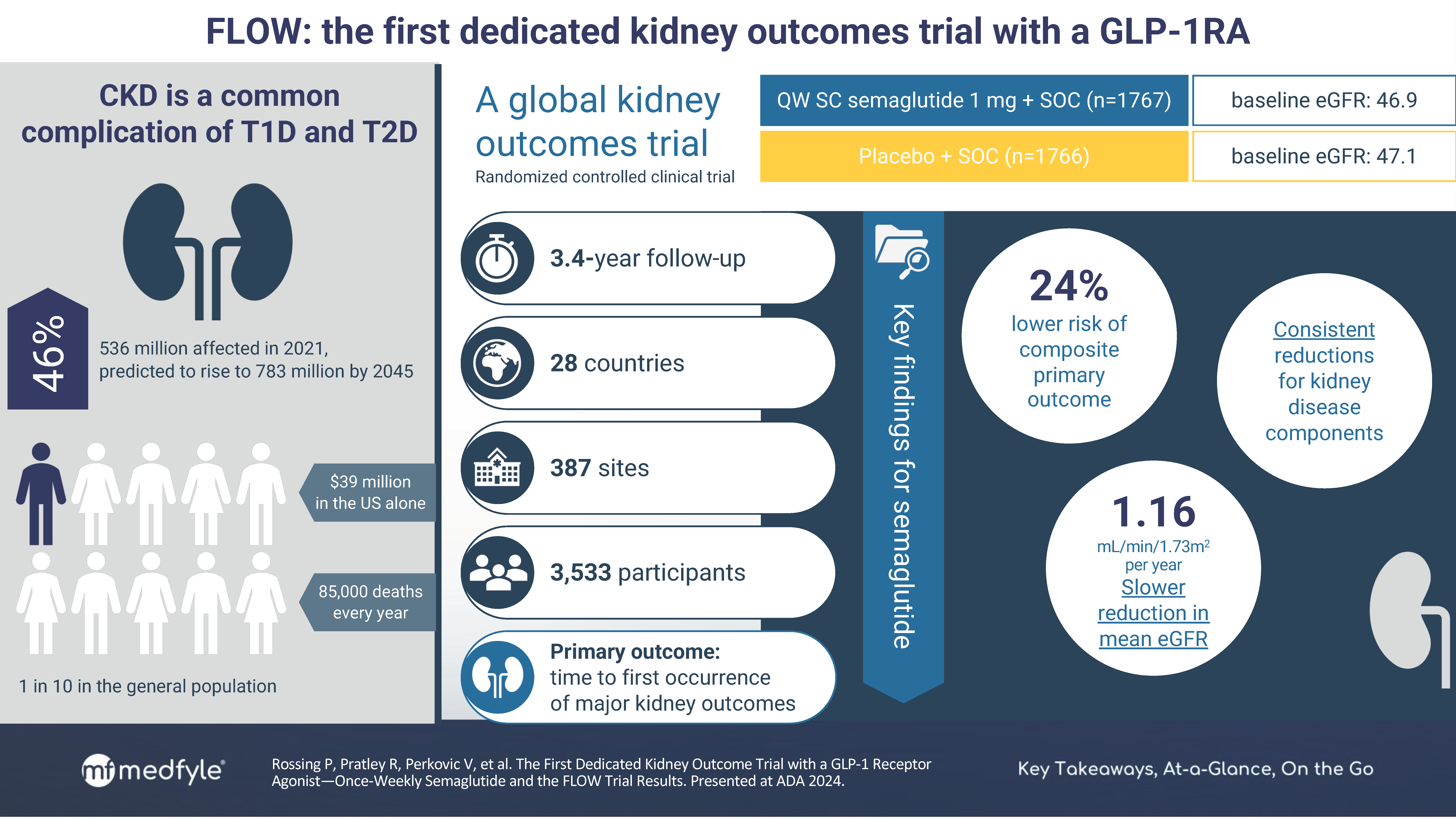
There is an important limit even within this positive kidney trial. FLOW was not powered to establish a separate reduction in kidney failure alone. Its results support a reduction in the prespecified composite, supported by the kidney-specific composite and eGFR findings; they do not prove that each individual kidney-failure component fell by the same amount.
Cardiovascular findings in FLOW are not interchangeable with SELECT’s
FLOW also tested major cardiovascular events as a prespecified confirmatory secondary outcome. A first cardiovascular death, nonfatal heart attack, or nonfatal stroke occurred in 12.0% of participants assigned to semaglutide and 14.4% assigned to placebo. The hazard ratio was 0.82 (95% confidence interval 0.68 to 0.98). Thus, FLOW provides cardiovascular-outcome evidence in people with type 2 diabetes and high-risk CKD, alongside its kidney findings.
Cardiovascular death was also lower in FLOW—7.0% versus 9.6%, hazard ratio 0.71 (95% confidence interval 0.56 to 0.89). It was a component of the primary outcome, rather than a separately listed confirmatory secondary outcome. Keeping that distinction visible is more informative than treating every row of a results table as having the same evidentiary status.
SELECT’s less certain separate cardiovascular-death result and FLOW’s favorable cardiovascular-death result are not a contradiction. They come from different populations, using different doses, with different starting risks and event counts. Neither result licenses replacing the other trial’s population with a broader one.
| Trial | Studied treatment and population | Firmest outcome claim |
|---|---|---|
| SELECT | Semaglutide targeting 2.4 mg weekly; overweight or obesity, established cardiovascular disease, no diabetes | Fewer first events in the cardiovascular death, nonfatal heart attack, or nonfatal stroke composite |
| FLOW | Semaglutide 1.0 mg weekly; type 2 diabetes and high-risk CKD | Fewer first events in its kidney-and-death primary composite, with supporting kidney-specific results and slower average eGFR decline; fewer major cardiovascular events as a confirmatory secondary outcome |
The percentages across the two rows should not be compared to decide which dose has a larger effect. The outcomes, populations, and baseline risks are different, and the trials did not compare the doses head to head.
Where the evidence stops
An outcome trial estimates the effect of assignment to the studied treatment under the trial’s conditions. It does not, on its own, determine how much of that effect was caused directly by GLP-1 receptor activity in the kidney or cardiovascular system, rather than by changes in weight, glucose, blood pressure, or other pathways.
FLOW’s discussion identifies further limits worth keeping alongside its positive result.
Effects of Semaglutide on Chronic Kidney Disease in Patients ...
The paper’s “Discussion” (around p. 12) distinguishes a strong result in the enrolled population from unanswered questions about other populations and background treatments.
In the latter part of “Discussion,” find the paragraph on trial limitations beginning with background-treatment limits. Focus on why relatively modest use of some other kidney-protective medicines, lower-risk populations, and individual kidney-failure events remain separate questions.
In particular, FLOW does not by itself establish the same kidney benefit in people without diabetes, people with type 1 diabetes, or everyone with lower-risk CKD. Its comparison was semaglutide versus placebo on background care, not semaglutide versus another active drug. These two trials also cannot establish the same cardiovascular or kidney effects for every other GLP-1 receptor agonist or for a dual GIP/GLP-1 agonist. Those medicines need evidence tied to their own studied populations and outcomes.
Key takeaways
SELECT establishes a reduction in first major cardiovascular composite events with semaglutide in people with overweight or obesity and established cardiovascular disease without diabetes. FLOW establishes a reduction in its major kidney disease composite with semaglutide in people with type 2 diabetes and high-risk CKD, supported by kidney-specific and eGFR findings; it also found fewer major cardiovascular events in that population. Neither trial proves that every component improved equally or that its results apply automatically to other drugs and populations.
The next lesson turns from events counted in trials to weight trajectories during treatment and after withdrawal, where the duration of observation and the difference between group averages and individual responses remain just as important.